































If you’ve ever asked how to study abroad, where to even start, which country fits you best, how much it costs, or what documents you need — you’re in the right place. At Every Moment Travels, we walk students through exactly this process regularly, and this guide breaks it down into clear, actionable stages: from choosing a country to boarding your flight. Whether you’re a high-school graduate, undergraduate, postgraduate applicant, or working professional, it walks through exactly how to study abroad successfully.
What Does It Mean to Study Abroad?
Studying abroad means pursuing education in a foreign country — typically through an undergraduate degree, a postgraduate degree (Master’s or PhD), a diploma or certificate, or an exchange or short-term program. Students choose this path for international qualifications, real global exposure, and access to stronger academic facilities, research opportunities, and job prospects.
In practice, the process involves choosing a destination and course, meeting academic and language requirements, applying to universities, securing a student visa, arranging finances and accommodation, and preparing for departure. Most students should begin planning 6–12 months before their intended intake.
Why Studying Abroad Is Worth the Effort
Before diving into the process, it’s worth understanding why so many students choose this path. Universities in the UK, USA, Canada, Australia, and Germany offer globally recognized degrees and world-class education. International degrees genuinely improve employability, often opening real post-study work opportunities. Living in a new country builds independence, adaptability, and global awareness. And the process itself — navigating a new system, a new culture, a new level of self-reliance — tends to build real confidence and discipline along the way.
The Step-by-Step Process
- Decide your study abroad goals
- Choose a country and course
- Select accredited universities
- Meet academic and language requirements
- Prepare required documents
- Apply to universities
- Accept an offer letter
- Apply for a student visa
- Arrange finances and accommodation
- Prepare for travel and departure
Here’s each step in more detail.
Step 1: Decide Why You Want to Study Abroad
This sounds simple, but it’s genuinely foundational. Ask yourself what you actually want to study, whether international work opportunities matter to you after graduation, whether you’re prioritizing quality education, affordability, or a migration pathway, and how long you actually want to study abroad for. Your answer shapes your country choice, course selection, budget, and visa strategy — a lot of students run into trouble simply because they copied a trending destination instead of aligning their choice with their own actual goals.
Step 2: Choose the Right Country
This is one of the most critical decisions in the whole process. Popular destinations include the United Kingdom (shorter degrees, strong global recognition), the United States (a flexible, research-focused system), Canada (affordable, with real post-study work options), Australia (high quality of life, genuinely international-student friendly), Germany (low or no tuition at public universities), and emerging favorites like Ireland, France, the Netherlands, and New Zealand.
Weigh tuition fees, cost of living, language of instruction, visa approval rates, post-study work opportunities, and immigration policy — and always compare the total cost, not just the tuition number, since living costs can shift the real picture significantly.
If you’re deciding between destinations, our comparison of the UK and Canada for international students is worth reading alongside this section, and our guide to the best countries to study abroad covers this decision more broadly.
Step 3: Select the Right Course and University
This is where many applicants make costly mistakes. For your course, match it to your academic background, make sure it aligns with your career goals, check the duration and structure, and confirm its accreditation. For your university, weigh its ranking (both global and subject-specific), its graduate employability rate, its international student support, and whether a city or town setting genuinely suits you.
Step 4: Check Admission Requirements
Requirements vary by university and country. Common academic requirements include a high school certificate for undergraduate study, a bachelor’s degree for postgraduate study, and a minimum GPA or grade percentage. Most institutions also require proof of English proficiency through IELTS, TOEFL, or PTE — though some offer waivers if you studied in English previously, or your country uses English officially.
Step 5: Prepare for English Proficiency Tests
If English isn’t your first language, this step is unavoidable. IELTS is the most widely accepted test, TOEFL is popular specifically in the USA, PTE Academic offers faster computer-based results, and Duolingo is accepted by a growing number of universities. Start preparing at least two to three months early, focus on your weaker areas (writing and speaking trip up the most applicants), and take mock tests regularly. Your score matters beyond admission too — it directly affects visa approval in many countries.
Step 6: Gather Required Documents
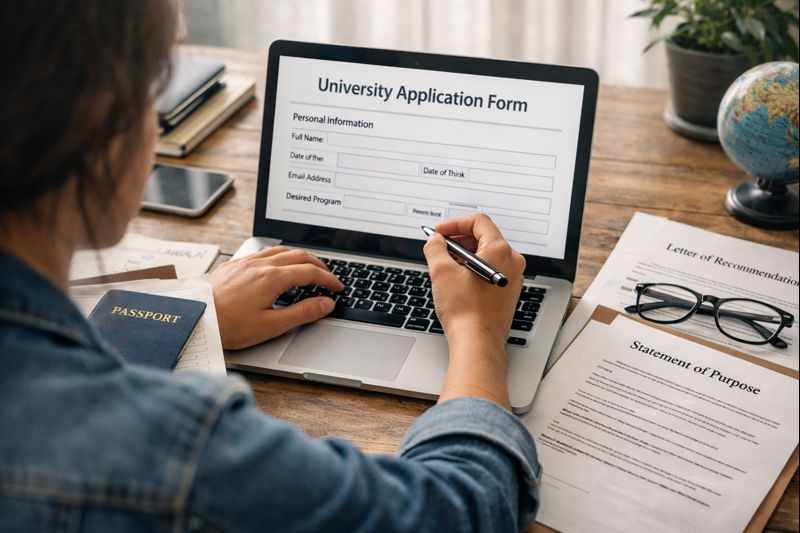
Document preparation is a genuinely crucial step. You’ll typically need a valid international passport, academic transcripts and certificates, a Statement of Purpose (SOP), letters of recommendation, your English proficiency test results, a CV or resume, proof of funds, and your admission offer letter once you have it.
Your Statement of Purpose deserves particular care — it explains why you chose your course, why this country and university, your academic background, and your career goals. SOP quality often matters as much to admission decisions as your grades do.
Step 7: Apply to Universities
Once your documents are ready, apply directly through university websites, through centralized platforms like UCAS or the Common App, or via licensed education consultants. Some universities charge application fees; others don’t. As a general rule, apply to three to six universities to genuinely improve your odds of a strong outcome.
Step 8: Receive Your Admission Offer and Accept It
After you apply, universities review your file, may request additional documents, and eventually issue an offer — either conditional (requiring you to meet specific conditions) or unconditional (fully accepted as-is). Once you accept, you’ll pay a tuition deposit and receive your Confirmation of Enrollment or CAS.
Step 9: Apply for a Student Visa

A student visa is what legally allows you to study abroad. Common requirements include your admission letter, proof of funds, a medical examination, a police clearance certificate, and the visa application form itself.
Where an interview is required, be honest, explain your study plans clearly, and show real, documented ties to your home country. Weak financial documentation is one of the most common reasons visa applications get refused — our full guide to proof of funds requirements covers exactly what to prepare.
Step 10: Plan Your Finances
Studying abroad takes real financial planning. Budget for tuition, accommodation, food, health insurance, transportation, and books and supplies. Most countries also require proof of funds — evidence that you can cover tuition and at least a year of living expenses before your visa gets approved.
Step 11: Apply for Scholarships
Scholarships can meaningfully reduce the cost of studying abroad. Look into government scholarships, university-specific scholarships, and private or international scholarships. To improve your odds, apply early, maintain strong academics, and write a genuinely compelling personal statement rather than a generic one.
Step 12: Arrange Accommodation
Common options include university dormitories, private student housing, shared apartments, and homestays. If your permanent housing isn’t sorted before you arrive, it’s worth booking temporary accommodation to bridge the gap rather than leaving it until landing.
Step 13: Book Your Flight
Once your visa is approved, book your flight early, look into student-friendly airlines for better fares and baggage allowances, and confirm your baggage limits before you pack. Our guide to booking cheap international flights as a student covers this step in more depth.
Step 14: Prepare for Departure
Before you fly, make sure you have copies of all your important documents, your currency exchange sorted, travel insurance in place, and airport pickup arranged if your university or accommodation offers it. It’s also worth mentally preparing for the adjustment ahead — cultural differences, a new climate, and different academic expectations are all part of the transition, and knowing that going in makes the adjustment easier.
Common Mistakes to Avoid
Choosing a country without real research, submitting a weak Statement of Purpose, applying late, ignoring visa requirements, and underestimating living costs are the mistakes we see derail applications most often.
Frequently Asked Questions
How long does it take to apply for study abroad? Typically 6 to 12 months, depending on the country, intake period, test preparation time, and visa processing duration.
Can I study abroad without IELTS? Yes, in some cases — it depends on the specific university and country. Our guide to studying abroad without IELTS covers which destinations and universities offer this.
Is studying abroad expensive? Costs vary widely, and some countries are genuinely more affordable than others, our guide to the cheapest countries to study abroad breaks this down further.
Can I work while studying abroad? Most countries allow part-time work during term time, generally with limits on weekly hours.
Final Thoughts
Learning how to study abroad doesn’t have to be complicated. Broken down into clear steps, the process becomes manageable, predictable, and genuinely achievable. Start early, research deeply, prepare your documents carefully, and seek professional guidance when you need it.