
































The best countries to study abroad in 2026 are generally the United States, United Kingdom, Canada, Australia, Germany, France, and the Netherlands. These destinations offer globally recognized universities, strong post-study work options, affordable tuition in some cases, and genuinely strong career prospects for international students.
Studying abroad is no longer just a dream — it’s a strategic investment in your future. With globalization reshaping careers, education systems around the world are opening their doors to international students more than ever. With so many options available, though, the real question most students face is simply: which one is actually right for me?
At Every Moment Travels, this is one of the first questions we help students work through. This guide breaks down the best countries to study abroad based on education quality, cost, lifestyle, visa policies, and career prospects — whether your priority is world-class universities, affordable tuition, post-study work opportunities, or cultural exposure.
Why Choosing the Right Country to Study Abroad Matters
Choosing a country for higher education is more than selecting a university — it shapes your academic quality and degree recognition, your career opportunities and global employability, your cost of education and living, your cultural exposure and personal growth, and your immigration and post-study work prospects. The best countries to study abroad strike a genuine balance between academic excellence, affordability, and future opportunity.
Key Factors Used to Rank the Best Countries to Study Abroad
Before diving into the list, here’s what we weighed for each destination: quality of education and global rankings, affordability (tuition plus living costs), post-study work and immigration opportunities, student lifestyle and safety, language and cultural adaptability, scholarships and financial aid, and overall employability and job market strength.
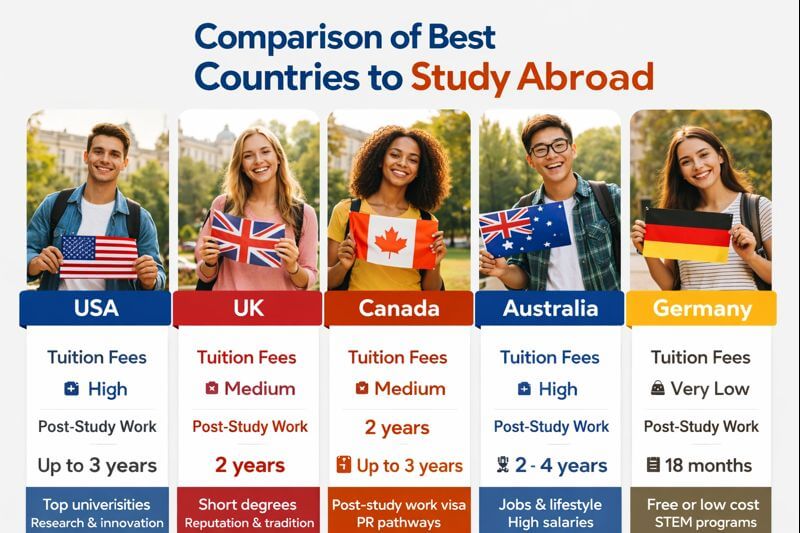
At a glance: the United States leads for top-ranked universities and research, the United Kingdom for short-duration degrees, Canada for post-study work and PR pathways, Australia for employability and lifestyle, Germany for free or low-cost education, France for arts, culture, and affordability, and the Netherlands for English-taught programs in Europe.
1. United States: The Global Education Powerhouse
The United States consistently ranks as a top destination for international students, hosting over a million learners from across the globe. It’s home to Ivy League and top-ranked universities, offers a flexible education system with real interdisciplinary options, and brings strong research funding and global degree recognition. Harvard, Stanford, MIT, the University of California system, and Columbia rank among its most recognized institutions, with Computer Science, Business, Engineering, Medicine, and Data Science among the most popular fields.
Tuition typically runs $20,000–$55,000 a year, with living costs adding $10,000–$18,000. On the post-study work side, Optional Practical Training (OPT) offers up to 3 years for STEM graduates, with a real pathway toward H-1B visa sponsorship beyond that. It’s best suited to students seeking elite education, deep research exposure, and strong global career prospects.
2. United Kingdom: Academic Excellence With Shorter Degrees
The UK combines centuries of academic tradition with modern teaching and genuinely shorter program durations — a real draw for students weighing time and cost. One-year master’s programs, globally respected universities, strong international student support, and the Graduate Route visa all factor in. Oxford, Cambridge, Imperial College London, and LSE lead its most recognized institutions, with Law, Business & Finance, Engineering, and Arts & Humanities among the most popular fields.
Tuition typically runs £10,000–£35,000 a year, with living costs adding £9,000–£15,000. Post-study work comes through the 2-year Graduate Route (3 years for PhD graduates). It suits students specifically looking for prestigious education in less time than they’d spend elsewhere.
3. Canada: Affordable Education With PR Opportunities
Canada remains a top choice for students seeking affordability, safety, and a genuine long-term settlement path. High-quality education at a comparatively lower cost, welcoming immigration policy, a multicultural and safe environment, and a strong job market all factor in. Toronto, UBC, McGill, and the University of Alberta lead its most recognized institutions, with IT & Software Engineering, Business Analytics, Healthcare, and Environmental Studies among the most popular fields.
Tuition typically runs CAD $15,000–$35,000 a year, with living costs adding CAD $10,000–$15,000 — though note that Canada’s federal proof-of-funds requirement has risen recently, so confirm the current figure directly with IRCC before you budget. The Post-Graduation Work Permit (PGWP) offers up to 3 years, with a genuinely clear pathway toward Permanent Residency beyond that. It suits students aiming for education paired with real long-term immigration stability.
4. Australia: High Employability and Lifestyle Balance
Australia blends top-tier education with a genuinely strong quality of life and real employability. Globally ranked universities, strong international student rights, comparatively high minimum wages, and post-study work extensions all factor in. Melbourne, ANU, Sydney, and Monash lead its most recognized institutions, with Engineering, Nursing & Healthcare, Business, and Hospitality & Tourism among the most popular fields.
Tuition typically runs AUD $20,000–$45,000 a year, with living costs adding AUD $15,000–$22,000. Post-study work runs 2–4 years depending on your degree, with additional benefits available for regional study. It suits students seeking real career growth alongside genuine lifestyle appeal.
5. Germany: Free or Low-Cost Education in Europe
Germany offers world-class education at little to no tuition cost — a genuine standout in this list. Public universities with minimal fees, strong engineering and technical education, Europe’s largest economy, and research-driven programs all factor in. TU Munich, Heidelberg University, and RWTH Aachen lead its most recognized institutions, with Mechanical Engineering, Automotive Engineering, Data Science, and Renewable Energy among the most popular fields.
Tuition typically runs €0–€3,000 a year, with living costs adding €8,000–€12,000. Post-study work comes through an 18-month job search visa, with a genuine pathway toward the EU Blue Card beyond that. It suits students specifically seeking affordable, high-quality STEM education.
6. France: Affordable Education With Cultural Prestige
France is increasingly popular among international students for its affordable tuition and genuinely rich cultural heritage. Low tuition at public universities, strong fashion, arts, and business schools, and real scholarship availability for international students all factor in. The Sorbonne, HEC Paris, and Sciences Po lead its most recognized institutions, with Fashion & Design, International Business, and Arts & Humanities among the most popular fields.
Tuition typically runs €2,500–€10,000 a year, with living costs adding €9,000–€12,000. It suits students genuinely interested in culture, arts, and broader European exposure alongside their degree.
7. Netherlands: English-Taught Programs in Europe
The Netherlands offers one of the highest numbers of English-taught programs anywhere in Europe. An innovative education model, strong research universities, and genuinely high graduate employability all factor in. The University of Amsterdam, Delft University of Technology, and Erasmus University Rotterdam lead its most recognized institutions.
Tuition typically runs €8,000–€20,000 a year. It suits students wanting a genuine European education experience without a language barrier standing in the way.
8. Sweden: Innovation and Sustainability Focus
Sweden fits students genuinely passionate about innovation, sustainability, and technology. A student-centric education model, a strong tech and startup ecosystem, and a real work-study balance all factor in, with Sustainability, AI & Machine Learning, and Engineering among its most popular fields.
9. New Zealand: Safe and Student-Friendly
New Zealand offers high-quality education in a genuinely peaceful environment. A safe, welcoming atmosphere, real work rights for students, and strong agriculture and environmental programs all factor in.
10. Japan and South Korea: Rising Education Hubs in Asia
Asian countries are rapidly becoming top study destinations, thanks to affordability and technological advancement. Advanced research capacity, government scholarships, and a growing number of English-taught programs are all driving this shift.
Comparison Table: Best Countries to Study Abroad
| Country | Tuition Cost | Post-Study Work | Best For |
|---|---|---|---|
| USA | High | Yes | Research & global careers |
| UK | Medium | Yes | Short degrees |
| Canada | Medium | Yes | PR opportunities |
| Australia | High | Yes | Employability |
| Germany | Low | Yes | STEM fields |
| France | Low | Limited | Arts & culture |
| Netherlands | Medium | Yes | English-taught programs |
| Sweden | Medium | Limited | Innovation & tech |
| New Zealand | Medium | Yes | Safety & lifestyle |
| Japan/South Korea | Low–Medium | Limited | Affordability & tech |
Frequently Asked Questions
Which is the best country to study abroad in 2026? Canada, the USA, the UK, Germany, and Australia top most students’ lists — the right choice depends on your specific goals.
Which country is cheapest to study abroad? Germany is generally the cheapest, since most public universities charge little to no tuition. France and the broader Nordic region also offer genuinely affordable public institutions, making Europe a strong option for budget-conscious students.
Which country offers PR after study? Canada and Australia generally offer the most accessible pathways.
Which country is best for Nigerian and other international students? Canada, the UK, Australia, Germany, and the USA all remain strong options depending on your budget and career goals.
Final Thoughts: Choosing the Best Country to Study Abroad
There’s no single “best” country for everyone. The right destination depends on your academic background, budget, career goals, and lifestyle preferences.
As a quick starting point: if budget matters most alongside quality, look at Germany or France. If PR and jobs are your priority, Canada and Australia lead. If it’s top-ranked universities you’re after, the USA and UK stand out. And if innovation and tech draw you specifically, Sweden and the Netherlands are worth a close look.
Studying abroad is genuinely life-changing. Choose deliberately, and the world opens up in a real way.







[…] Which country is best for me? […]