























Studying in the United Kingdom remains one of the most popular choices for international students worldwide. With world-class universities, globally recognized degrees, flexible study options, and excellent post-study work opportunities, the UK continues to attract thousands of students every year.
If you’re searching for how to study in the UK, this guide walks you through everything you need to know—from choosing a course and meeting entry requirements to securing a UK student visa and working after graduation.
Whether you’re a student from Nigeria, Ghana, India, Pakistan, Kenya, or anywhere else, this guide is tailored to help you plan confidently and avoid costly mistakes.
Why Study in the UK?
The UK is home to some of the world’s oldest and most respected institutions, but its appeal goes far beyond tradition.
1. World-Class Education System
UK universities consistently rank among the top globally. Institutions like:
- University of Oxford
- University of Cambridge
- Imperial College London
- University College London (UCL)
- University of Edinburgh
are internationally respected for research excellence, innovation, and academic rigor.
A UK degree is recognized and valued by employers worldwide.
2. Shorter Degree Duration (Save Time & Money)
One major advantage of studying in the UK is shorter course duration:
| Level | UK Duration | Other Countries |
| Bachelor’s Degree | 3 years | 4 years |
| Master’s Degree | 1 year | 2 years |
| PhD | 3–4 years | 5–7 years |
This means:
- Lower tuition costs overall
- Faster entry into the job market
- Quicker return on investment
3. Wide Range of Courses & Flexible Study Options
UK universities offer over 50,000 courses, including:
- Academic degrees
- Professional certifications
- Foundation programs
- Sandwich courses (study + placement)
You can also switch courses early if your interests change.
4. Work While Studying
International students can work:
- 20 hours per week during term
- Full-time during holidays
This helps cover living costs and gain UK work experience.
5. Multicultural & Student-Friendly Environment
The UK welcomes students from over 200 countries. Cities like London, Manchester, Birmingham, Leeds, and Glasgow are diverse, vibrant, and student-friendly.
You’ll find:
- Cultural communities
- International student support
- Faith centers
- Student societies
6. Post-Study Work Opportunities (Graduate Route)
After graduation, you can stay back to work in the UK for up to 2 years (3 years for PhD) under the Graduate Route Visa—no employer sponsorship required.
Popular Courses for International Students in the UK
Choosing the right course is crucial when planning how to study in the UK.
1. Business & Management
One of the most popular choices due to strong global employability.
Popular programs:
- Business Administration
- International Business
- MBA
- Finance & Accounting
- Marketing
- Human Resource Management
Career opportunities:
- Banking
- Consulting
- Entrepreneurship
- Corporate management
2. Computer Science & IT
The UK tech sector is booming.
Top courses include:
- Computer Science
- Artificial Intelligence
- Data Science
- Cybersecurity
- Software Engineering
- Information Technology
Graduates are highly sought after in:
- Tech startups
- FinTech companies
- Multinational corporations
3. Engineering
UK engineering degrees are globally respected.
Popular fields:
- Mechanical Engineering
- Civil Engineering
- Electrical & Electronics Engineering
- Automotive Engineering
- Petroleum Engineering
Many courses include industry placements.
4. Health & Life Sciences
Healthcare remains a high-demand sector.
Common programs:
- Nursing
- Public Health
- Biomedical Science
- Pharmacy
- Biotechnology
Note: Some health programs require additional professional registration.
5. Law
UK law degrees are prestigious worldwide.
Options include:
- LLB
- LLM (International Law, Commercial Law, Human Rights Law)
6. Creative Arts & Media
For creative students, the UK is a global hub.
Popular programs:
- Film & Media Studies
- Fashion Design
- Graphic Design
- Fine Arts
- Music Production

UK Entry Requirements for International Students
Understanding UK entry requirements is essential when planning how to study in the UK.
Academic Requirements by Level
1. Foundation Program
- WAEC / NECO / O-Levels
- Minimum of 5 credits
- Designed for students who don’t meet direct entry
2. Undergraduate (Bachelor’s Degree)
- WAEC / NECO with 5–6 credits
- A-Levels, IB, or equivalent (optional)
- Some universities accept direct entry from Nigeria
3. Postgraduate (Master’s Degree)
- Bachelor’s degree from a recognized university
- Minimum Second Class Lower (2:2) or Upper (2:1) depending on course
4. PhD Programs
- Master’s degree
- Research proposal
- Academic references
Other Documents Required
- Academic transcripts
- Academic references
- Personal Statement
- CV (for postgraduate courses)
- Portfolio (for creative programs)
IELTS Requirements for UK Universities
English language proficiency is mandatory unless exempted.
IELTS Score Requirements
| Level | IELTS Requirement |
| Foundation | 4.0 – 5.0 |
| Undergraduate | 6.0 – 6.5 |
| Postgraduate | 6.5 – 7.0 |
| Medical/Law | 7.0+ |
IELTS Alternatives Accepted by UK Universities
- WAEC English (for some Nigerian students)
- PTE Academic
- TOEFL iBT
- Duolingo English Test
⚠️ Always confirm with your chosen university.
IELTS Waiver for Nigerians
Some UK universities waive IELTS if:
- You scored C6 or above in WAEC English
- You studied in English previously
Tuition Fees & Cost of Living in the UK
Tuition Fees (Per Year)
| Level | Estimated Cost |
| Foundation | £8,000 – £15,000 |
| Undergraduate | £10,000 – £20,000 |
| Postgraduate | £11,000 – £25,000 |
| MBA | £15,000 – £40,000 |
Medical and laboratory courses may cost more.
Cost of Living (Monthly)
| Expense | Estimated Cost |
| Accommodation | £400 – £800 |
| Food | £150 – £300 |
| Transport | £50 – £150 |
| Utilities | £50 – £100 |
| Miscellaneous | £100 – £200 |
📍 London is more expensive than other cities.
Proof of Funds (UK Visa Requirement)
You must show:
- £1,334/month (London)
- £1,023/month (outside London)
For 9 months, plus tuition fees.
UK Student Visa (CAS Explained)
To study in the UK, you need a Student Visa.
What Is CAS?
CAS (Confirmation of Acceptance for Studies) is an electronic document issued by your university after:
- You accept your offer
- Pay a tuition deposit
- Submit required documents
CAS contains:
- Course details
- Tuition fees
- Sponsor license number
UK Student Visa Requirements
- Valid CAS
- Passport
- Proof of funds
- English test results
- TB test certificate (for some countries)
- Visa application fee
- Immigration Health Surcharge (IHS)
Visa Fees (Approximate)
- Student Visa: £490
- IHS: £776 per year
Post-Study Work in the UK (Graduate Route)
The Graduate Route Visa allows international students to stay and work after graduation.
Key Benefits
- 2 years for Bachelor’s & Master’s graduates
- 3 years for PhD graduates
- No job offer required
- Work full-time or self-employed
Eligible Courses
- Undergraduate degree
- Master’s degree
- PhD
Career Opportunities After Graduation
- Skilled Worker Visa
- Employer sponsorship
- Permanent residence pathway
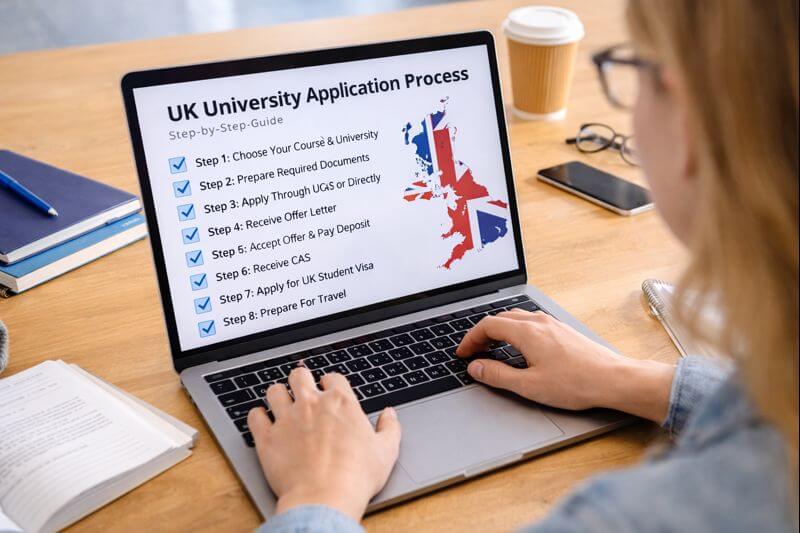
Step-by-Step Application Process (How to Study in the UK)
1: Choose Your Course & University
Research:
- Course content
- Entry requirements
- Location
- Tuition fees
2: Prepare Required Documents
- Academic transcripts
- Personal statement
- References
- CV
3: Apply Through UCAS or Directly
- Undergraduate: UCAS
- Postgraduate: Direct university applications
4: Receive Offer Letter
- Conditional or unconditional offer
5: Accept Offer & Pay Deposit
Secure your place.
6: Receive CAS
Required for visa application.
7: Apply for UK Student Visa
Apply online and attend biometrics.
8: Prepare for Travel
- Book accommodation
- Arrange airport pickup
- Attend pre-departure briefing
Final Thoughts: Is Studying in the UK Worth It?
Absolutely.
If you’re looking for:
- High-quality education
- Shorter study duration
- Global career opportunities
- Post-study work options
Then studying in the UK is one of the best decisions you can make