






















Ever wondered if there is a complete guide to Post-study work visas to direct you properly as an international student so that you can stay back and work after graduation?
The dream of studying abroad is rarely just about the degree. For most international students, the true goal is the return on investment: the chance to gain international work experience, recoup tuition costs, and potentially build a long-term life in a new country.
However, the transition from “student” to “professional” is where many stumble. The complexity of immigration law, shifting government policies, and the pressure of expiring study permits can turn an exciting opportunity into a logistical nightmare. In 2024 and 2025, we’ve seen significant policy shifts across major study destinations—from the UK’s review of the Graduate Route to Canada’s tightening of work permit eligibility.
If you are feeling overwhelmed by the “alphabet soup” of visa subclasses and eligibility windows, you aren’t alone. This guide provides a definitive, step-by-step roadmap to the Post-Study Work (PSW) visas in the world’s four most popular destinations.
Before applying for a post-study work visa, it’s important to understand the full process in our complete student visa guide to avoid common mistakes.
1. The United Kingdom: The Graduate Route
The UK’s Graduate Route is one of the most straightforward post study work visa options, though it has faced intense political scrutiny recently. It allows students to stay and work, or look for work, at any skill level without needing a sponsor.
Step-by-Step Solution: Applying for the Post-Study Work Visas
- Wait for Results: Do not apply as soon as you finish your exams. You must wait until your university officially notifies the Home Office that you have successfully completed your course.
- Check Your Current Leave: You must be in the UK on a valid Student visa (or Tier 4 visa) at the time of application.
- Submit Online: Complete the application on the GOV.UK website.
- Identity Verification: Use the “UK Immigration: ID Check” app to scan your BRP and face. This usually bypasses the need for an in-person appointment.
- Pay the Fees: You will need to pay the application fee (£822) and the Immigration Health Surcharge (IHS) for each year of the visa.
Requirements Checklist
- [ ] Successful Completion: A degree (Undergraduate, Masters, or PhD) from a “licensed sponsor” with a track record of compliance.
- [ ] Physical Presence: You must have studied in the UK for at least 12 months (or the full duration of the course if it’s shorter).
- [ ] No Previous Graduate Visa: You can only be granted this visa once in a lifetime.
2. Canada: The Post-Graduation Work Permit (PGWP)
Canada remains a top choice due to its clear pathway to Permanent Residency (PR). The Post-Study work visas is called Post-Graduation Work Permit in Canada. It is an “open” work permit, meaning you can work for almost any employer.
Step-by-Step Solution: Securing Your Post-Graduate Work Permit

- Gather Graduation Documents: You need an official letter from your school confirming you completed your program and a final transcript.
- Confirm Eligibility: Ensure your institution is a Designated Learning Institution (DLI) and the specific program is PGWP-eligible.
- Apply within 180 Days: You have six months from the date you receive your final marks to apply.
- Maintain Status: If your student visa expires before you apply, you must either leave Canada and apply from abroad or apply to change your status to “visitor” to stay in Canada while you wait.
Requirements Checklist
- [ ] Full-time Status: You must have maintained full-time student status in Canada during each semester of your program (except the final session).
- [ ] Program Length: The program must be at least 8 months long.
- [ ] Public vs. Private: Generally, only graduates from public post-secondary schools or specific private schools authorized by provincial statute are eligible.
Canada processing can take months, so check this latest visa processing time breakdown before applying.
3. Germany: The Job Seeker & 18-Month Post-Study Residence Permit
Germany offers one of the most generous post-study work visas windows in Europe, reflecting its urgent need for skilled labor in engineering, IT, and healthcare.
Step-by-Step Solution: Transitioning to the German Workforce
- Apply for the 18-Month Extension: Upon graduation, apply for a residence permit for the purpose of seeking employment (Section 20 (3) no. 1 AufenthG).
- Work Without Limits: Unlike many other countries, during these 18 months, you can work any job (even outside your field) to support yourself while you look for a “qualified” position.
- Switch to a Work Permit: Once you find a job that matches your academic qualification, you can switch to a Blue Card (EU) or a standard German Work Permit.
Requirements Checklist
- [ ] Proof of Degree: A certificate from a German university.
- [ ] Financing: Proof that you can cover living costs (approx. €11,000–€12,000 per year) via a blocked account or employment contract.
- [ ] Health Insurance: Continuous coverage in the German healthcare system.
4. Australia: Temporary Graduate Visa (Subclass 485)
Australia recently underwent a major “Migration Strategy” overhaul, changing the age limits and duration of stay for graduates to ensure the system targets younger, highly skilled workers. Australia’s post-study work visas are referred to as temporary graduate visas (Subclass 485).
Step-by-Step Solution: Navigating the 485 Visa
- Choose Your Stream: Most international students apply for the post-study work visas through the Post-Higher Education Work Stream.
- Check Age Limits: As of mid-2024, the maximum age to apply for most streams is 35 years old (though some exceptions exist for Masters by Research and PhDs).
- English Proficiency: Ensure you have an updated IELTS or PTE score (usually valid for one year for this visa).
- Apply within 6 Months: You must apply within six months of your course completion date.
Requirements Checklist
- [ ] CRICOS Registration: Your course must be registered on the Commonwealth Register of Institutions and Courses for Overseas Students.
- [ ] Australian Study Requirement: You must have completed at least two academic years (92 weeks) of study in Australia.
- [ ] AFP Check: You must provide an Australian Federal Police clearance.
Australia requires health insurance, so review this affordable student travel insurance guide before applying.
Comparison Table: Post-Study Work Visas at a Glance
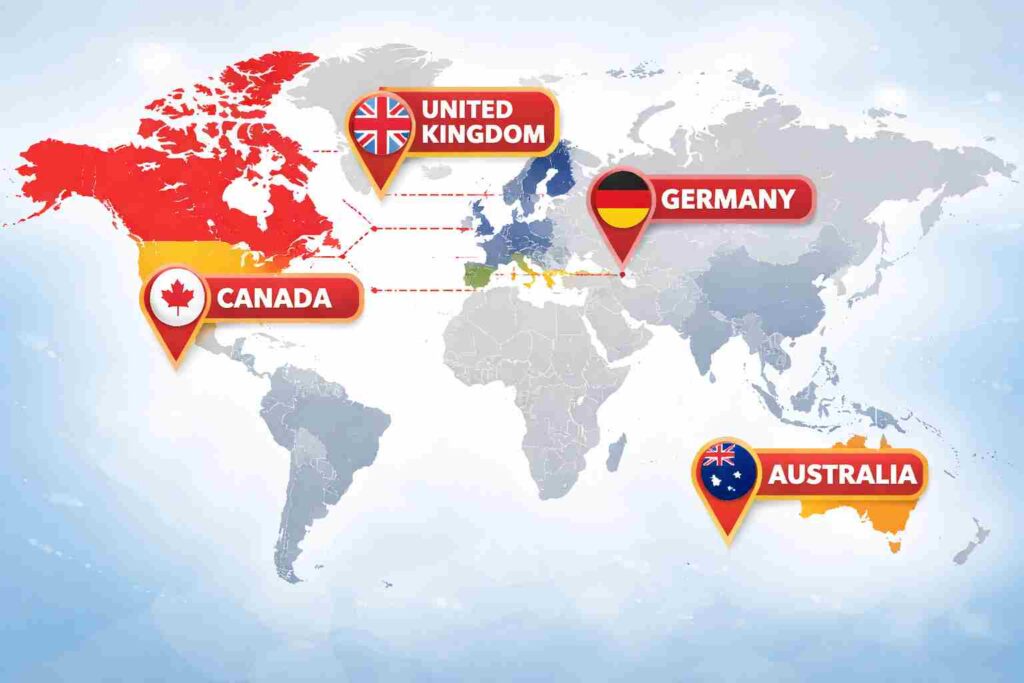
| Feature | United Kingdom | Canada | Germany | Australia |
| Visa Name | Graduate Route | PGWP | 18-Month Extension | Subclass 485 |
| Duration (Masters) | 2 Years | Up to 3 Years | 18 Months | 2 Years* |
| Work Restrictions | None (Open) | None (Open) | None (Open) | None (Open) |
| Sponsorship | Not Required | Not Required | Not Required | Not Required |
| Age Limit | None | None | None | 35 (most streams) |
| PR Pathway | Via Skilled Worker | Express Entry/PNP | Blue Card / PR | Skilled Independent |
*Note: Australian durations vary by degree type and regional study locations.
Expert Tips for Success
- The “Regional” Advantage: In Australia and Canada, studying in regional or less-populated areas (like Adelaide or the Atlantic provinces) can grant you an extra 1–2 years of work rights and extra points for Permanent Residency.
- Don’t Gap Your Insurance: In Germany and Australia, a single day’s gap in health insurance coverage can be grounds for visa rejection.
- Keep Your Passport Updated: Your work permit duration is often capped by your passport’s expiration date. If your passport expires in 12 months, Canada will only give you a 12-month PGWP, even if you are eligible for 3 years.
Permanent Residency Pathway Roadmaps for 2026
For international students and skilled workers, the Post-Study Work visa is a bridge, but Permanent Residency (PR) is the destination. In 2026, the global immigration landscape has shifted toward “merit-based” and “sector-specific” selection.
Governments are no longer just looking for “any” graduate; they are looking for specific contributors to their economy. Below is the step-by-step roadmap to PR in the UK, Canada, Germany, and Australia.
1. United Kingdom: The “Earned Settlement” Roadmap
As of April 2026, the UK has moved away from the traditional 5-year fixed route to an “Earned Settlement” model. This means you can accelerate your path to Indefinite Leave to Remain (ILR) by contributing more to the economy or community.
Step-by-Step Path to PR
- Graduate Route (1–2 Years): Use this time to find an employer with a Sponsorship License.
- Switch to Skilled Worker Visa: Secure a job with a minimum salary of £41,700 (or higher depending on the specific “going rate” for your job code).
- The 10-Year Baseline: The default period for ILR is now 10 years, but you can “earn” reductions.
- Acceleration Phase: * High Earner: If you earn over £50,270 for 3 consecutive years, you can apply for ILR in as little as 3–5 years.
- English Mastery: Achieving C1 level English can reduce your wait time by 1 year.
- Community Contribution: Verified volunteering or public service can further reduce the timeline.
- ILR Application: Prove continuous residence (no more than 180 days abroad in any 12-month period) and pass the “Life in the UK” test.
Requirements Checklist
- [ ] Salary: Minimum £41,700 (unless in a “Shortage Occupation”).
- [ ] English: Minimum B2 level for Skilled Worker; C1 recommended for PR acceleration.
- [ ] National Insurance: Proof of at least 3 years of NI contributions.
2. Canada: The “Targeted Draw” Roadmap
Canada’s PR system in 2026 is hyper-focused on Category-Based Selection via Express Entry and the new TR-to-PR 2026 Pathway.
Step-by-Step Path to PR
- PGWP Phase (1–3 Years): Gain 12 months of Canadian work experience in a skilled role (TEER 0, 1, 2, or 3).
- Express Entry Profile: Enter the pool. In 2026, focus on Healthcare, STEM, Trades, Transport, or French Proficiency.
- TR-to-PR 2026 Pathway: If you are already working in a shortage sector (e.g., Construction or Healthcare), watch for the one-time 33,000-seat allocation for temporary residents.
- Provincial Nominee Program (PNP): If your Express Entry score is low, apply for a provincial nomination (e.g., Ontario’s Human Capital Priority) to get an automatic 600-point boost.
- Invitation to Apply (ITA): Once invited, you have 60 days to submit your full PR application.
Requirements Checklist
- [ ] Language: IELTS (General) or CELPIP. Minimum CLB 7 for most streams; CLB 9+ for high scores.
- [ ] Work Experience: At least 1 year of full-time (or equivalent part-time) experience in Canada.
- [ ] NOC Alignment: Ensure your job duties match the 2021 National Occupational Classification codes.
3. Germany: The “Blue Card & Skilled Worker” Roadmap

Germany has introduced the Chancenkarte (Opportunity Card) and the updated Skilled Immigration Act, making it the fastest PR route in Europe for qualified professionals.
Step-by-Step Path to PR
- Job Search Phase: Use your 18-month post-study permit or the Chancenkarte to find a “qualified” job.
- EU Blue Card: If you earn at least €50,700 (€45,934.20 for shortage occupations/new grads), you can get an EU Blue Card.
- Fast-Track Settlement: * With German B1: You can apply for Permanent Settlement after only 21 months on a Blue Card.
- Standard Skilled Worker: If you don’t meet Blue Card salary levels but have a recognized degree, you can apply for PR after 3 years.
- Citizenship Option: Germany now allows dual citizenship and naturalization in as little as 3–5 years for well-integrated individuals.
Requirements Checklist
- [ ] Language: German A1 is the minimum for work; B1 is required for fast-track PR.
- [ ] Pension Fund: Proof of 21–33 months of statutory pension insurance contributions.
- [ ] Accommodation: Proof of sufficient living space for you and any family members.
4. Australia: The “Points & Regional” Roadmap
Australia’s 2026 migration plan prioritizes Regional Migration (491) and State Nomination (190) over the highly competitive Independent (189) route.
Step-by-Step Path to PR
- Skills Assessment: Immediately after graduation, get your skills assessed by the relevant authority (e.g., ACS for IT, Engineers Australia for Engineering).
- Expression of Interest (EOI): Submit an EOI via SkillSelect.
- The Regional Strategy: Move to a designated regional area (anywhere outside Sydney, Melbourne, or Brisbane).
- Subclass 491: This 5-year visa grants you PR after 3 years of living and working in a regional area.
- State Nomination (190): Apply for state nomination to gain an extra 5 points. Each state (like WA or VIC) has a specific “Graduate Stream.”
- Final PR Grant: Once invited (ITA), submit health and character checks for the Subclass 190 or 191 (PR) visa.
Requirements Checklist
- [ ] Points Score: Minimum 65 points. In 2026, competitive scores are 85+ for IT/Business and 70+ for Healthcare/Teaching.
- [ ] Age: You must be under 45 for the PR grant (though the Graduate Visa age limit is 35).
- [ ] English: PTE Academic (79+) or IELTS (8.0) is almost mandatory to get the 20 “Superior English” points needed for an invite.
Comparison of PR Pathways (2026 Data)
| Feature | United Kingdom | Canada | Germany | Australia |
| Primary PR Route | Skilled Worker / ILR | Express Entry (CEC) | EU Blue Card | Subclass 190 / 491 |
| Typical PR Timeline | 3–10 Years | 1–3 Years | 21 Months – 3 Years | 3–5 Years |
| Language Focus | English (B2/C1) | English or French | German (B1) | English (Superior) |
| Key Advantage | High salary = Fast PR | Targeted sector draws | Fastest timeline in EU | Regional area perks |
Expert Tips for the “Long Game”
- For Canada: If your English scores are peaked but your points are still low, learn French. A CLB 7 in French can be the difference between a rejection and an immediate ITA.
- For Australia: Don’t wait in Sydney or Melbourne. The government is “parking” invitations for those in the big cities. Moving to Perth, Adelaide, or Hobart can slash years off your wait time.
- For Germany: The “Recognition Partnership” is your friend. If your degree isn’t fully recognized, you can start working while you complete the recognition process.
- For the UK: Keep a “Contribution Portfolio.” Log your volunteering hours and community involvement now; they are the new currency for settlement acceleration in 2026.
Common Mistakes to Avoid When Applying For Post-Study Work Visas
- Working Beyond Your Hours: If you exceed the 20 or 24-hour weekly work limit while studying, your post-study work visa application may be rejected due to “breach of visa conditions.”
- Applying Too Late: The “completion date” is not your graduation ceremony date; it’s the date your final results are released.
- Missing “Authorized Leaves”: If you took a semester off for reasons other than medical leave, Canada may deem you ineligible for the Post Graduation Work Permit.
- Incomplete Documents: Failing to provide a police check (Australia) or proof of funds (Germany) leads to immediate delays or denials.
Frequently Asked Questions (FAQs)
Can I bring my family on a post-study work visa?
- UK: Only if they were already your dependents during your student visa.
- Canada/Germany/Australia: Generally, yes, your spouse may be eligible for an open work permit or a dependent visa.
Do I need a job offer to apply?
No. In all four countries, the beauty of the Post-Study Work visa is that it is granted based on your education, not a current job offer.
Can I travel while my application is pending?
It is highly discouraged. In the UK, leaving the Common Travel Area while an application is pending automatically withdraws the application.
Once your visa is approved, use our cheap international flight booking guide to save money.
Conclusion
Securing a post-study work visa is the bridge between your education and your career. While the UK offers simplicity, Canada provides a robust PR path, Germany offers low barriers to entry for skilled workers, and Australia rewards those who study in regional growth zones.
The rules change rapidly. Always cross-reference this guide with official government websites (Home Office, IRCC, BAMF, or DHA) before submitting your application.
Not sure where to study? Start with our best countries to study abroad in 2026 guide.