

























Introduction
Every year, thousands of students win admission to international universities. Many still lose their visa over a poor interview.
For most applicants, the visa interview is the most stressful part of the entire process. You can have your admission letter, financial proof, and every supporting document ready. A short conversation with a visa officer still decides your outcome.
At Every Moment Travels, we’ve seen this play out often. Many rejections don’t happen because students are unqualified. They happen because students can’t clearly explain their intentions, study plans, or finances under pressure.
Common problems we see include:
- Not understanding the interview’s real purpose
- Giving inconsistent answers
- Showing weak ties to their home country
- Struggling to explain their own financial documents
- Appearing unprepared or visibly nervous
A visa officer typically spends 3–10 minutes assessing your credibility. In that short window, they decide whether you’re a genuine student or a risk. That’s exactly why preparation matters so much.
This guide covers how student visa interviews work, step-by-step preparation, the most common questions, key required documents, and the mistakes that most often cause rejection.
If you want the fuller visa picture first, our complete guide to tourist visas breaks down the general application process.
Step-by-Step Preparation Guide
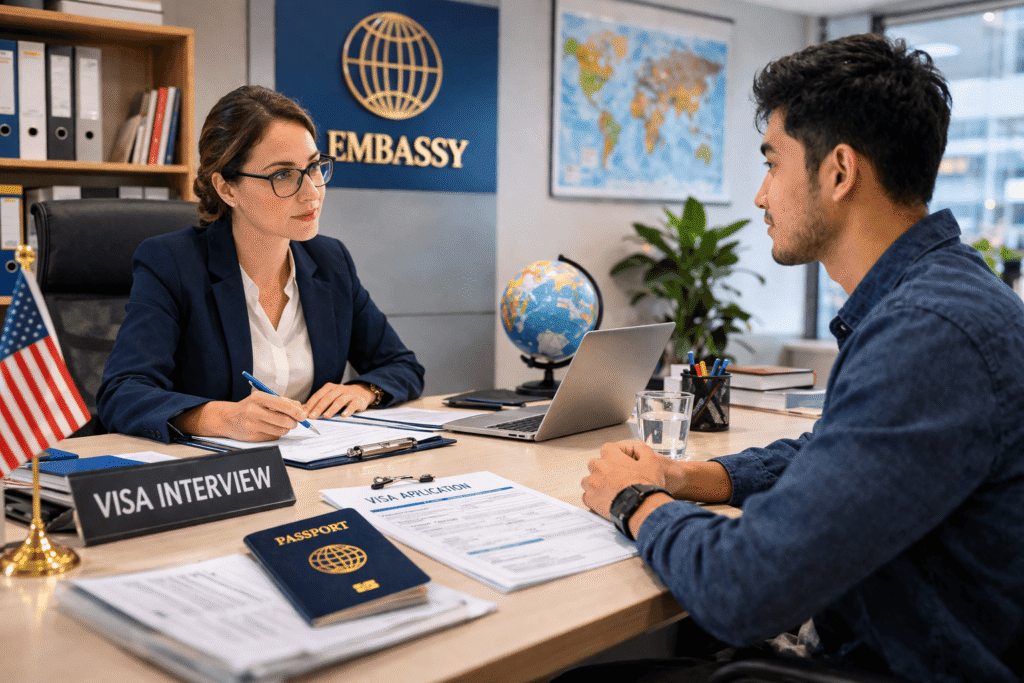
Step 1: Understand What the Interview Actually Tests
The interview exists to confirm you’re a genuine student with real study intentions. Officers mainly evaluate five things.
| Evaluation Factor | What Officers Check |
|---|---|
| Study intentions | Are you genuinely planning to study? |
| Academic background | Does your program match your prior studies? |
| Financial capacity | Can you afford tuition and living costs? |
| Immigration intent | Will you return home after your studies? |
| Communication skills | Can you explain your plans clearly? |
Fail to convince an officer on any one of these, and your visa can be refused.
Step 2: Know Your University Inside Out
Officers expect real, specific knowledge about your school. Be ready to explain the university’s name and location, your course, its duration, tuition costs, the school’s reputation, and why you chose it specifically.
A strong answer sounds like this: “I chose this university because it offers a specialized program in international business with real internship opportunities. It builds directly on my undergraduate work in business administration.”
That kind of answer shows genuine research, not a copied script.
Step 3: Explain Your Program Clearly
Many students fail simply because they can’t explain their own course. Prepare to answer why you chose it, how it connects to your prior education, and where it leads your career.
| Question | Good Answer Strategy |
|---|---|
| Why this course? | Link it to your academic background |
| Why this country? | Point to education quality |
| Why this university? | Speak to the program’s specific strengths |
Step 4: Prepare Your Financial Proof
Financial capability is one of the heaviest-weighted parts of the interview. Officers need confidence you can cover tuition, accommodation, living expenses, and travel.
Typical accepted proof includes bank statements, scholarship letters, sponsor letters, education loans, and proof of income.
A solid answer sounds like: “My parents are sponsoring my education. Their income comfortably covers my tuition and living costs.” Know your own numbers before you walk in.
Step 5: Show Real Ties to Home
Officers need to believe you’ll return home after graduating. Family ties, property ownership, a waiting job, or business interests all support that case.
Example: “After my master’s, I plan to return and work in my family’s logistics company.”
Step 6: Practice the Common Questions
Rehearsing your answers builds real confidence, not memorized confidence.
| Common Question | What the Officer Wants |
|---|---|
| Why study abroad? | Your genuine motivation |
| Why this country? | Education benefits |
| Who’s sponsoring you? | Financial proof |
| What are your career plans? | Clear future goals |
| Do you plan to return home? | Immigration intent |
If your school sits inside the Schengen Area, make sure your travel insurance meets the requirement before your interview. Our complete travel insurance guide covers exactly what you need.
Interview Requirements Checklist
Confirm you have every document ready before you go.
| Document | Purpose |
|---|---|
| Passport | Identity verification |
| Admission letter | Proof of university acceptance |
| Visa application form | Official visa request |
| Financial documents | Proof of funds |
| Academic certificates | Education background |
| Language test results | Proof of language proficiency |
| Appointment confirmation | Interview scheduling |
Your Preparation Timeline
| Time Before Interview | Task |
|---|---|
| 4 weeks before | Research your university and course thoroughly |
| 3 weeks before | Gather every financial document |
| 2 weeks before | Practice your interview answers |
| 1 week before | Review your full application again |
| 1 day before | Organize your documents and rest well |
Before your interview, make sure you understand the full student visa process. Our complete guide to student visas walks through it end to end.
Expert Tips to Pass Your Interview
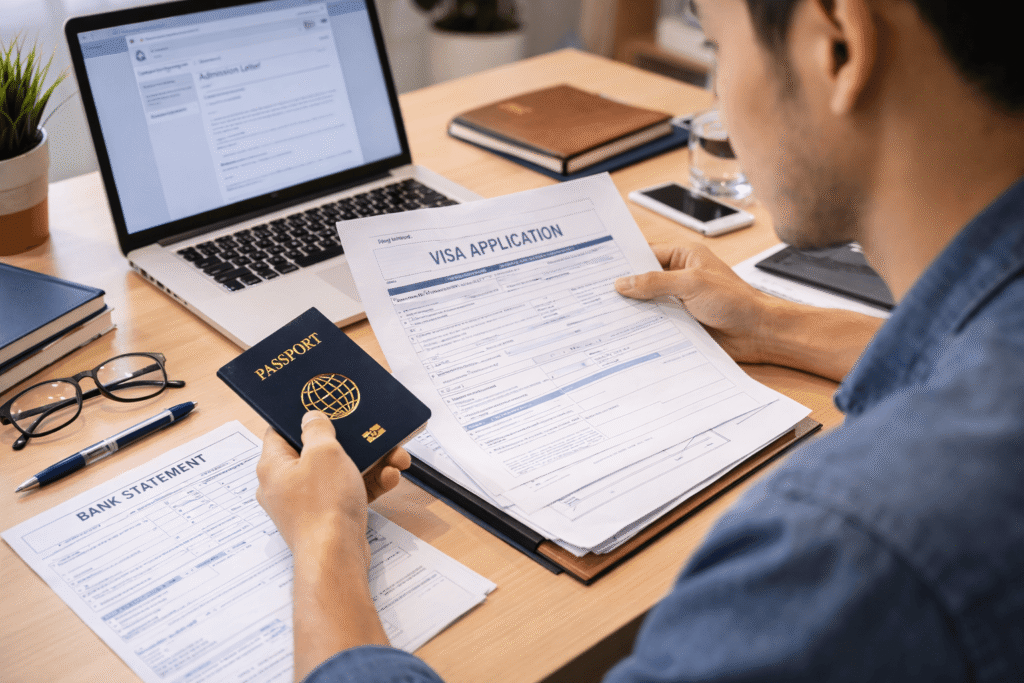
Be honest. Never give false information. Officers catch inconsistencies fast.
Keep answers short and direct. A rambling answer (“Well, I was thinking about maybe studying business because…”) reads as unsure. A direct one (“I chose business administration because it aligns with my undergraduate studies and career plans”) reads as confident.
Watch your body language. Maintain eye contact, sit upright, speak clearly, and smile naturally. Avoid looking down, fidgeting, or rushing your words.
Dress professionally. Your appearance signals how seriously you’re taking the process. A formal shirt and trousers work well for men; a formal blouse or business dress works well for women. Closed, professional shoes finish the look either way.
Arrive early. Get there at least 30 minutes before your interview to settle your nerves.
Before you travel, look into accommodation near your university. Our complete hotel booking guide covers how students book safely.
Common Mistakes That Cause Rejection
Memorizing scripted answers. Officers spot rehearsed, robotic responses quickly. Understand your own answers instead of reciting them.
Not understanding your own course. If you can’t explain what you’ll study, it raises real doubt about your intentions.
Weak financial knowledge. Applicants often can’t explain who’s paying, what a sponsor earns, or what’s in their own bank statement.
Signaling immigration intent. A phrase like “I hope to settle here after graduation” can sink an otherwise strong application.
Giving inconsistent information. Your spoken answers need to match your written application exactly.
Interview Processes by Country
| Country | Interview Required | Typical Duration | Approval Rate |
|---|---|---|---|
| USA | Yes | 3–5 minutes | Moderate |
| UK | Sometimes | 10–20 minutes | High |
| Canada | Rare | Varies | High |
| Australia | Sometimes | 5–10 minutes | High |
Each country runs its own version of this process, so confirm your destination’s specifics directly.
Sample Questions and Answers
Why did you choose this country? “I chose this country for its globally recognized education and hands-on learning opportunities in my field.”
Who will sponsor your studies? “My parents will sponsor me. They’re financially stable, with enough savings to cover tuition and living costs.”
What will you do after graduation? “After finishing my degree, I plan to return home and work in the finance sector.”
For deeper practice, our visa interview questions and answers guide covers a wider range of scenarios.
Frequently Asked Questions
How long does a student visa interview last? Most last between 3 and 15 minutes, depending on the country.
Can I actually fail this interview? Yes. If the officer isn’t convinced about your intentions, finances, or study plans, they can refuse your visa.
What happens right after the interview? The officer may approve your visa, request more documents, or reject the application.
How many times can I apply? There’s usually no strict limit, but repeated rejections can hurt future applications.
Do all countries require an interview? No. Some approve student visas based on documentation alone.
Once you’re through the interview, book your flight next. Our cheap international flights guide covers how to find affordable fares.
Conclusion
The student visa interview is one of the most critical steps in studying abroad. It feels intimidating, but real preparation changes the odds significantly.
Understand what the interview tests, prepare your documents, practice the common questions, and show genuine study intentions. These are the strategies that actually move the needle.
Visa officers aren’t trying to trip you up. They’re verifying you’re a legitimate student who’ll follow the visa’s terms. Walk in prepared, and your study-abroad plans stand a real chance of becoming reality.