





























The dream of studying abroad is rarely just about the degree. For most international students, the real goal is the return on investment: the chance to gain international work experience, recoup tuition costs, and potentially build a long-term life in a new country.
The transition from “student” to “professional” is where many students stumble, though. The complexity of immigration law, shifting government policies, and the pressure of an expiring study permit can turn an exciting opportunity into a genuine logistical headache. At Every Moment Travels, we’ve watched this play out across major destinations — from the UK’s ongoing review of the Graduate Route to Canada’s tightening of work permit eligibility.
If you’re feeling overwhelmed by the alphabet soup of visa subclasses and eligibility windows, you’re not alone. This guide walks through the Post-Study Work (PSW) visas in the world’s four most popular destinations, step by step.
Before applying for a post-study work visa, it’s worth understanding the full student visa process first — our complete student visa guide covers that groundwork.
1. The United Kingdom: The Graduate Route
The UK’s Graduate Route is one of the more straightforward post-study work options, though it’s faced real political scrutiny recently. It lets students stay and work, or look for work, at any skill level without needing a sponsor.
Applying for the Graduate Route, Step by Step
- Wait for your results. Don’t apply the moment you finish your exams — you need to wait until your university officially notifies the Home Office that you’ve completed your course.
- Check your current leave. You must hold a valid Student visa (or Tier 4 visa) at the time you apply.
- Submit online through the GOV.UK website.
- Verify your identity using the “UK Immigration: ID Check” app to scan your BRP and face — this usually replaces the need for an in-person appointment.
- Pay the fees, including the application fee and the Immigration Health Surcharge (IHS) for each year of the visa. Confirm the current fee directly on GOV.UK, since these figures change periodically.
Requirements Checklist

- [ ] Successful completion: a degree (undergraduate, master’s, or PhD) from a licensed sponsor with a genuine track record of compliance.
- [ ] Physical presence: you need to have studied in the UK for at least 12 months, or the full duration of the course if it’s shorter.
- [ ] No previous Graduate visa: this route can only be granted once in a lifetime.
2. Canada: The Post-Graduation Work Permit (PGWP)
Canada remains a top choice thanks to its relatively clear pathway to Permanent Residency (PR). The PGWP is an “open” work permit, meaning you can work for almost any employer.
Securing Your PGWP, Step by Step
- Gather your graduation documents — an official letter from your school confirming completion, plus your final transcript.
- Confirm eligibility. Your institution needs to be a Designated Learning Institution (DLI), and your specific program needs to be PGWP-eligible.
- Apply within 180 days of receiving your final marks.
- Maintain your status. If your student visa expires before you apply, you’ll need to either leave Canada and apply from abroad, or apply to change your status to “visitor” to stay in Canada while you wait.
Requirements Checklist
- [ ] Full-time status: maintained throughout each semester of your program, except the final session.
- [ ] Program length: at least 8 months.
- [ ] Public vs. private institution: generally, only graduates from public post-secondary schools, or specific private schools authorized by provincial statute, qualify.
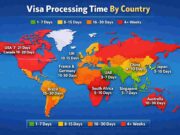
Canada’s processing can take months, so it’s worth checking our visa processing time breakdown before you apply.
3. Germany: The Job Seeker & 18-Month Post-Study Residence Permit
Germany offers one of the more generous post-study work windows in Europe, reflecting its real need for skilled labor in engineering, IT, and healthcare.
Transitioning to the German Workforce, Step by Step
- Apply for the 18-month extension upon graduation — a residence permit specifically for seeking employment (Section 20(3) no. 1 AufenthG).
- Work without limits. During these 18 months, you can take any job, even outside your field, to support yourself while you search for a “qualified” position.
- Switch to a work permit once you find a job matching your academic qualification — either an EU Blue Card or a standard German work permit.
Requirements Checklist
- [ ] Proof of degree: a certificate from a German university.
- [ ] Financing: proof you can cover living costs (roughly €11,000–€12,000 per year) via a blocked account or an employment contract.
- [ ] Health insurance: continuous coverage in the German healthcare system.
4. Australia: Temporary Graduate Visa (Subclass 485)
Australia recently went through a significant migration strategy overhaul, adjusting the age limits and stay duration for graduates to target younger, highly skilled workers. Australia’s post-study work visa is officially called the Temporary Graduate Visa (Subclass 485).
Navigating the 485 Visa, Step by Step
- Choose your stream — most international students apply through the Post-Higher Education Work Stream.
- Check age limits. As of mid-2024, the maximum age for most streams is 35, with some exceptions for Master’s by Research and PhD graduates.
- Confirm your English proficiency with an updated IELTS or PTE score, usually valid for one year for this visa.
- Apply within 6 months of your course completion date.
Requirements Checklist
- [ ] CRICOS registration: your course needs to be registered on the Commonwealth Register of Institutions and Courses for Overseas Students.
- [ ] Australian study requirement: at least two academic years (92 weeks) of study completed in Australia.
- [ ] AFP check: an Australian Federal Police clearance.
Australia also requires health insurance for the duration of your stay — our guide to student travel insurance covers what to look for.
Comparison Table: Post-Study Work Visas at a Glance
| Feature | United Kingdom | Canada | Germany | Australia |
|---|---|---|---|---|
| Visa name | Graduate Route | PGWP | 18-month extension | Subclass 485 |
| Duration (Master’s) | 2 years | Up to 3 years | 18 months | 2 years* |
| Work restrictions | None (open) | None (open) | None (open) | None (open) |
| Sponsorship | Not required | Not required | Not required | Not required |
| Age limit | None | None | None | 35 (most streams) |
| PR pathway | Via Skilled Worker | Express Entry/PNP | Blue Card/PR | Skilled Independent |
*Australian durations vary by degree type and study location.
Permanent Residency Pathway Roadmaps for 2026
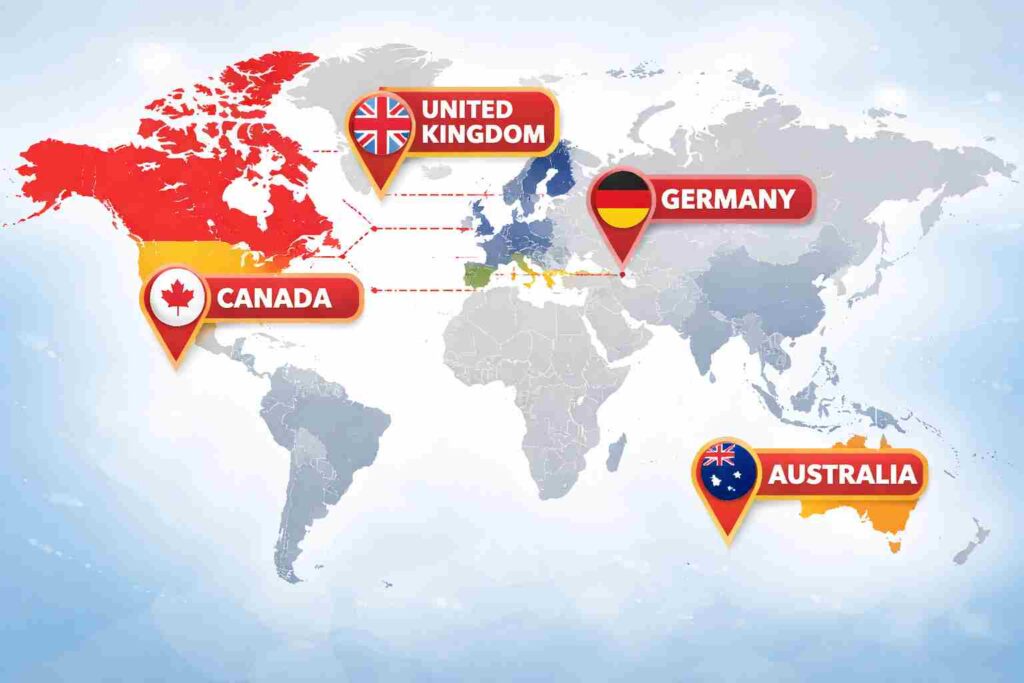
For international students, the post-study work visa is a bridge, but Permanent Residency is the actual destination. In 2026, the global immigration landscape has shifted toward more merit-based and sector-specific selection. Below is a roadmap for the UK, Canada, Germany, and Australia — treat these as current directional guidance, not a substitute for checking official sources before you plan around any specific figure.
1. United Kingdom: A Route in Genuine Transition
This is important to get right, because the UK’s settlement rules are in real flux. As of mid-2026, the UK government has proposed — but has not yet implemented — a major overhaul called the “Earned Settlement” model, which would replace the current fixed-time route to Indefinite Leave to Remain (ILR) with one based on contribution, integration, character, and residence.
What’s actually confirmed right now: the existing 5-year route to ILR for Skilled Worker visa holders remains fully in force. Nothing has changed yet.
What’s proposed, pending implementation (realistically no earlier than autumn 2026, and possibly later): a new baseline qualifying period of 10 years for most routes, rising to 15 years for Skilled Worker and Health and Care roles below RQF Level 6. Under the proposal, sustained high earnings could shorten that wait — taxable income above £125,140 for three consecutive years could cut the qualifying period by up to 7 years (down to as few as 3), while income above £50,270 could cut it by up to 5 years. The proposal would also raise the English requirement for ILR from B1 to B2, with that specific change currently set to take effect March 26, 2027, regardless of how the broader Earned Settlement consultation resolves.
If you’re currently on, or planning, a UK Skilled Worker route: given the genuine uncertainty around whether these changes will apply to people already in the system, it’s worth getting current, personalized advice from a regulated immigration adviser rather than planning around any single figure in this guide.
Requirements Checklist (Current Rules)
- [ ] Salary: meet the current “going rate” for your specific job code under the Skilled Worker route.
- [ ] English: currently B1 for the Skilled Worker route; confirm the current requirement before applying, since this is one of the areas actively changing.
- [ ] National Insurance: proof of continuous contributions throughout your qualifying period.
2. Canada: The “Targeted Draw” Roadmap
Canada’s PR system in 2026 leans heavily on Category-Based Selection through Express Entry.
Roadmap:
- PGWP phase (1–3 years): gain at least 12 months of Canadian work experience in a skilled role (TEER 0, 1, 2, or 3).
- Build your Express Entry profile. In 2026, category-based draws have prioritized healthcare, STEM, skilled trades, transport, and French proficiency.
- Watch for targeted temporary-to-permanent pathways in shortage sectors like construction and healthcare — IRCC has discussed limited-allocation pathways of this kind, though the specific numbers shift, so confirm current details directly on IRCC’s website rather than relying on a fixed figure.
- Consider a Provincial Nominee Program (PNP) if your Express Entry score is on the lower side — a provincial nomination adds a substantial points boost and effectively guarantees an invitation.
- Respond to your Invitation to Apply (ITA) within 60 days once invited.
Requirements Checklist
- [ ] Language: IELTS (General) or CELPIP, with a minimum CLB 7 for most streams and CLB 9+ generally needed for a competitive score.
- [ ] Work experience: at least 1 year of full-time (or equivalent part-time) Canadian experience.
- [ ] NOC alignment: your actual job duties need to match the current National Occupational Classification code you’re claiming.
3. Germany: The Blue Card & Skilled Worker Roadmap
Germany has introduced the Chancenkarte (Opportunity Card) alongside an updated Skilled Immigration Act, making it one of the faster PR routes in Europe for qualified professionals.
Roadmap:
- Job search phase: use your 18-month post-study permit or the Chancenkarte to find a qualified role.
- EU Blue Card: if you meet the current salary threshold (higher for standard roles, lower for shortage occupations and new graduates), you can secure an EU Blue Card. Confirm the current thresholds directly with BAMF, since these adjust periodically.
- Fast-track settlement: with German at the B1 level, you can generally apply for permanent settlement (Niederlassungserlaubnis) after around 21 months on a Blue Card. Without meeting that language threshold, standard skilled workers with a recognized degree typically face a longer route, often around 3 years.
- Citizenship: Germany now allows dual citizenship, with naturalization possible in as little as 3–5 years for well-integrated applicants.
Requirements Checklist
- [ ] Language: German A1 is generally the minimum for work; B1 is needed for the fast-track PR route.
- [ ] Pension fund: proof of the required months of statutory pension insurance contributions.
- [ ] Accommodation: proof of sufficient living space for you and any accompanying family members.
4. Australia: The Points & Regional Roadmap
Australia’s 2026 migration settings favor Regional Migration (491) and State Nomination (190) over the highly competitive Independent (189) route.
Roadmap:
- Get your skills assessed immediately after graduation through the relevant authority (ACS for IT, Engineers Australia for engineering, and so on).
- Submit an Expression of Interest (EOI) via SkillSelect.
- Consider a regional strategy — moving to a designated regional area (anywhere outside Sydney, Melbourne, or Brisbane). The Subclass 491 visa, a 5-year visa, grants PR eligibility after 3 years of living and working regionally.
- Apply for state nomination (190) for an additional points boost — each state runs its own graduate-specific stream.
- Complete health and character checks once invited, for either the 190 or the 191 (PR) visa.
Requirements Checklist
- [ ] Points score: a minimum of 65, though competitive scores in fields like IT and business generally run well above that.
- [ ] Age: under 45 for the PR grant itself (the Graduate visa age limit is separately capped at 35).
- [ ] English: a strong PTE Academic or IELTS score is close to essential for the “Superior English” points that make an invitation realistic.
Comparison of PR Pathways (2026)
| Feature | United Kingdom | Canada | Germany | Australia |
|---|---|---|---|---|
| Primary PR route | Skilled Worker / ILR | Express Entry (CEC) | EU Blue Card | Subclass 190/491 |
| Typical PR timeline | Currently 5 years; a 10-year (or longer) proposal is pending | 1–3 years | ~21 months–3 years | 3–5 years |
| Language focus | English (currently B1; B2 proposed) | English or French | German (B1) | English (Superior) |
| Key consideration | Rules genuinely in flux — verify before planning | Targeted sector draws move fast | Among the faster EU timelines | Regional areas offer real advantages |
Expert Tips for the Long Game
For Canada: if your English scores have plateaued but your points are still short, learning French can genuinely change your position — a strong CLB score in French has, in past category-based draws, been enough to secure an invitation well below the general cutoff.
For Australia: don’t default to Sydney or Melbourne. Moving to a regional hub like Perth, Adelaide, or Hobart can meaningfully shorten your wait, since competition is lower and regional points are real.
For Germany: if your degree isn’t fully recognized yet, you can often start working while the recognition process runs in parallel — worth asking about directly rather than assuming you need to wait.
For the UK: given the genuine uncertainty around Earned Settlement, keep a record of anything that could count as a “contribution” under the proposed system — sustained earnings, volunteering, community involvement — so you’re prepared regardless of which version of the rules eventually applies to you.
Common Mistakes to Avoid
Working beyond your permitted hours. Exceeding the weekly work limit while studying can get your post-study work visa application rejected for a breach of visa conditions.
Applying too late. Your “completion date” is the date your final results are released, not your graduation ceremony date.
Missing authorized leave documentation. If you took a semester off for a reason other than approved medical leave, Canada may deem you ineligible for the PGWP.
Incomplete documents. Missing a police check (Australia) or proof of funds (Germany) leads to immediate delays or denials.
Frequently Asked Questions
Can I bring my family on a post-study work visa? In the UK, only if they were already your dependents during your student visa. In Canada, Germany, and Australia, your spouse is generally eligible for an open work permit or a dependent visa.
Do I need a job offer to apply? No. In all four countries, the post-study work visa is granted based on your education, not a current job offer.
Can I travel while my application is pending? It’s genuinely discouraged. In the UK specifically, leaving the Common Travel Area while your application is pending automatically withdraws it.
Once your visa is approved, our guide to booking cheap international flights as a student can help you save money getting there.
Conclusion

Securing a post-study work visa is the bridge between your education and your career. The UK currently offers real simplicity through the Graduate Route (though its settlement rules are genuinely in transition), Canada provides one of the more accessible PR paths, Germany offers a relatively low barrier to entry for skilled workers, and Australia rewards those willing to study or work in regional growth areas.
These rules change quickly, and in the UK’s case specifically, some of the biggest changes are still proposals rather than settled law. Always cross-reference this guide against official government sources — the Home Office, IRCC, BAMF, or the Department of Home Affairs — before you submit an application or make a major decision based on any figure here.
Not sure where to study in the first place? Start with our guide to the best countries to study abroad in 2026.