
































Why a Travel Itinerary Matters for Visa Applications
At Every Moment Travels, we review a lot of visa applications before clients submit them. The itinerary is often the weakest document in the whole file, even when everything else looks solid.
A vague itinerary raises questions a consulate officer doesn’t want to ask twice. A strong one answers those questions before they come up. It shows the consulate you have a real, structured plan. In addition to that, it proves you’ve booked accommodation and transport, not just dreamed up a trip. It signals that your visit is genuine and temporary.
Many applicants treat the itinerary as an afterthought. That’s a mistake. A vague or incomplete itinerary often causes delays or outright rejection, even when your finances and documents are strong.
What Consulates Actually Look For
Before you start writing, understand what a visa officer scans for.
Clarity and structure. Officers need to see where you’ll be, when, and for how long, at a glance.
Consistency with your other documents. Your itinerary must match your flight bookings, hotel reservations, and financial statements exactly.
Proof of intent to return. Your plan should read as a temporary visit, backed by real ties to your home country.
If you’re new to the visa process, our complete guide to tourist visas covers the requirements and approval tips before you dive into the itinerary itself.
Gather Your Information First
A solid itinerary starts with accurate details. Collect the following before you write anything:
- Flight details — departure, arrival, and return dates, plus airline and flight numbers
- Accommodation — hotel bookings, Airbnb details, or a formal invitation letter
- Daily activities — sightseeing, meetings, tours, and local transport
- Financial proof — a rough daily budget for transport, food, and activities
- Emergency contacts — local contacts, embassy details, or your tour operator
Step-by-Step: Writing Your Itinerary
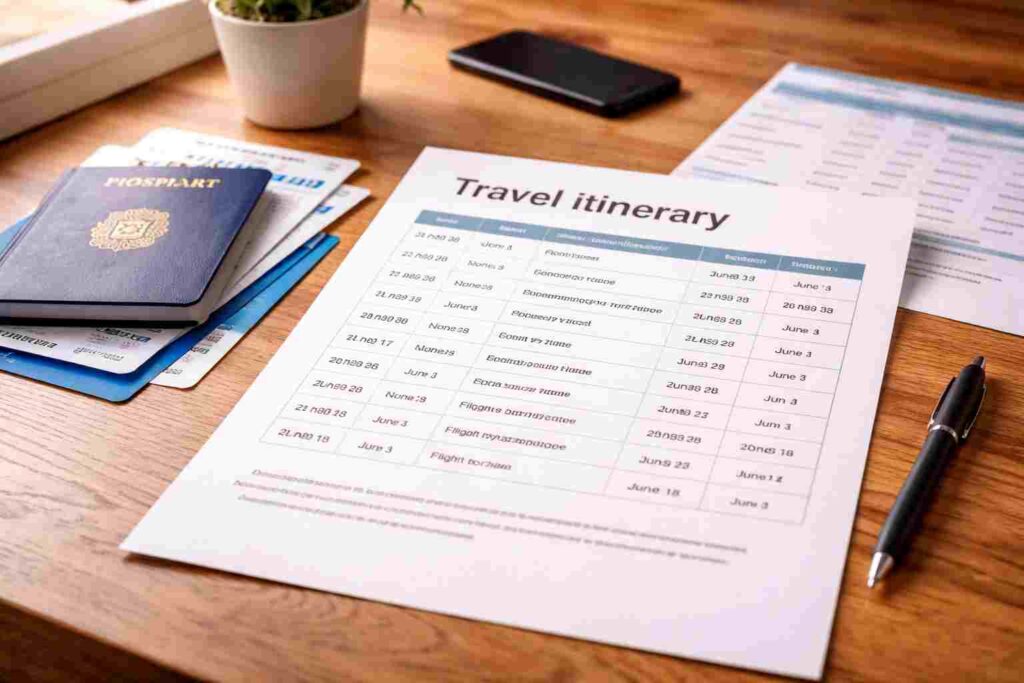
Step 1: Start With a Cover Page
Include your full name, passport number, visa type, travel dates, and destination.
Step 2: Build a Daily Schedule
Lay out your trip day by day, in a clear table:
| Day | Date | City | Accommodation | Activities | Transportation |
|---|---|---|---|---|---|
| 1 | 01/06/2026 | Paris | Hotel Lumiere | Eiffel Tower, Seine River tour | Taxi / Metro |
| 2 | 02/06/2026 | Paris | Hotel Lumiere | Louvre Museum, Notre Dame | Walking / Metro |
| 3 | 03/06/2026 | Lyon | Hotel Belle Vie | Old Town tour | Train |
Keep each day realistic — don’t overstuff it with activities. Match your activities to your visa type, whether tourist, student, or business.
Step 3: Add Transport and Accommodation Details
List your airline, flight number, and timing for every flight. Include booking confirmation numbers for trains or buses. Add the booking reference, address, and contact number for every hotel.
Pre-Submission Checklist
Confirm every item below before you submit your itinerary.
- [ ] A cover page with your personal and travel details
- [ ] A daily schedule with dates, cities, and activities
- [ ] Confirmed flight and accommodation bookings
- [ ] Transport arrangements between cities
- [ ] An estimated daily budget
- [ ] Emergency contacts and travel insurance details
- [ ] A signature or verification, where required
Your itinerary needs to match your flight reservations exactly. If you haven’t booked yet, our guide to cheap international flights explains how to find low fares and avoid common booking mistakes.
Simple vs. Detailed Itinerary
| Feature | Simple Itinerary | Detailed Visa Itinerary |
|---|---|---|
| Flight details | Departure and return dates only | Airline, flight numbers, and timing |
| Accommodation | Hotel names only | Names, addresses, and booking numbers |
| Activities | “Sightseeing” | A detailed schedule with times and locations |
| Transportation | Not included | A complete local travel plan |
| Purpose explanation | Not mentioned | A clear reason for each visit |
| Approval impact | Low | High |
Visa officers consistently favor the detailed version.
Tips From Reviewing Hundreds of Applications
Stay truthful. Never fabricate a booking — officers can and do verify them.

Keep it concise. Tables and bullet points read faster than dense paragraphs.
Build in buffer days. A little flexibility protects you against unexpected delays.
Match every supporting document. Your flights, hotels, and financial proof all need to tell the same story.
Use professional formatting. Submit a typed PDF or Word document, not a handwritten one.
Write in the consulate’s official language. English works for most destinations, but always check first.
Common Mistakes That Slow Down Approval
Vague descriptions. “Visit attractions” tells an officer nothing. Name the specific sites.
Mismatches with your bookings. Your itinerary must align exactly with your confirmed flights and hotels.
Overambitious schedules. Cramming too many stops into one day looks unrealistic, not impressive.
Missing transport logistics. Show how you’ll move between cities, not just where you’ll be.
Skipping emergency contacts. Leaving this out signals a lack of real preparation.
Frequently Asked Questions
Do I need paid bookings for flights and hotels? Consulates generally prefer confirmed bookings over loose plans. Many accept free-cancellation holds — real reservations you can cancel later — as long as they’re clearly refundable and not misrepresented as final purchases.
Can I use a tour package itinerary? Yes, especially for tourist visas. Include your tour agency’s contact details and booking reference.
Should I include sightseeing every single day? Yes, but keep it realistic. Two or three main activities per day, with clear cultural or business relevance, works best.
Can I submit a handwritten itinerary? It’s better to submit a typed document in PDF or Word format.
How long should the itinerary be? For a one- to two-week trip, aim for two to four pages. Longer trips may need five to seven.
Sample Travel Itinerary
Cover Page
- Name: Jane Doe
- Passport Number: X1234567
- Visa Type: Schengen Tourist Visa
- Travel Dates: 01/06/2026 – 15/06/2026
- Destination: France and Germany
Daily Plan (Excerpt)
| Day | Date | City | Accommodation | Activities | Transport |
|---|---|---|---|---|---|
| 1 | 01/06/2026 | Paris | Hotel Lumiere | Arrival, Eiffel Tower visit | Taxi |
| 2 | 02/06/2026 | Paris | Hotel Lumiere | Louvre Museum, Seine River cruise | Metro |
| 3 | 03/06/2026 | Lyon | Hotel Belle Vie | Old Town sightseeing, food tour | Train |
Estimated Daily Budget: €100 for accommodation, €50 for transport, €40 for food, and €20 for miscellaneous costs.
Related Guides
- How to get a Schengen visa approved
- International travel tips for first-time travelers
- Complete hotel booking guide
- Best travel insurance for Europe
Conclusion
A well-crafted travel itinerary is more than paperwork. It demonstrates real planning, credibility, and genuine intent to a consulate officer reviewing dozens of files a day. Follow the steps above, work through the checklist, and avoid the common mistakes, and you give your application a real edge.