


































1. Introduction: The High-Stakes Gatekeeper of Global Mobility
For millions of aspiring professionals, skilled workers, and students worldwide, the International English Language Testing System (IELTS) represents both a monumental hurdle and a critical gateway. Managed jointly by the British Council, IDP: IELTS Australia, and Cambridge University Press & Assessment, this standardized test evaluates language proficiency across four core communication modalities: Listening, Reading, Writing, and Speaking.
At Every Moment Travels, we help clients navigate this test constantly, and the real challenge isn’t usually the test format itself — it’s how deeply IELTS is woven into global immigration frameworks and university admissions metrics. Many qualified candidates find their international journeys delayed or derailed entirely by a mismatch between their actual functional English and their performance on test day.
Broadly, candidates fall into two streams. The Academic Stream feeds into higher education admissions and professional registration in fields like medicine, law, and engineering. The General Training Stream feeds into skilled migration pathways — Express Entry to Canada, skilled visas for Australia and New Zealand, and work visas for the UK and the Gulf states.
The underlying issue is a common misunderstanding: candidates often treat IELTS as a traditional academic memory test rather than an assessment of active linguistic competence and strategic time management. In immigration point systems, a minor deficit in a single sub-test score can disproportionately lower a candidate’s comprehensive ranking. For university applicants, a low score can trigger a mandatory, expensive pre-sessional language program before full academic enrollment is granted.
While IELTS remains a standard requirement for many institutions, alternatives do exist. If you want to explore other entry routes, our guide to studying abroad without IELTS covers whether your target university offers a language waiver.
This guide walks through the IELTS process from administrative requirements through exam strategy, so you can approach it with a clear plan rather than guesswork.
2. Step-by-Step: The Ultimate IELTS Preparation Roadmap
Achieving a high band score requires a methodical approach that balances real language development with targeted exam strategy — haphazard practice with random online sample tests often reinforces bad habits and produces inconsistent results. Here’s a four-phase framework worth following in order: establish your baseline and pick your stream, build the underlying skills, practice under real exam conditions, and finally optimize your pacing in the last stretch before test day.
Phase 1: Baseline Diagnosis and Stream Selection
Before engaging with test materials, establish an accurate baseline score and select the correct test stream.
Determine your stream. Register for the Academic Stream if your primary goal is undergraduate or postgraduate study, or professional registration in medical, legal, or engineering fields. Register for General Training if you’re pursuing skilled migration, secondary education, or work visas in destinations like Canada, Australia, New Zealand, or the UK.
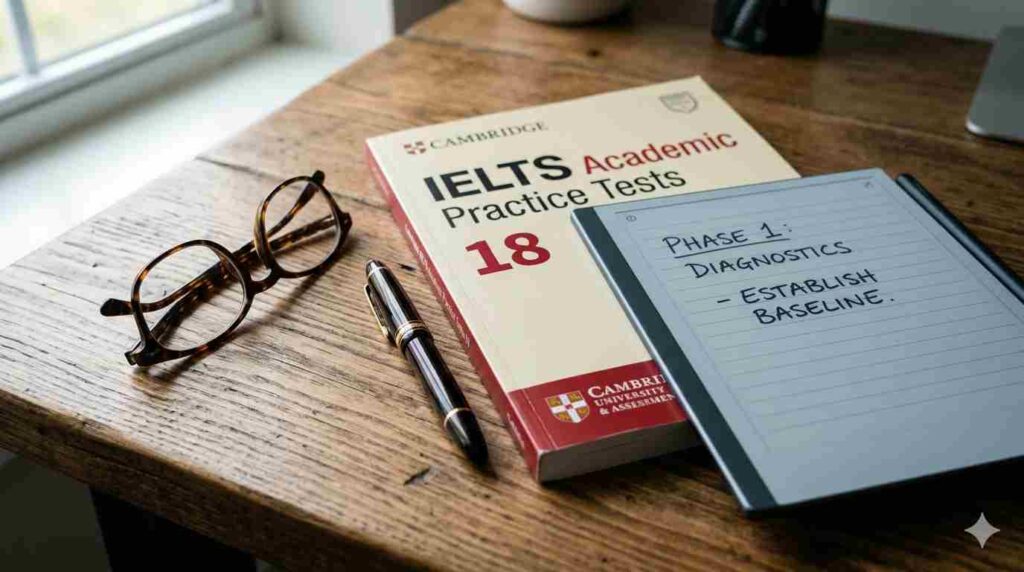
Take a full-length diagnostic test. Use an official, un-timed Cambridge past paper to evaluate your natural performance. This initial benchmark reveals whether your primary challenges stem from basic language proficiency or the structural constraints of the test format itself.
Phase 2: Systematic Mastery of the Test Infrastructure
Don’t jump straight into timed practice. Instead, take time to dissect the mechanics of each of the four modules first.
Deconstruct the band descriptors. Review the public version of the assessment criteria for the Writing and Speaking modules. Focus specifically on how Task Achievement/Response, Coherence and Cohesion, Lexical Resource, and Grammatical Range and Accuracy get scored.
Build modality-specific skills. Break down individual question types. For Reading matching-headings questions, practice identifying paraphrased information. For Writing Task 1, practice writing overview statements that capture the overall trend.
Phase 3: Conditioned Practice and Feedback Integration
Once you understand the test formats, shift your focus to applying that knowledge under real exam conditions.
Enforce strict timing. Move to timed practice sessions, and try targeting 55 minutes for IELTS Reading instead of the official 60 — it helps simulate the psychological pressure of the actual test center.
Establish a feedback loop. Self-study has real limits, particularly for the productive modules (Writing and Speaking). Work with qualified instructors, or use certified assessment services, to review your essays and recorded speaking responses against official criteria.
Phase 4: Final Optimization and Simulated Rehearsals
In the final two weeks before your test date, focus on building endurance and refining your pacing.
Run full-scale mock simulations. Complete Listening, Reading, and Writing back-to-back without breaks, mirroring the exact schedule of test day.
Review your error logs. Go back through your practice history and address recurring mistakes — common spelling errors in Listening, or premature detail-writing in Writing Task 1, tend to show up repeatedly if left unchecked.
3. Requirements and Document Checklist
Navigating the test center’s administrative requirements matters just as much as your academic preparation. Missing documentation or arriving with unapproved items can lead to immediate disqualification and the forfeiture of your registration fee.
Essential identity and administrative documents:
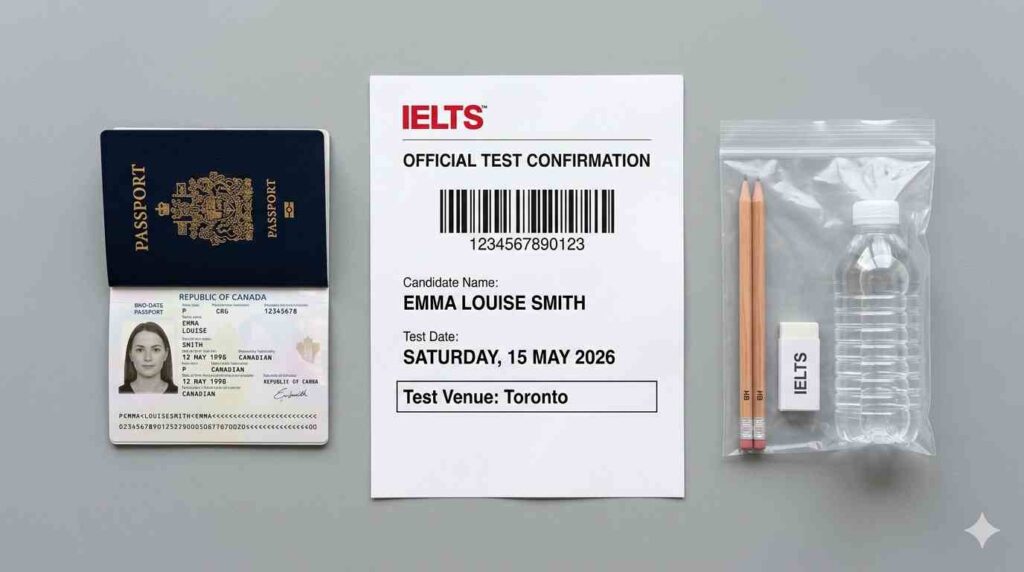
- Valid international passport — the exact physical document used during your online registration. Photocopies, digital copies, or expired passports aren’t accepted under any circumstances.
- Test confirmation email or letter — a printed or digital copy of your official venue assignment, with your candidate number and session details.
- An alternative national identity card, only where a specific test center explicitly approves local IDs at registration.
Permitted materials for paper-based testing:
- HB or 2B pencils — bring at least two sharpened ones, since pencils are mandatory for the Listening and Reading answer sheets.
- A clean, non-abrasive eraser with no paper wrapping or text on the body.
- A transparent water bottle, with all commercial labels completely removed.
Prohibited items (store these in lockers):
- Digital and analog watches — all timepieces are banned inside the exam room, and the venue provides a visible digital wall clock instead.
- Mobile phones and smart devices — these must be fully powered down and checked into secure storage.
- Correction fluid or tape — mistakes on answer sheets must be erased manually.
4. Global Immigration Target Equivalencies
Immigration departments don’t rely on raw IELTS band scores alone — they convert scores into their own national qualification scales.
Canada Express Entry: IELTS General Training to CLB Mapping
Canada uses the Canadian Language Benchmark (CLB) scale to award points under its economic immigration streams, including the Federal Skilled Worker Program and the Canadian Experience Class. Each skill converts independently — your overall CLB is limited by your weakest skill, not an average across all four.
| CLB Level | Listening | Reading | Writing | Speaking | What It Means |
|---|---|---|---|---|---|
| CLB 10+ | 8.5–9.0 | 8.0–9.0 | 7.5–9.0 | 7.5–9.0 | Maximum language points allocation |
| CLB 9 | 8.0 | 7.0 | 7.0 | 7.0 | The competitive target for most Express Entry draws |
| CLB 8 | 7.5 | 6.5 | 6.5 | 6.5 | A solid, above-baseline application |
| CLB 7 | 6.0 | 6.0 | 6.0 | 6.0 | The minimum threshold for Federal Skilled Worker eligibility |
Meeting CLB 7 makes you eligible for the Express Entry pool — it doesn’t make you competitive. In recent draws, CLB 9 has generally been the realistic target for candidates hoping to actually receive an Invitation to Apply, since the CRS points gap between CLB 7 and CLB 9 can run into the dozens. These figures shift as IRCC updates its policies, so confirm the current numbers directly on the IRCC website before you plan around them.
Meeting these thresholds is vital for your Express Entry profile. For the broader picture, our detailed breakdown of Canada PR pathways for skilled professionals covers what comes after the language requirement.
Australia and United Kingdom Skilled Migration Baseline Targets
Australia assesses language skills through the Department of Home Affairs’ visa pathways, while the UK uses the Common European Framework of Reference for Languages (CEFR) through its Secure English Language Test (SELT) framework.
| Destination | Visa Stream / Pathway | Mandatory Minimum Score | Core Purpose |
|---|---|---|---|
| Australia | Subclass 189 / 190 (Skilled Independent) | IELTS 7.0 across all modules | Secures 10 immigration points (Proficient English) |
| Australia | Subclass 189 / 190 (Superior tier) | IELTS 8.0 across all modules | Secures 20 immigration points (Superior English) |
| United Kingdom | Skilled Worker Visa | IELTS 4.0 (General Training) | Satisfies the mandatory CEFR B1 requirement |
| United Kingdom | Innovator Founder / Scale-up | IELTS 5.5 (General Training) | Satisfies the mandatory CEFR B2 requirement |
Australia’s points-based system is highly competitive — our analysis of Australia’s skilled migration occupation lists is worth reading alongside your language score planning.
Higher Education Admission Targets: Academic Stream
For university admissions, institutions set minimum overall and component scores to ensure incoming students can handle complex academic material. Postgraduate programs commonly target an overall score of 7.0, with no individual subtest below 6.5. Undergraduate programs typically ask for an overall 6.5, with no subtest below 6.0 — a somewhat lower bar, but still one that requires real precision across all four skills.
Achieving a strong band score is only the first step toward funding your studies abroad — our complete guide to winning international scholarships is worth pairing with your test preparation.
5. Module-by-Module Strategy and Expert Tips
Listening: Active Processing and Forward Tracking
The IELTS Listening audio plays exactly once. To stay focused through the full 30-minute recording, apply a few core strategies.
Pre-read and predict. Use the brief pauses between sections to scan the upcoming question stems. Identify the part of speech each blank requires — noun, number, adjective — and highlight key contextual anchors before the audio starts.
Track multiple questions simultaneously. Speakers often transition quickly between details, so keep your eyes on both the current question and the one after it to avoid losing your place.
Manage distractors carefully. Speakers frequently correct themselves mid-sentence (“We’ll meet on Tuesday — no wait, the room’s booked, let’s make it Thursday”). Don’t write down the first piece of data you hear without confirming the final, corrected version.
Reading: Eliminating the Time Deficit
Attempting to read every word of all three passages (2,100–2,750 words total) within 60 minutes is a recipe for running out of time. Treat the Reading module as a selective search exercise instead.
Skim in two stages. Spend no more than 90 seconds scanning a passage’s layout, topic sentences, and concluding statements to build a rough structural map before you dig in.
Locate keywords precisely. Look for stable keywords in the question stem — proper nouns, unique dates, technical terms — that can’t easily be paraphrased away in the text.
Hold to strict pacing. A reasonable allocation is around 17 minutes for Passage 1, 19 for Passage 2, and 22 for Passage 3. If any single question is taking more than 90 seconds, mark a provisional answer and move on.
Writing: Structural Discipline and Cohesive Flow
The Writing module is where many candidates fall short of their target score, often due to weak structure rather than weak language.
Writing Task 1 (Academic — data synthesis): the overview statement is mandatory — a clear, high-level summary of the main trends or differences, without quoting specific data points. Skipping it caps your Task Achievement score at Band 5. Group your data logically into body paragraphs by shared characteristics (upward trends versus downward ones, for instance), rather than listing points chronologically.
Writing Task 2 (essay composition): identify quickly whether the prompt asks for an Opinion (agree/disagree), a Discussion (both sides plus your opinion), a Problem/Solution response, or a Two-Part Question — your thesis needs to directly match the actual prompt type. A reliable four-paragraph structure works well: an introduction that paraphrases the prompt and states a direct thesis, a first body paragraph with your primary argument, an explanation, and a real-world example, a second body paragraph following the same pattern for a secondary or counter-argument, and a conclusion that restates your thesis in fresh language and summarizes your main points.
Speaking: Managing Fluency Under Direct Evaluation
The Speaking module is a face-to-face or video-call interview built to assess how naturally you sustain a conversation.
Prioritize fluency over perfection. Avoid pausing mid-sentence hunting for rare vocabulary. A natural, steady pace scores better than complex language delivered at the cost of fluency.
Extend your Part 2 responses. In the long-turn section, aim to speak for the full two minutes, continuing until the examiner explicitly tells you to stop.
Structure Part 3 answers deliberately. For the more abstract, analytical questions, a simple framework helps: state your opinion clearly, explain the reasoning behind it, give a relevant example, and tie it back to the question with a brief conclusion.
6. Critical Pitfalls: Common Mistakes to Avoid
The difference between a Band 6.5 and a Band 7.5 often comes down to eliminating a handful of simple administrative and tactical errors.
In Listening and Reading, writing “student” when the audio or text specifies “students” counts as a wrong answer entirely, even though the core information was correct — always check the immediate grammatical context around a blank space. Similarly, exceeding a stated word limit (like “NO MORE THAN TWO WORDS”) invalidates that answer even when the content itself is right — review your responses specifically for word-count compliance during your checking phase.
In Writing, copying the prompt’s exact phrasing into your introduction doesn’t count toward your word total and signals weak vocabulary — paraphrase it fully using synonyms and altered grammatical structure instead. Falling under the minimum word count (150 for Task 1, 250 for Task 2) triggers an automatic penalty — use a standard paragraph structure and develop your examples fully to comfortably clear the minimum.
In Speaking, reciting memorized, pre-prepared answers for common topics sounds unnatural and is easy for examiners to spot. Focus instead on learning versatile sentence starters and functional language patterns you can adapt on the spot, rather than memorizing entire paragraphs.
7. Frequently Asked Questions
What’s the actual difference between the Computer-Delivered and Paper-Based IELTS? The content, question types, scoring criteria, and difficulty are identical across both formats — the difference is entirely in the testing experience. On the computer-delivered version, you type your Writing responses, use headphones with individual volume control for Listening, and navigate Reading passages on a split screen, with results typically released within 3 to 5 days. On the paper-based version, you write by hand, the Listening audio plays over room speakers, and results release exactly 13 days after the test.
How long do official IELTS results stay valid for immigration and academic purposes? IELTS Test Report Forms are valid for a maximum of two years from the test date. After that, the scores drop out of active validation databases, and you’ll need to retake the test.
Can I request an official re-evaluation if I’m unhappy with my score? Yes — this is called an Enquiry on Results (EOR), and you can apply within six weeks of your test date. You can choose to have specific modules or your entire test re-graded by senior examiners. If your score goes up in any module, your EOR fee gets refunded in full; if it stays the same, the fee is forfeited.
How often can I retake the IELTS exam? There’s no administrative limit — you can register for any available date worldwide. That said, it’s generally wiser to allow real time for targeted study between attempts rather than retaking immediately without addressing your weak points.
Is the One Skill Retake (OSR) option universally accepted by immigration departments? No, acceptance varies significantly by country. Australia accepts OSR scores widely across various visa subclasses and professional registration boards. Canada’s IRCC does not accept OSR for its core Express Entry pathways — applicants need a complete, single-sitting test report instead.
8. Conclusion: From Strategy to Global Success
Mastering the IELTS is a genuinely manageable challenge that responds well to disciplined preparation, clear target-setting, and a real understanding of how the test is graded. Whether you’re aiming for CLB 9 to strengthen a Canadian Express Entry profile, or a 7.5 Academic score for a competitive university program, success comes from moving past passive practice into deliberate, targeted preparation.
Choosing your destination matters just as much as the score you achieve. If you’re still weighing major English-speaking destinations against each other, our comparison of the UK and Canada for international students can help you narrow that decision down.
By diagnosing your baseline honestly, mastering each section’s specific strategy, avoiding the common pitfalls above, and tracking your own progress along the way, you can walk into test day with real, earned confidence.