
































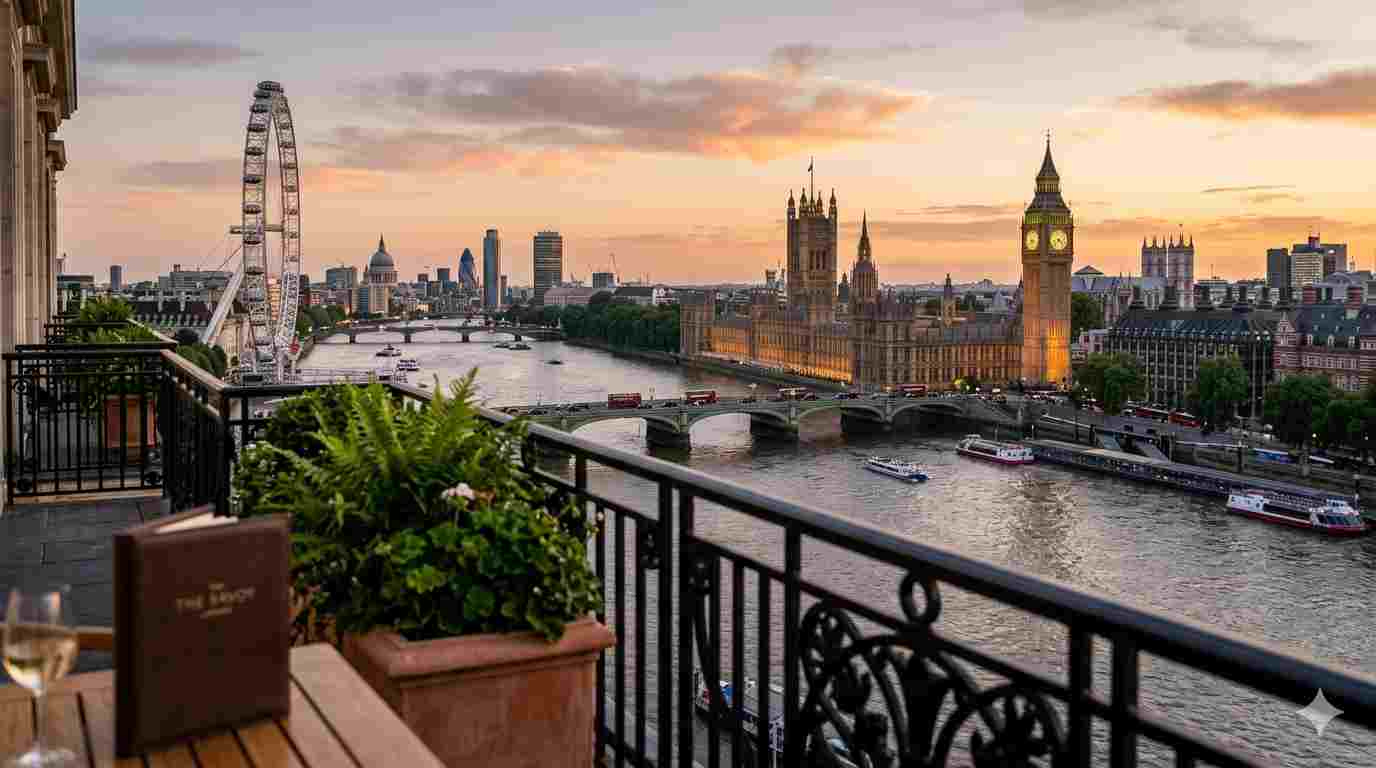
Navigating London’s vast hospitality landscape can feel like solving a puzzle in the dark. With over 160,000 hotel rooms spread across 32 boroughs, the “perfect” choice often depends on whether you’re chasing the royal glitz of Mayfair, the creative pulse of Shoreditch, or the museum-heavy quiet of South Kensington.
At Every Moment Travels, this is one of the questions we help travelers work through most: not whether London has good hotels, but which part of the city actually fits their trip. The London hotel market has settled into what industry analysts describe as a period of “selective resilience” heading into 2026. According to PwC’s UK hotels forecast, London occupancy is projected to grow by 1.7% this year, alongside a comparable rise in revenue per available room. For tourists, that means plenty of choice, but also real stakes in picking the wrong location. This is a mismatch that can quietly eat hours of your trip on the Tube.
Why Your Hotel Choice Can Make or Break Your Trip
The core problem tourists run into isn’t a lack of options, it’s geographic misalignment. London is polycentric, meaning it has multiple genuine “centers” rather than one obvious downtown. A common mistake is booking a cheap hotel in Zone 4, only to realize the daily commute and round-trip travel time quietly erases whatever you saved on the room.
Average occupancy across the city runs around 76%, peaking in June through August and again in December, and hotel rates have climbed roughly 3.3% year-on-year. Staying in Covent Garden or Soho (London’s “West End”) typically costs around 45% more than staying in emerging hubs like Stratford or Southwark, a gap worth weighing against how much time you’re willing to spend commuting in from farther out.
How to Choose Your Perfect London Hotel, Step by Step
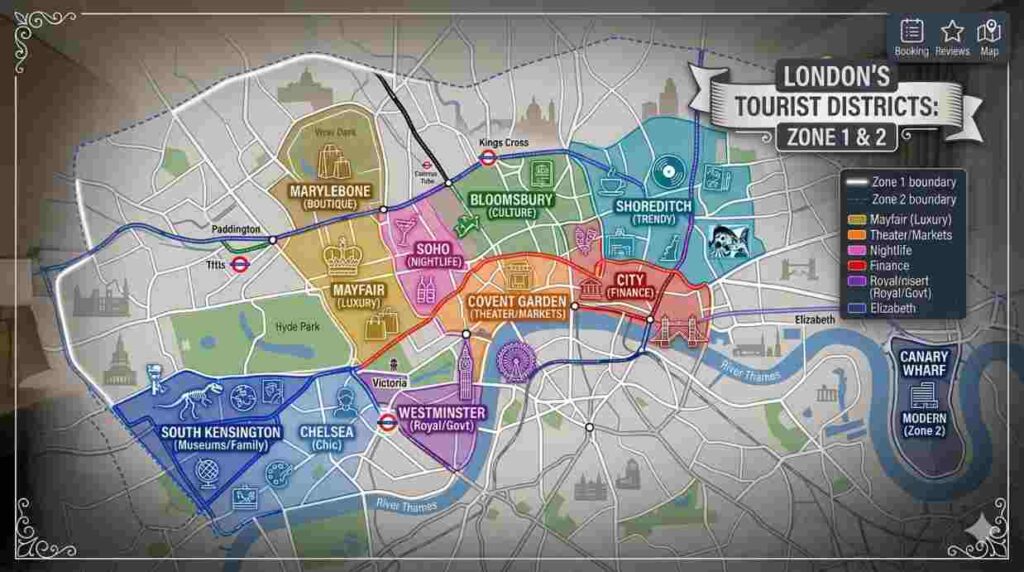
Finding the right stay takes a systematic approach. Here’s a four-step framework to narrow down the 1,600-plus properties in the city.
Step 1: Identify Your “Anchor” Attractions
Decide what you actually want to see most. First-timers tend to do well focusing on the South Bank (London Eye, Big Ben) or Westminster. If museums and culture are the draw, Bloomsbury (British Museum) or South Kensington (the V&A, the Natural History Museum) make more sense. If you’re after London’s creative, trend-driven side, look toward Shoreditch or Hackney instead.
Step 2: Understand London’s Travel Zones
London splits into travel zones that directly affect both price and convenience. Zone 1 sits at the heart of the city, most expensive, but most walkable. Zone 2 offers better value, in neighborhoods like Paddington, Islington, and Shepherd’s Bush. For short stays under four days, we’d generally steer you away from Zone 3 and beyond, unless your hotel sits right next to a major Elizabeth Line station.
Step 3: Match the Hotel Type to Your Trip
If budget genuinely isn’t a constraint, The Ritz, Claridge’s, or The Savoy deliver the classic London experience. Travelers who want a more design-forward, contemporary stay tend to gravitate toward The Hoxton or CitizenM. Families needing real space are often better served by properties like Park Plaza Westminster Bridge or Taj 51 Buckingham Gate, both of which offer larger rooms than London’s notoriously compact standard.
Step 4: Verify Real Transit Connectivity Before You Book
Use a map tool to check the actual walking distance to the nearest Tube station before you commit. A “15-minute walk” reads very differently in the rain with luggage than it does on a map.
Checklist for the Smart London Traveler
Before you book, confirm your chosen hotel meets these standards:
- [ ] Air conditioning. Not every historic London hotel has it, and London’s summers have been running hotter. This has become a genuine “must,” not a nice-to-have.
- [ ] Elizabeth Line access. Proximity to a station on this line (Paddington, Tottenham Court Road, Liverpool Street) can meaningfully cut your transit time from Heathrow.
- [ ] A working lift. Many boutique hotels in converted Georgian townhouses, especially in Bloomsbury, only have stairs. This is worth checking if that matters for your luggage or mobility.
- [ ] Genuinely fast, complimentary Wi-Fi. Some older luxury properties still charge extra for it.
- [ ] Clarity on breakfast inclusion. A “Full English” ordered separately can run £25 or more per person. This is worth knowing whether it’s bundled into your rate.
London’s Top Hotels by Category
| Hotel Name | Neighborhood | Category | Avg. Price (Night) | Best For |
|---|---|---|---|---|
| Claridge’s | Mayfair | Ultra-Luxury | £950+ | A classic, formal London stay |
| The Savoy | Strand/Covent Garden | Classic Luxury | £700+ | History and river views |
| Park Plaza Westminster Bridge | South Bank | Mid-Range | £210+ | Families and sightseeing |
| The Hoxton | Shoreditch | Trendy/Boutique | £190+ | Solo travelers and business trips |
| The Resident | Covent Garden | Value-Luxury | £180+ | Self-catering with a central location |
| CitizenM | Tower of London | Budget-Chic | £140+ | Tech-forward solo travelers |
| Premier Inn County Hall | Waterloo | Budget | £95+ | Reliable, predictable savings |
Pricing shifts seasonally and by booking window — treat these as a general starting range rather than a locked-in quote, and always confirm current rates directly before booking.
A Closer Look by Area
The Luxury “Golden Triangle” (Mayfair, St. James, Knightsbridge)
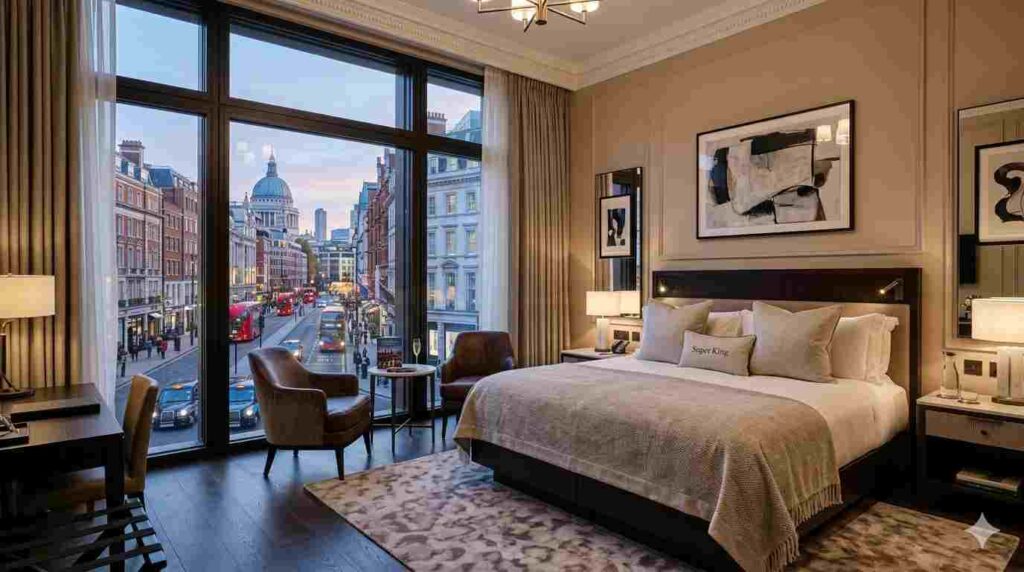
For travelers where budget is genuinely secondary, this cluster of neighborhoods delivers the quintessential London experience. The Ritz on Piccadilly remains the gold standard for formal British service, known for its afternoon tea and Louis XVI-style decor. Newer entrants like The Chancery Rosewood in Mayfair, (housed in the former US Embassy building) blend mid-century architecture with contemporary luxury.
The Family-Friendly Hub (South Bank & Westminster)
Families generally need space more than glamour. Taj 51 Buckingham Gate offers multi-bedroom residences with full kitchens, while Park Plaza County Hall’s “Studio Rooms” sleep four comfortably. This is a genuine rarity in a city where standard rooms run small.
The “Cool” Quotient (East London & Shoreditch)
If craft coffee and street art matter more to you than doormen in top hats, East London delivers. One Hundred Shoreditch, for instance, pairs a rooftop bar with panoramic views and a design aesthetic built around low platform beds and neutral tones.
Tips for Booking a London Hotel in 2026
Consider the business district on weekends. Hotels in The City (the Square Mile) or Canary Wharf often drop prices meaningfully on Friday and Saturday nights once the weekday business crowd clears out.
Look for a kitchenette. Brands like The Resident and Locke Hotels include mini-kitchen, a microwave, a sink, sometimes a Nespresso machine, This can save real money on breakfast and snacks over a multi-night stay.
Check for direct-booking perks. Many London hotels now offer “book direct” incentives like free late check-out or a small food credit, specifically to bypass fees from third-party booking platforms.
Common Mistakes to Avoid
Ignoring the service charge. Some high-end hotels add a discretionary service charge, commonly around 5%, on top of the listed room rate. Check the fine print before you assume the quoted price is final.
Assuming “King Size” means the same thing everywhere. A UK King bed runs smaller than a US King. If space matters to you, look specifically for “Super King.”
Over-relying on buses. They’re scenic, but London traffic can be brutal. The Tube, or the Uber Boat river service along the Thames, is often faster and more reliable for getting around as a tourist.
Frequently Asked Questions
What’s the best area for a first-time visitor? Covent Garden or the South Bank put you within walking distance of a large share of London’s major sites, including the National Gallery, the London Eye, and the West End theater district.
How much should I budget for a decent hotel? For a clean, well-located 3- or 4-star hotel, budget somewhere around £160–£200 per night. Going under £100 generally means staying farther out or opting for a hostel instead.
Is it better to stay near Heathrow? Only really worth it for a very early flight. Otherwise, staying in the city makes more sense — the Elizabeth Line makes the commute fast enough (around 35 minutes to central London) that an airport hotel isn’t necessary for most trips.
Making Your Choice
Choosing among London’s best hotels for your 2026 trip isn’t really about chasing the highest star rating. It’s about alignment. If history is what draws you, the Strand fits. If you want to wake up within sight of Big Ben, the South Bank delivers that.
Prioritize proximity to the Tube, check for modern essentials like air conditioning, and match the neighborhood to how you actually plan to spend your days. A simple hotel room becomes a genuinely strategic base for exploring one of the world’s most rewarding cities to get lost in.