
































Introduction: Why “Temporary” Isn’t a Strategy Anymore
At Every Moment Travels, we talk to a lot of skilled professionals who assume a student visa or a short-term work permit is a reasonable first step toward eventually settling abroad. Increasingly, it isn’t. Across the major destination countries, governments are tightening caps on temporary visas and international student numbers, while at the same time expanding direct pathways to permanent residency for skilled workers. The two trends are connected: countries facing aging workforces and labor shortages are choosing to select fewer temporary migrants and more permanent ones, aiming squarely at professionals with the qualifications, language skills, and work experience to contribute long-term.
That shift matters for how you plan. Treating a temporary work permit or a study visa as a loose “bridge” to something more permanent is a riskier strategy than it used to be — processing backlogs, policy changes, and years spent in temporary status without a clear route forward are a real possibility. If you’re a professional with a university degree, in-demand technical expertise, or a licensed trade, it’s usually worth looking directly at permanent residency pathways rather than assuming a temporary permit will eventually convert into one.
This guide walks through how the leading skilled migration systems — Canada, Australia, Germany, and New Zealand — actually work, step by step, along with the documentation you’ll need and the mistakes that most often derail an application.
Choosing Your Pathway: Category-Based vs. Points-Tested Immigration
Most skilled migration systems sort applicants into one of two broad approaches.
Category-based pathways are built around specific occupations facing labor shortages — commonly healthcare, technology, engineering, construction, and skilled trades. If your occupation is in demand, these pathways often mean faster invitations and less competition.
Standard points-tested pathways assess a broader range of applicants on age, education, work experience, and language ability, with competition based on your overall ranking.
| Category-Based Immigration | Standard Points-Tested Immigration |
|---|---|
| Built for occupations facing labor shortages | Built for a broad range of skilled professionals |
| Prioritizes healthcare, tech, engineering, construction, trades | Scores age, education, experience, and language |
| Faster invitations, less competition for in-demand roles | Competition based on overall ranking |
| Occupation demand drives selection | Your whole profile determines competitiveness |
Examples of category-based programs: Canada’s Express Entry category-based selection draws, Germany’s Opportunity Card (Chancenkarte) for shortage occupations, Ireland’s Critical Skills Employment Permit, Portugal’s Highly Qualified Activities Visa, and the Netherlands’ Highly Skilled Migrant Program.
Examples of standard points-tested programs: Australia’s Skilled Independent Visa (Subclass 189) and Skilled Nominated Visa (Subclass 190), New Zealand’s Skilled Migrant Category, Canada’s general Express Entry pool, and Sweden’s skilled worker pathways.
If your occupation appears on a country’s shortage list — nursing, software engineering, cybersecurity, or a licensed trade like electrical work or welding, for example — it’s usually worth prioritizing the category-based route first, since it tends to move faster with less competition. Roles like accounting, business analysis, marketing, or general administration are more likely to go through the standard points-tested route.
Canada: The Express Entry and Provincial Nominee Systems
Canada remains one of the most active destinations for skilled migration, though its targets have shifted to balance economic growth against domestic infrastructure pressure. Under the government’s official 2026–2028 Immigration Levels Plan, Canada is holding its permanent resident admission target at 380,000 annually while increasing the share of economic-class migrants from 59% to 64% by 2027 — even as it sharply reduces intake of temporary students and workers. In practice, that means the door for skilled economic applicants is opening wider even as temporary routes narrow.
The system runs through Express Entry, a digital application platform that manages three federal programs: the Federal Skilled Worker Program, the Federal Skilled Trades Program, and the Canadian Experience Class.
Step by step
- Get your language and education credentials sorted. Take an approved language exam — IELTS General Training or CELPIP for English, TEF or TCF for French — and get an Educational Credential Assessment (through a body like World Education Services) to confirm your foreign degree aligns with Canadian standards.
- Identify your NOC TEER category. Canada classifies occupations under a Training, Education, Experience, and Responsibilities matrix. Skilled applicants typically need to fall within TEER 0 through 3.
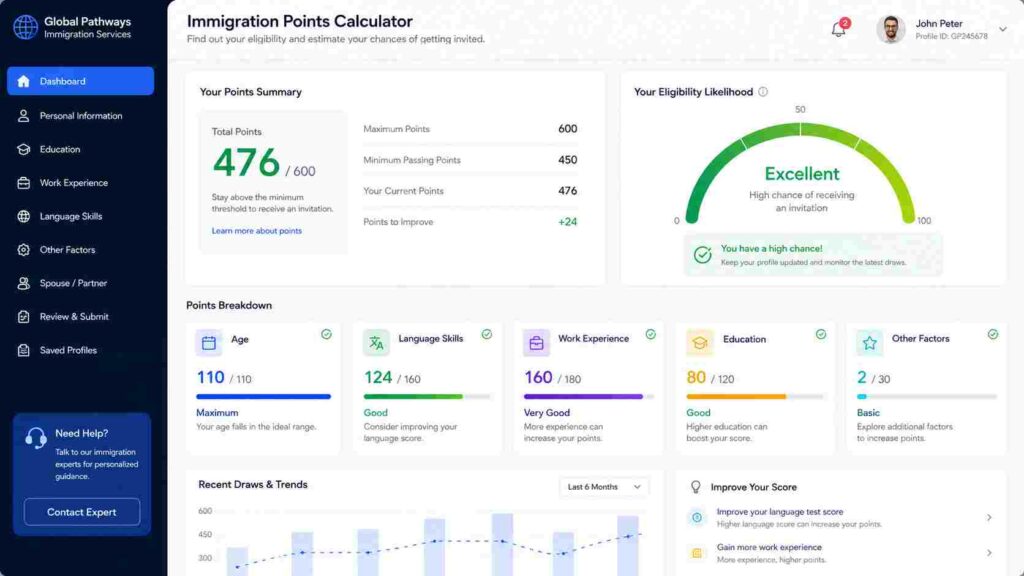
- Calculate your Comprehensive Ranking System (CRS) score. Submit an Expression of Interest into the Express Entry pool. The system scores you out of 1,200 points based on age, education, language ability, work experience, and adaptability factors.
- Look at category-based draws and Provincial Nominee Programs. IRCC has been prioritizing category-based draws — healthcare, STEM, skilled trades, transport, agriculture, and strong French-language ability all currently qualify — which can mean an invitation well below the general CRS cutoff. A Provincial Nomination, if you can secure one, adds 600 points to your profile and effectively guarantees an invitation.
- Receive your Invitation to Apply and submit. Once drawn from the pool, you have 60 days to submit a complete application with police clearance certificates, medical exams, and proof of settlement funds.
Australia: The General Skilled Migration Framework
Australia runs a competitive, points-tested system managed through SkillSelect, aimed at selecting migrants who address specific labor shortages and support long-term productivity.
Three main visa pathways cover most skilled applicants: the Skilled Independent Visa (Subclass 189), which is non-sponsored and lets you live anywhere in the country; the Skilled Nominated Visa (Subclass 190), which requires state nomination and a two-year commitment to that state; and the Employer Nomination Scheme (Subclass 186), which requires formal sponsorship from an accredited employer.
Step by step
- Pass a mandatory skills assessment. Unlike some countries, Australia requires formal verification of your skills before you can even enter the pool — through the assessing authority for your occupation (the Australian Computer Society for software engineers, Engineers Australia for engineers, and so on).
- Sit an approved English test. IELTS or PTE Academic. Reaching “Proficient” (roughly IELTS 7) or “Superior” (roughly IELTS 8) adds meaningful bonus points to your score.
- Lodge an Expression of Interest via SkillSelect. You need a minimum of 65 points to be eligible, though in practice competitive scores in popular occupations run well above that.
- Track state nomination criteria if pursuing a 190 visa. Each state runs its own migration portal with different priority sectors and application windows.
- Respond to your invitation. File your full application with the Department of Home Affairs within 60 days, including biographical, medical, character, and professional documentation.
Germany: The Skilled Immigration Act and Opportunity Card
Germany has substantially rewritten its immigration rules to attract non-EU skilled professionals, driven largely by demographic pressure on its workforce. Two main routes lead to settlement:
The EU Blue Card (Blaue Karte EU) is the faster route for university graduates and IT professionals with a concrete, qualifying job offer. The Opportunity Card (Chancenkarte) is a points-tested route that lets skilled professionals relocate for up to a year to find qualifying employment.
Step by step
- Get your qualification recognized. University degrees are checked against the ZAB’s Anabin database; degrees rated highly are automatically recognized. Regulated professions (doctors, teachers, engineers) require a separate formal recognition process.
- Secure a job offer or enter via the Chancenkarte. With a recognized degree and a qualifying salary offer, you can apply directly for the Blue Card. Without a job offer, the Chancenkarte scores you on language skills, age, qualifications, and ties to Germany, and grants a visa to search for work locally.
- Move toward permanent settlement. Germany doesn’t grant permanent residency on arrival, but the Blue Card offers one of the fastest tracks to it of any major destination: current rules put permanent settlement (Niederlassungserlaubnis) within reach after roughly 21 months with German at the B1/B2 level, or around 33 months without meeting that language threshold. Standard skilled workers outside the Blue Card track generally face a longer runway. These timelines shift periodically with immigration law reforms, so it’s worth confirming the current figures directly with Germany’s Federal Office for Migration and Refugees (BAMF) before you plan around them.
New Zealand: The Skilled Migrant Category
New Zealand’s Skilled Migrant Category (SMC) Resident Visa runs on a transparent points system rather than a competitive ranking — if you clear the threshold and have a qualifying job offer, you’re generally drawn from the pool.
Step by step
- Secure an accredited job offer. This is a hard requirement — a current job offer from an Immigration New Zealand accredited employer, generally paying at least the median wage.
- Reach the required point threshold. Points come from your strongest qualifying category: professional registration, an advanced degree (a bachelor’s typically scores lower than a postgraduate or doctoral qualification), or a sufficiently high income relative to the median wage. If your top category doesn’t clear the threshold on its own, verified skilled work experience in New Zealand can help close the gap, up to a capped amount.
- Submit your Expression of Interest. Because the system isn’t a competitive ranking, a genuinely qualifying profile is generally drawn automatically.
- Complete verification. Biometric, medical, and character checks follow, along with an audit of both your employer’s standing and your employment history.
The Universal Document Checklist
Every system has its own quirks, but the core documentation required is broadly consistent. Missing any of these is one of the most common reasons applications stall.
- [ ] Identity documents — passport valid well beyond your planned entry date, birth certificate, and documentation for any legal name changes.
- [ ] Language test results — an original test report (IELTS, PTE, CELPIP, TEF, or TCF), taken within the validity window your target country requires (commonly 2 years).
- [ ] Academic credentials — original diplomas and transcripts, plus a completed Educational Credential Assessment or equivalent recognition.
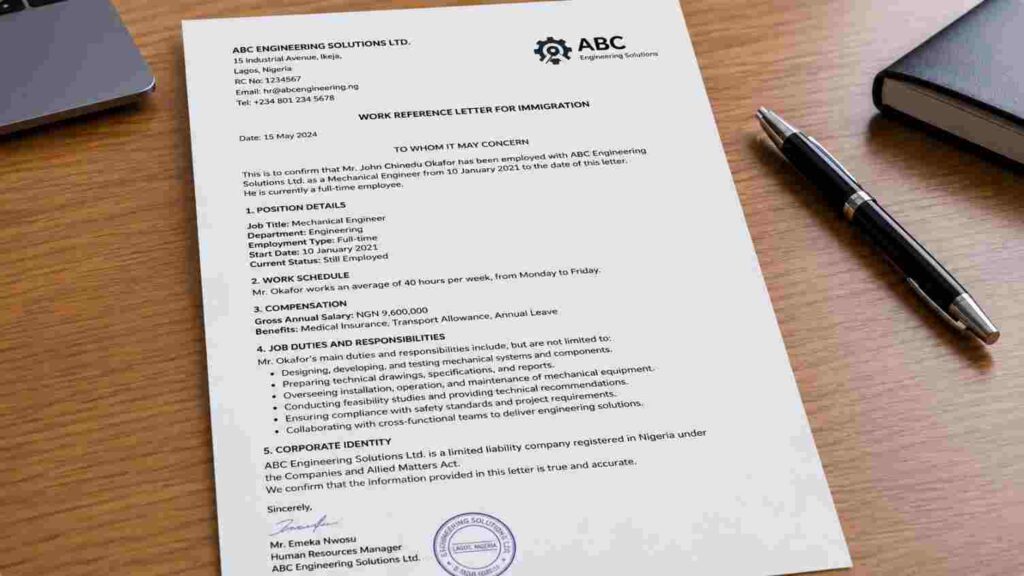
- [ ] Employment verification — formal reference letters on company letterhead stating your exact dates, title, hours, and duties, backed by tax records, pension statements, or bank statements showing consistent salary.
- [ ] Police clearance and medical exams — clearance certificates from your home country and everywhere you’ve lived for six months or more in the last decade, plus a medical exam from an approved panel physician.
- [ ] Proof of settlement funds — bank certification of liquid, unencumbered funds meeting your destination’s threshold for your household size.
Comparing the Major Pathways
| Canada (Express Entry) | Australia (GSM) | Germany (Blue Card / Opportunity Card) | New Zealand (SMC) | |
|---|---|---|---|---|
| Main routes | Federal Skilled Worker, category draws, PNPs | Subclass 189, 190 | Blue Card, Opportunity Card | SMC Resident Visa |
| How it’s assessed | CRS ranking pool + category selection | SkillSelect ranking + state nomination | Direct job offer, or points-tested job search | Fixed point threshold (non-ranking) |
| Job offer required? | No, but adds points | No, but helps for state nomination | Yes for Blue Card; no for Chancenkarte | Yes — a hard requirement |
| Typical processing | ~5–8 months from invitation | ~6–11 months from invitation | 1–3 months once matched with an employer | ~4–7 months |
| Language baseline | CLB 7–9 competitive | Proficient/Superior English | No fixed English requirement; German helps speed to PR | IELTS ~6.5 overall |
| Path to permanence | Immediate on landing | Immediate on landing | Deferred — roughly 21–33+ months on Blue Card | Immediate on approval |
| Pre-assessment required | Yes (education + occupation code) | Yes (formal skills assessment) | Yes (education recognition; licensing board if regulated) | Yes (qualification checks) |
Figures above are current as of 2026 and change periodically with policy updates — always confirm current thresholds directly with the relevant immigration authority before applying.
Getting the Most Out of Your Application
If you’re applying with a partner, run the numbers both ways. A common mistake is defaulting to whichever partner earns more as the principal applicant — but most points systems don’t weigh current salary directly. If your partner has stronger academic credentials or a better language score, it’s often worth designating them as the principal applicant instead, even if their income is lower.
Consider regional pathways. Applicants who focus only on major cities — Toronto, Vancouver, Sydney, Melbourne — run into steep competition. Regional programs, like Canada’s Atlantic Immigration Program or state-based regional nomination streams in Australia, often carry lower thresholds and target in-demand occupations directly.
If your language skills give you an edge, use it. In Canada specifically, French-language ability has become a meaningful advantage — category-based draws have at times accepted CRS scores meaningfully lower than general draws for candidates with strong French. If you’re close to a threshold, investing in a language certification can be worth more than waiting for a job offer.
Common Mistakes That Cause Rejections
Writing a reference letter that reads like a resume. Immigration officers don’t care about your job title or your achievements — they need proof that your actual day-to-day duties match an official occupation code. A letter that says “led cross-functional teams” or “exceeded targets” doesn’t help; a letter that names your employer, your exact hours, and a detailed list of duties does.
| Standard Resume | Immigration Reference Letter |
|---|---|
| Highlights achievements | Documents verifiable job duties |
| “Exceeded targets by 40%” | States exact dates, hours, and title |
| Written to impress a hiring manager | Written to satisfy an immigration officer |
| Can vary by application | Must match your actual employment record |
A strong letter needs the company’s legal name and contact details, your exact start and end dates, weekly hours, salary, a detailed list of duties, and a signature from a supervisor or HR contact on letterhead. Officers generally want your listed duties to closely match — often 70-80% or more — the official description for your occupation code.
Not documenting where a large sum of money came from. If you need to show settlement funds and a large deposit shows up in your account shortly before you apply with no clear paper trail — no asset sale, inheritance, or documented gift — it can read as a temporary loan meant to inflate your balance, and that’s grounds for rejection.
Miscounting your eligible work experience. You generally can’t count experience earned during a degree that’s itself required for the occupation, and unemployment gaps or undocumented freelance work need to be excluded from your tally, not rounded up. Overstating your experience even slightly counts as misrepresentation and can trigger a multi-year ban.
Letting a language or education credential expire. Most language test results are valid for two years for immigration purposes, regardless of what the testing body itself lists. If your certificate or Educational Credential Assessment expires while your application is pending, it can be treated as incomplete.
Frequently Asked Questions
Can I apply without a job offer? Yes, for some systems. Canada’s Federal Skilled Worker stream and Australia’s Skilled Independent Visa (189) don’t require one — they assess your standalone profile on age, language, education, and experience. A job offer still adds bonus points where allowed. New Zealand’s system is the exception: a qualifying job offer is mandatory.
How has the shift away from temporary visas affected these pathways? It’s made permanent pathways more structured but not necessarily harder for genuinely qualified applicants. Canada, for instance, is reducing its temporary resident population toward 5% of the total population while holding permanent economic admissions steady — meaning the squeeze is falling mainly on casual student and low-wage temporary routes, not on skilled permanent streams.
What’s the difference between a “Resident Visa” and a “Permanent Resident Visa” in New Zealand? When you first clear the Skilled Migrant Category, you receive a Resident Visa, which lets you live, work, and study indefinitely but comes with travel restrictions for the first two years. After two years of residence, you can transition to a Permanent Resident Visa with unrestricted travel rights.
Does age affect my points score? Yes, in most points-tested systems. Canada’s CRS system generally favors applicants in their 20s, with points declining after 30 and reaching zero around 45. Australia’s system follows a similar curve. If you’re applying later in your career, strong language scores, an advanced degree, or a job offer can offset the age penalty.
Can I claim points for freelance or self-employed work? Generally yes, but expect more scrutiny. You’ll need business registration documents, tax returns showing business income, bank statements showing client payments, signed contracts, and reference letters from clients — a personal statement alone usually isn’t enough.
Conclusion
Permanent residency through a skilled pathway is a genuinely achievable goal for qualified professionals, but it rewards careful preparation. Start with your language test and education assessment early, make sure your employment documentation actually matches the occupation code you’re applying under, and choose your destination based on a realistic read of your own competitiveness rather than which country sounds most appealing. The process takes real effort, but it’s a predictable one when you know what each system is actually looking for.