
































If you’ve typed “legitimate immigration agencies for Nigerians” into Google at midnight, you’re not being paranoid. You’re just being smart. This is one of the most scammed corners of the internet, and the people running those scams know exactly how to sound like the real thing. As someone who spends my days helping people navigate the study-abroad and relocation process, I get asked almost every week: “Is this agency real? Should I pay them?”
So let’s deal with this honestly, because the honest answer isn’t what most “Top 10 Agencies” listicles will tell you.
Let’s Start With the Truth Nobody Tells You
There is no government body (not in Nigeria, not in any European country) that certifies or “approves” private relocation and immigration companies. No official registry exists that you can check to confirm an immigration agency is legitimate. That gap is exactly what fraudulent operators exploit, and it’s why you’ll find dozens of websites confidently ranking themselves as the “#1 legit agency in Nigeria.” A company writing its own review of itself isn’t proof of anything — it’s marketing.
This doesn’t mean every agency is a scam. It means legitimacy has to be verified by you, case by case, using the checklist further down — not assumed because a website looks professional or a Google ad promises fast results.
The Real Numbers Behind the Panic
For the full Schengen-visa-requirements-Nigeria, read “our full Schengen visa requirements guide”
Here’s why so many Nigerians feel pressured to hand money to a stranger promising a shortcut: according to European Commission data, Nigeria’s Schengen visa rejection rate hit 45.9% in 2024, up from around 40% the year before — the highest on record. Out of 111,201 applications filed that year, over 50,376 were refused, and because visa fees are non-refundable, Nigerians collectively lost more than €4.5 million just on applications that never succeeded.
That kind of pressure is exactly what pushes desperate applicants toward anyone who promises to remove the uncertainty. It’s also exactly what scammers are counting on. The Nigeria Immigration Service has publicly warned about a rise in fraudulent migration schemes, and immigration authorities in the UK, Canada, and Australia jointly launched a #FightingVisaFraud campaign specifically because Nigerians were being targeted at scale.
One thing worth holding onto: the National Association of Nigerian Travel Agencies has pointed out that consistent, well-documented finances matter far more to a visa officer than a single large bank balance dropped in right before applying. Credibility on paper beats a lucky number.
First, Get This Straight: A Schengen Visa Cannot Relocate You
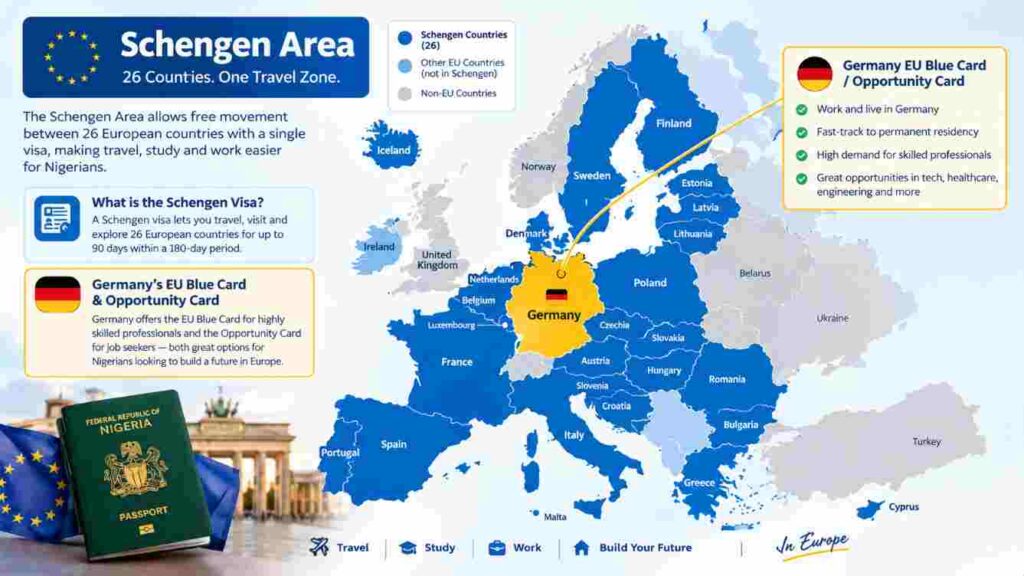
This single misunderstanding fuels a huge share of the scams out there. A Schengen visa is a short-stay visa — it lets you visit any of the Schengen countries for up to 90 days. It was never designed for relocation, and no agent can turn it into one.
Actual relocation requires a National Visa (Type D), issued by the specific country you intend to live in. For work, study, family reunification, or another qualifying route. Once you arrive on a Type D visa, you convert it into a residence permit. If anyone offers to get you a “Schengen visa to relocate,” that sentence alone tells you they either don’t understand the system or are counting on you not knowing better. This alone disqualifies such an agency from being legitimate.
Red Flags That Should Make You Close the Chat
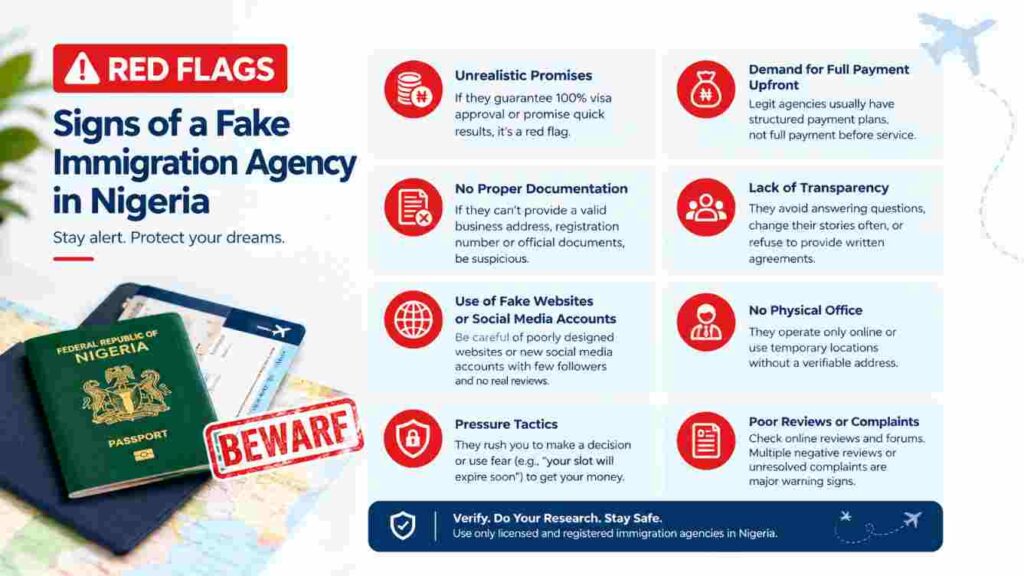
- “Guaranteed” approval. No agent, consultant, or lawyer can guarantee a visa decision — that power belongs entirely to the consulate or immigration authority.
- Claims of “connections” inside the embassy. No legitimate third party can influence a consular decision. This claim exists purely to justify a higher fee.
- Payment into a personal bank account instead of a registered corporate account.
- No physical office, no verifiable past clients you can actually speak to.
- Vague job or school offers that can’t be checked against the official website of the employer or institution.
- Pressure to pay quickly, “before the slots close,” or via crypto.
- Self-published “Top 10” or “Best Agency” rankings where the publisher conveniently ranks itself first.
What We Actually Check Before Trusting Any Agency
This is the filter worth running before you send a single naira:
- CAC registration — is the business actually registered in Nigeria, and does the registered name match what’s on their marketing materials?
- Named, checkable staff — for anything involving legal advice abroad, is there a licensed immigration lawyer whose registration you can verify on that country’s bar or law society register?
- Independent reviews — not testimonials on their own site, but reviews on Google, Trustpilot, or genuine discussion on forums like Nairaland’s travel section.
- A corporate account and a proper invoice or contract — not a personal transfer request.
- Clear, honest language about risk — a legitimate consultant will tell you upfront that outcomes aren’t guaranteed, not sell you certainty.
- A physical, verifiable office address.
If an agency fails more than one of these, that’s your answer.
Legal Routes That Don’t Need a Middleman At All
Some of the most reliable paths into Europe don’t require paying a private company anything:
- VFS Global — the official outsourced visa application centre used by many Schengen consulates in Nigeria for biometrics and document submission. This is a government-authorised service, not a private “connection.”
- The embassy or consulate website of your target country — always the primary, authoritative source for requirements. If an agent’s advice contradicts the embassy’s own site, trust the embassy.
- IOM Nigeria (International Organization for Migration) — runs legal labour migration and counter-trafficking support programmes.
- Germany’s skilled-worker pathways — genuinely worth knowing about if you’re skilled or qualified. As of June 2026, Germany eliminated general guest-worker residence permits for new applicants and shifted its focus almost entirely toward two legal routes:
- The EU Blue Card, for graduates with a qualifying job offer. 2026 salary thresholds are €50,700/year gross for general professions, €45,934.20/year for shortage occupations (IT, engineering, healthcare, construction), and €55,770/year for applicants over 45.
- The Opportunity Card (Chancenkarte), a points-based visa that lets you enter Germany for up to 12 months to search for work without a job offer first, based on qualifications, language ability, work experience, and age. You’ll need to show proof of funds (around €1,091/month for 2026) and can work part-time while job-hunting.
None of this requires a “connection.” It requires paperwork, patience, and honesty about your qualifications.
What “Genuine Results” Actually Looks Like
Since you specifically asked about companies with “confirmed results” — here’s the honest standard to hold anyone to. A track record you can actually verify looks like: named attorneys with public, checkable credentials; a real base of independent reviews spanning years, not weeks; and specific, attributable outcomes rather than vague percentages published on the company’s own blog.
One example that surfaces with that kind of checkable detail is Movingto, which works primarily on Portugal and Spain visa cases through named immigration attorneys — one Nigerian client’s testimonial describes securing a Portugal D8 visa roughly 60 working days after a previous Schengen refusal. I’m not endorsing them, and you should do your own diligence — but that’s the type of evidence (named professionals, dated outcomes, independently post able reviews) that separates a real track record from a marketing claim. Compare that to agencies publishing their own “94% success rate” with no independent source behind it, and the difference becomes obvious.
Your Pre-Payment Checklist For legitimate Immigration Agencies For Nigerians
Save this before you pay anyone:
- Confirm the company’s CAC registration matches their business name.
- Ask for the name and license/registration number of anyone advising you on legal matters abroad, Proceed to verify it independently.
- Search “company name + reviews” and “company name + scam” before paying anything.
- Insist on a written contract and an invoice from a corporate account.
- Cross-check every requirement they quote you against the embassy’s official website.
- Never pay for a government program that is officially free (the US DV Lottery is a well-known example).
- Walk away from anyone who guarantees an outcome.
Where This Leaves You

None of this means you need to go it alone. It means the agency you work with should welcome this level of scrutiny, not resist it. “See how we work with Study Abroad applicants” — if your path into Europe runs through a scholarship or admission (which, for a lot of people, is the most realistic and legal route of all), that’s the exact problem we spend our days helping people solve, honestly and without shortcuts that don’t exist.
FAQ
Can I use a Schengen visa to relocate to Europe?
No. A Schengen visa only permits short stays of up to 90 days. Relocation requires a National Visa (Type D) issued by the specific country you’re moving to.
How much should legitimate immigration help actually cost?
It varies by service and country, but pricing should always be transparent, itemized, and tied to a written contract. It should never be a lump-sum “connection fee” with no breakdown.
Are all Nigerian travel or relocation agencies scams?
No — but there’s no official list separating the genuine ones from the fraudulent ones, so the burden of verification falls on you. Use the checklist above for every agency, no matter how professional their website looks.
What’s the safest way to move to Europe from Nigeria in 2026?
Routes tied to a verifiable qualification — a scholarship, an accredited degree programme, a skilled-worker visa like Germany’s EU Blue Card, or a confirmed job offer — carry far less risk than any route sold as a “shortcut.”
Do I need to hire an agent at all?
Not always. Many steps — VFS Global appointments, direct embassy applications, IOM programmes — can be done yourself. An agent adds value when they save you time or catch errors, not when they claim to bypass the system.
A note on this article: This is a general information, not legal advice. Immigration rules change often — always confirm current requirements directly with the relevant embassy, consulate, or official government portal before making decisions. If something here is out of date, please “reach us” and we’ll correct it.
Written by Nneoma Ogbureke, Founder, Every Moment Travels And Tours. Last updated October 2026.
Sources referenced:
- Nigeria Immigration Service public statement on fraudulent migration schemes (via Nairametrics, May 2026)
- European Commission Schengen visa statistics for Nigeria (via TechCabal, 2025)
- #FightingVisaFraud campaign coverage (The Guardian Nigeria)
- Germany Federal Foreign Office / Skilled Immigration Act updates for 2026 (via iamexpat.nl, feather-insurance.com)
- National Association of Nigerian Travel Agencies (NANTA) public guidance