


































By Nneoma Ogbureke, Study Abroad Consultant at Every Moment Travels And Tours | Updated November 2026
Let me guess, you are confuse with how to write a winning scholarship essay. You’ve found a scholarship that could change your life, the deadline is closer than you’d like, and you’re staring at a blank page wondering how on earth to start.
I’ve been there, and so have most of the students I talk to. I remember one of the recent students we reviewed her scholarship’s essay. She was confused and did not know how and where to start with her scholarship essay. So, relax, you are not alone.
So here’s what I want you to know before we start: learning how to write a winning scholarship essay isn’t about big words or a perfect life story. It’s about being clear, honest, and specific, and showing a committee that you’re worth betting on. That’s a skill, and skills can be learned.
Let’s walk through it together, one step at a time.
Quick Takeaways Of How To Write a Winning Scholarship Essay
- Answer the exact question the scholarship asks, not the one you wish it asked.
- Choose one specific story and let it carry your essay.
- Show how your goals connect to this scholarship’s mission.
- Write in your own voice. Committees are increasingly alert to generic and AI-written essays.
- Edit twice, read it aloud once, and proofread before you submit.
What Are Scholarship Committees Really Looking For?
Before you write a single line, it helps to know who’s reading. Committees often go through hundreds of essays, so yours needs to be easy to follow and hard to forget.
Across the recent guides and advice I reviewed for this update, the same four qualities keep showing up:
- Authenticity: your real experiences, in your real voice.
- Clarity: a clear point, without padding.
- Fit: evidence that you match what the scholarship stands for.
- Purpose: a believable plan for what you’ll do with the opportunity.
One more thing has changed lately, and it matters. A ScholarshipOwl survey of more than 12,000 students found that about one in five (21%) admitted using AI to write college or scholarship application essays. Scholarships360 also ran an AI detector on 986 submissions to one of its own scholarships and found that roughly 42% looked largely AI-built. Committees know this is happening, and many now screen for it. We’ll come back to this in a moment.
Step 1: Read the Prompt Twice (Then Read the Rules)
This sounds obvious, but it’s where many strong students slip. A prompt that says “Tell us about a challenge you overcame” is rarely just asking for a sad story. The committee usually wants to see how you think, how you grow, and what you do next.
Try this: rewrite the prompt in your own words as a single question. For example, “Describe a time you showed leadership” might really mean, “Can this person take initiative and bring others along?”
Then check the practical details:
- Word or character limit
- Formatting rules
- Deadline and time zone
- Whether the provider has a policy on AI tools
Going over the word limit can cost you before anyone reads a word, so treat the rules seriously.
Step 2: Research the Scholarship Before You Write
Every scholarship exists for a reason. Someone, somewhere, decided to fund a certain kind of student. Your job is to figure out what kind.
Spend 20 minutes on the provider’s website. Look at the following:
- Their mission statement and values
- Past winners, if they’re published
- The wording they use repeatedly (leadership? community? research? service?)
Then weave those values into your story naturally. You’re not copying their website back to them. You’re showing, through real examples, that you already live what they care about.
A quick test I like: if you could swap the scholarship’s name for another one and the essay would still work, it’s too generic. Tailored essays win more often than one-size-fits-all ones.
Step 3: Find Your Story
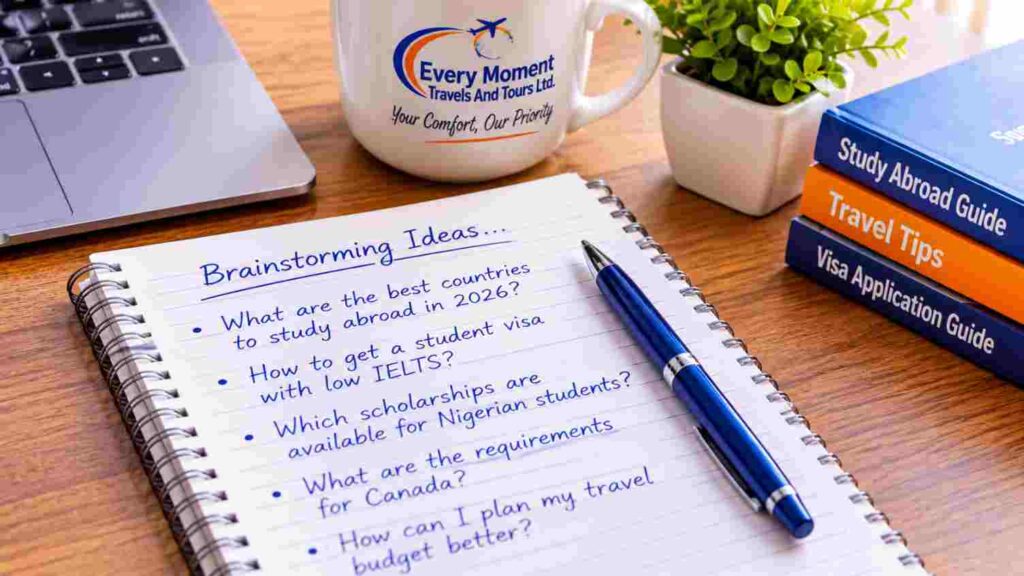
Here’s the part most people skip, and it’s the part that makes the difference. Before you outline anything, take 15 minutes with a notebook and answer these questions honestly:
- What moment changed how I see the world?
- What problem have I actually tried to solve, even a small one?
- What have I done that no one asked me to do?
- What do I want to study, and why does it matter to me?
- What will I do with this scholarship that I can’t do without it?
You’re hunting for something specific. “I’ve always been passionate about helping people” could be written by anyone. “I spent my Saturdays teaching younger kids in my neighbourhood how to use a computer because our school had only two working ones” could only be written by you.
And please don’t think you need a dramatic tragedy. Committees aren’t handing out money for struggle alone. They want to see what you did with your circumstances, and where you’re heading. Our guide on how to win a scholarship to study abroad explains this extensively.
Step 4: Build a Simple Structure
You don’t need anything fancy. A clear shape keeps the reader with you. Here’s a structure that works for most 500 to 650-word essays:
- Opening (about 10%): Start in the middle of a moment. A scene, a question, or a surprising detail works better than “Ever since I was young…”
- The story (about 40%): What happened, what you did, what went wrong or right.
- The lesson or growth (about 20%): What changed in you. Be specific.
- The link to the scholarship (about 20%): Your goals, your plan, and how this scholarship makes it possible.
- Closing (about 10%): Echo your opening and end with a confident look forward.
A quick example
Weak opening: “I am a hardworking student who is passionate about technology and wants to make a difference in the world.”
Stronger opening: “The first computer I ever repaired was my uncle’s, and I broke it twice before I fixed it.”
See the difference? The first could be anyone. The second makes you curious, and it already tells you something about the person’s persistence.
Step 5: Write a Messy First Draft
Give yourself permission to write badly. Set a timer for 30 minutes, put the outline aside, and just tell the story as if you were explaining it to a friend. Don’t edit as you go.
A first draft isn’t supposed to be perfect. It’s supposed to exist. You can’t fix a blank page, but you can fix almost anything once there are words on it.
Step 6: Edit Like You Mean It
Now the real work starts. Go through your draft with these questions:
- Does every paragraph earn its place? If you can delete it and nothing is lost, delete it.
- Am I telling or showing? Swap “I am a good leader” for what you actually did.
- Is it specific? Add names, numbers, places, and details where you can.
- Does it sound like me? Cut any sentence you’d never say out loud.
- Have I answered the prompt? Reread it one more time.
Then read the whole essay aloud. It feels silly, but it’s one of the most reliable tricks I know. Your ear will catch clumsy phrasing, long-winded sentences, and anything that sounds fake.
Step 7: Proofread and Get a Second Pair of Eyes
Typos won’t ruin a great essay, but they can distract from it. Check spelling, punctuation, names (especially the scholarship’s name), and the word count.
If you can, ask a teacher, mentor, or a friend who knows you well to read it. Ask one simple question: “Does this sound like me?” Feedback that helps you sharpen your own voice is gold. Feedback that rewrites you into someone else is not.
A Word on Using AI for Your Scholarship Essay
Let’s talk about it honestly, because I know many of you are tempted.
AI tools can be useful for brainstorming questions or catching grammar slips. But handing your essay over to a chatbot is risky, for three reasons:
- Some providers ban it outright. Chevening, for example, states that using AI to generate answers to its essay questions is strictly prohibited and says it uses tools to detect plagiarism and AI-generated content.
- It sounds like everyone else. Scholarships360’s review of AI-flagged essays found the same limited word choices cropping up again and again. Committees read piles of essays, and generic ones blend together fast.
- It can’t tell your story. It doesn’t know your neighbourhood, your family, or the late nights you spent studying by candlelight. Only you do, and that’s your advantage.
My advice: always check the provider’s AI policy first. Even where tools are allowed, write the story yourself, in your own words. If you’re ever unsure, ask the scholarship office directly.
Common Mistakes That Sink Good Essays
- Reusing one essay for every application without tailoring it
- Listing achievements instead of telling a story
- Clichés such as “I want to change the world” with nothing behind them
- Ignoring the prompt or the word limit
- Vague goals like “I want a better future” without a clear plan
- Over-polished writing that hides your personality
- Leaving it until the last night
Extra Tips for International and Study Abroad Applicants

If English isn’t your first language, or you’re applying to study in another country, a few things are worth remembering:
- Simple, clear English beats fancy English. Committees care about your ideas, not your vocabulary.
- Explain your context. A reader abroad may not know what your school system, community, or opportunities look like. Briefly set the scene without making excuses.
- Connect your home to your plan. Many international scholarships love to see how you’ll use your education to contribute back, whether that’s to your community, your field, or your country.
- Be specific about your course and institution. Say exactly why you chose that programme and that university.
- Start early. Between visas, transcripts, and references, there’s a lot to juggle. From my experience, it is always good to start early. Start at least one year ahead.
If you’re still working out where to apply, my guide on how to win a scholarship to study abroad is a good place to start.
Your Pre-Submission Checklist
Before you hit submit, tick these off:
- I answered the exact prompt.
- I stayed within the word limit.
- My opening grabs attention.
- I shared one specific, real story.
- I connected my goals to this scholarship’s values.
- I read it aloud and it sounds like me.
- I checked spelling, grammar, and the scholarship’s name.
- I followed the provider’s rules on AI and formatting.
- I submitted before the deadline, not at the last minute.
Frequently Asked Questions
How long should a scholarship essay be?
Always follow the limit given. If none is stated, 400 to 650 words is a safe range for most applications. Shorter and sharper usually beats longer and padded.
Can I reuse the same essay for different scholarships?
You can reuse parts, such as your core story, but always tailor the essay to each scholarship’s prompt and values. A generic essay is easy to spot.
When should I start writing?
As early as you can. Give yourself at least two to four weeks for brainstorming, drafting, editing, and feedback. Rushed essays read like rushed essays.
What if I don’t have impressive achievements?
You don’t need a trophy shelf. Committees care about how you’ve used the opportunities you’ve had. Small, real, specific actions often make stronger essays than big, vague titles.
Is it okay to use AI to write my scholarship essay?
It depends on the provider, and some prohibit it entirely. Check the rules first, and write your own story in your own voice either way.
Final Thoughts
Writing a scholarship essay can feel like standing at the bottom of a hill, but you only need to take one step at a time. Understand the prompt, research the scholarship, choose one honest story, and edit until it sounds like you at your clearest.
If you remember just one thing about how to write a winning scholarship essay, let it be this: they’re not looking for the perfect applicant. They’re looking for a real one. Be that person on the page, and you’re already ahead.
If you’d like personal guidance with your study abroad plans, you’re welcome to reach out to us at Every Moment Travels And Tours. And if this guide helped you, share it with a friend who’s applying too.
No article can guarantee a scholarship, and every provider sets its own rules and deadlines, so always confirm details on the official scholarship website.
About the Author
Nneoma Ogbureke is a travel and study abroad consultant with over 7 years of experience guiding international students through scholarship and admission applications at Every Moment Travels And Tours. We have assisted over 50 students in securing admission to international universities across the globe.
Sources Referenced
- ScholarshipOwl student survey on AI use, as reported by Cyprus Mail (July 2026): https://cyprus-mail.com/2026/07/20/how-universities-spot-ai-generated-content
- Scholarships360, “Can I Use AI for Scholarship Essays?”: https://scholarships360.org/scholarships/can-i-use-ai-for-scholarship-essays/
- Chevening AI rules summary (citing Chevening’s own application guidance): https://gradpilot.com/news/chevening-ai-policy-own-work-attestation
- AP Guru, “6 Best Practices for Writing Winning Scholarship Essays for U.S. Colleges in 2026”: https://apguru.com/blog/writing-winning-scholarship-essays
- Empowerly, “How to Write a Winning Scholarship Essay”: https://empowerly.com/applications/write-a-winning-scholarship-essay