































Studying in the United Kingdom remains one of the most popular choices for international students worldwide. With world-class universities, globally recognized degrees, flexible study options, and strong post-study work opportunities, the UK continues to draw thousands of students every year.
At Every Moment Travels, this is one of the destinations we get asked about most. This guide walks through everything you need to know — from choosing a course and meeting entry requirements to securing a UK student visa and working after graduation. Whether you’re a student from Nigeria, Ghana, India, Pakistan, Kenya, or anywhere else, this guide is built to help you plan confidently and avoid the costly mistakes we see repeat most often.
Why Study in the UK?
The UK is home to some of the world’s oldest and most respected institutions, but its appeal goes well beyond tradition.
A world-class education system. UK universities consistently rank among the best globally — Oxford, Cambridge, Imperial College London, UCL, and the University of Edinburgh among them — internationally respected for research excellence and academic rigor. A UK degree carries real weight with employers worldwide.
Shorter degree duration, which saves both time and money. A UK bachelor’s degree runs 3 years against the 4 years common elsewhere, a master’s runs 1 year against 2, and a PhD runs 3–4 years against 5–7. That translates to lower overall tuition costs, faster entry into the job market, and a quicker return on your investment.
A wide range of courses and flexible study options. UK universities offer well over 50,000 courses, spanning academic degrees, professional certifications, foundation programs, and sandwich courses that combine study with a work placement. You can also switch courses early if your interests genuinely change.
Real work rights while studying. International students can work up to 20 hours a week during term time, and full-time during holidays — a genuine help with living costs and a chance to build UK work experience before you graduate.
A multicultural, student-friendly environment. The UK welcomes students from over 200 countries, and cities like London, Manchester, Birmingham, Leeds, and Glasgow are genuinely diverse and student-friendly, with cultural communities, dedicated international student support, faith centers, and student societies.
Real post-study work opportunities through the Graduate Route. After graduation, you can stay and work in the UK for up to 2 years (3 years for PhD graduates) under the Graduate Route Visa — no employer sponsorship required.
Popular Courses for International Students in the UK
Choosing the right course matters as much as choosing the right university.
Business and management remains one of the most popular choices, thanks to strong global employability. Programs like Business Administration, International Business, MBA, Finance & Accounting, Marketing, and Human Resource Management feed directly into banking, consulting, entrepreneurship, and corporate management careers.
Computer science and IT benefits from the UK’s booming tech sector. Computer Science, Artificial Intelligence, Data Science, Cybersecurity, and Software Engineering graduates are genuinely sought after by tech startups, fintech companies, and multinationals alike.
Engineering degrees from UK universities carry real global respect, spanning mechanical, civil, electrical and electronics, automotive, and petroleum engineering — many with industry placements built directly into the program.
Health and life sciences stay in consistently high demand. Nursing, Public Health, Biomedical Science, Pharmacy, and Biotechnology are common paths, though some health programs require additional professional registration beyond the degree itself.
Law degrees from the UK carry prestige worldwide, whether through an LLB or an LLM specializing in international, commercial, or human rights law.
Creative arts and media find a genuine global hub in the UK, with strong programs in Film & Media Studies, Fashion Design, Graphic Design, Fine Arts, and Music Production.
UK Entry Requirements for International Students

Requirements vary by level of study.
For a foundation program, expect to need WAEC, NECO, or O-Levels with a minimum of 5 credits — this route suits students who don’t yet meet direct entry requirements.
For an undergraduate degree, most universities ask for WAEC or NECO with 5–6 credits, with A-Levels or the IB accepted as an optional alternative. Some universities accept direct entry from Nigeria specifically.
For a master’s degree, you’ll need a bachelor’s degree from a recognized university, typically at least a Second Class Lower (2:2) or Upper (2:1), depending on the specific course.
For a PhD, you’ll need a master’s degree, a research proposal, and academic references.
Beyond these, most applications also require academic transcripts, academic references, a personal statement, a CV (for postgraduate courses), and a portfolio for creative programs.
IELTS Requirements for UK Universities
English proficiency is mandatory unless you qualify for an exemption. As a general guide: foundation programs ask for 4.0–5.0, undergraduate programs 6.0–6.5, postgraduate programs 6.5–7.0, and medical or law programs 7.0 or above.
Alongside IELTS, UK universities also accept WAEC English for some Nigerian applicants, PTE Academic, TOEFL iBT, and the Duolingo English Test. Always confirm the accepted alternatives directly with your chosen university, since policies vary.
Some UK universities waive IELTS entirely for Nigerian applicants who scored C6 or above in WAEC English, or who previously studied in English — worth checking before you commit to sitting the full test.
Tuition Fees and Cost of Living in the UK
Annual tuition runs roughly £8,000–£15,000 for foundation programs, £10,000–£20,000 for undergraduate degrees, £11,000–£25,000 for postgraduate degrees, and £15,000–£40,000 for an MBA. Medical and laboratory-based courses often run higher still.
Monthly living costs typically run £400–£800 for accommodation, £150–£300 for food, £50–£150 for transport, £50–£100 for utilities, and £100–£200 for miscellaneous spending — with London running noticeably more expensive than other UK cities across the board.
For your student visa, you’ll need to show £1,334 per month if studying in London, or £1,023 per month outside London, for 9 months, on top of your tuition fees.
The UK Student Visa and CAS, Explained
To study in the UK, you’ll need a Student Visa, and the process starts with your CAS.
A Confirmation of Acceptance for Studies (CAS) is an electronic document your university issues once you’ve accepted your offer, paid a tuition deposit, and submitted your required documents. It contains your course details, tuition fees, and your university’s sponsor license number.
Beyond your CAS, your visa application will need a valid passport, proof of funds, your English test results, a TB test certificate for applicants from certain countries, your visa application fee, and the Immigration Health Surcharge (IHS). As a rough guide, the Student Visa fee runs around £490, with the IHS adding roughly £776 per year. Always confirm both figures directly with UKVI before you budget, since fees shift periodically.
Post-Study Work in the UK: The Graduate Route
The Graduate Route Visa lets international students stay and work in the UK after graduation — 2 years for bachelor’s and master’s graduates, 3 years for PhD graduates, with no job offer required and the freedom to work full-time or be self-employed. It’s open to undergraduate, master’s, and PhD graduates, and can lead onward to a Skilled Worker Visa, employer sponsorship, or a longer-term path toward permanent residence.
How to Apply, Step by Step
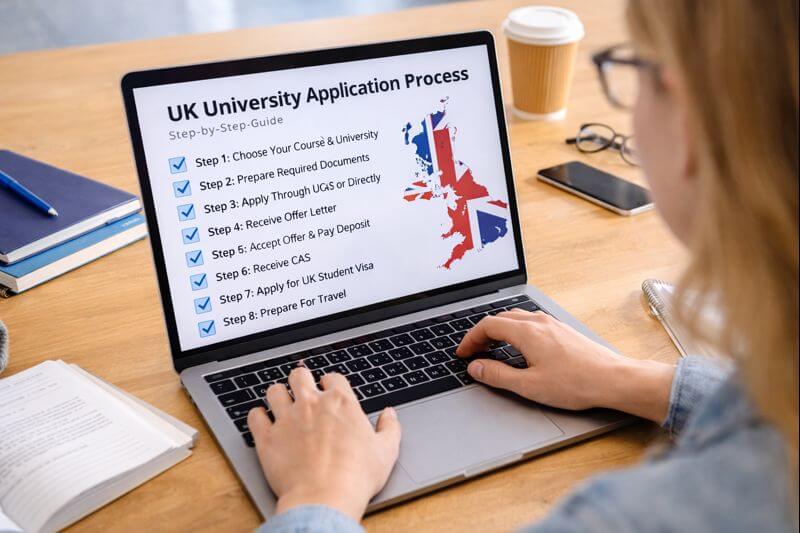
1: Choose your course and university. Research the course content, entry requirements, location, and tuition fees carefully before you commit.
2: Prepare your required documents — academic transcripts, a personal statement, references, and a CV.
3: Apply through UCAS for undergraduate study, or directly to the university for postgraduate programs.
4: Receive your offer letter, which will come as either conditional or unconditional.
5: Accept your offer and pay your deposit to secure your place.
6: Receive your CAS, which you’ll need for your visa application.
7: Apply for your UK Student Visa online and attend your biometrics appointment.
8: Prepare for travel — book your accommodation, arrange airport pickup, and attend any pre-departure briefing your university offers.
Final Thoughts: Is Studying in the UK Worth It?
For most students weighing high-quality education, shorter study duration, real global career opportunities, and genuine post-study work options, studying in the UK is one of the strongest choices available. The process takes real preparation (entry requirements, IELTS, financial documentation, and the visa itself all need attention) but for students who plan carefully, it remains one of the most well-trodden and rewarding paths into international study.