

































Introduction
Studying in Canada is a genuine dream for many international students, especially from Nigeria, India, and elsewhere in Africa and Asia. The country offers world-class education, globally recognized degrees, and strong post-study work opportunities.
The real challenge is different: how much does it actually cost, and can you realistically afford it? At Every Moment Travels, we see students start this journey full of excitement, only to get overwhelmed once the hidden costs surface — tuition, accommodation, visa fees, proof of funds, health insurance, and more. Without proper planning, that can mean visa rejection, real financial stress, or abandoning the goal altogether.
This guide breaks down the total cost of studying in Canada in 2026: tuition by program, living expenses, visa and application costs, affordable cities and universities, and genuine ways to cut costs.
Tuition Fees in Canada
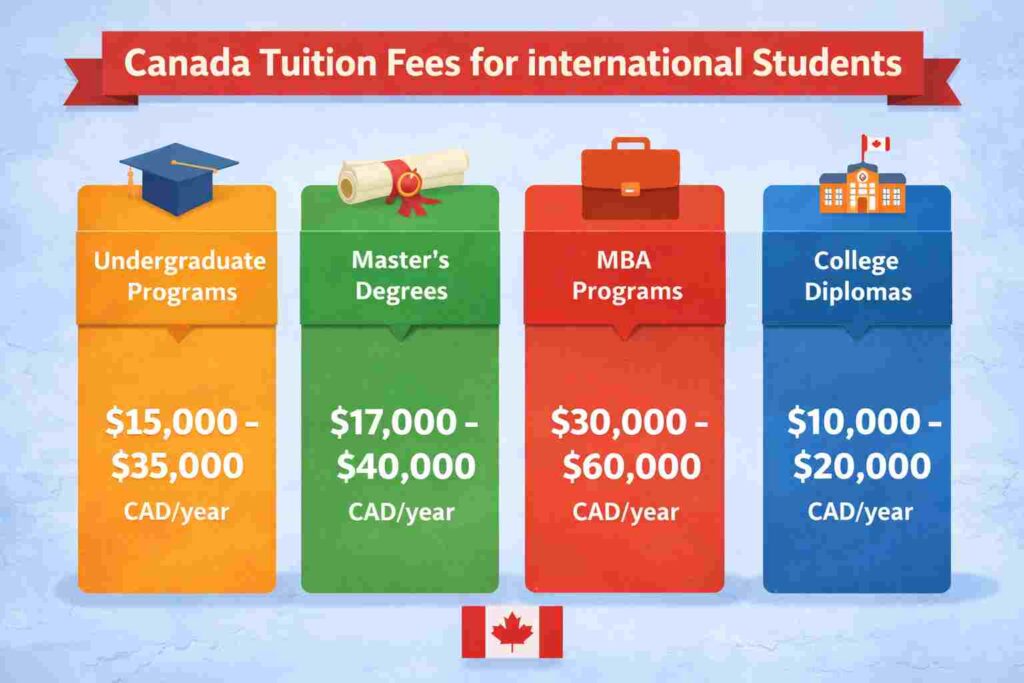
Tuition varies based on program type, university, province, and level of study. You can search the government’s list of Designated Learning Institutions (DLIs) to confirm your target school qualifies before you plan around it.
| Program Type | Annual Tuition (CAD) | Annual Tuition (approx. USD) |
|---|---|---|
| Undergraduate | 15,000 – 35,000 | $11,000 – $26,000 |
| Postgraduate (Master’s) | 17,000 – 40,000 | $12,500 – $30,000 |
| MBA programs | 30,000 – 60,000 | $22,000 – $45,000 |
| College diploma | 10,000 – 20,000 | $7,500 – $15,000 |
As a general pattern, arts and humanities programs tend to run cheaper, engineering and medicine tend to run more expensive, and MBAs sit at the top of the cost range.
Cost of Living in Canada
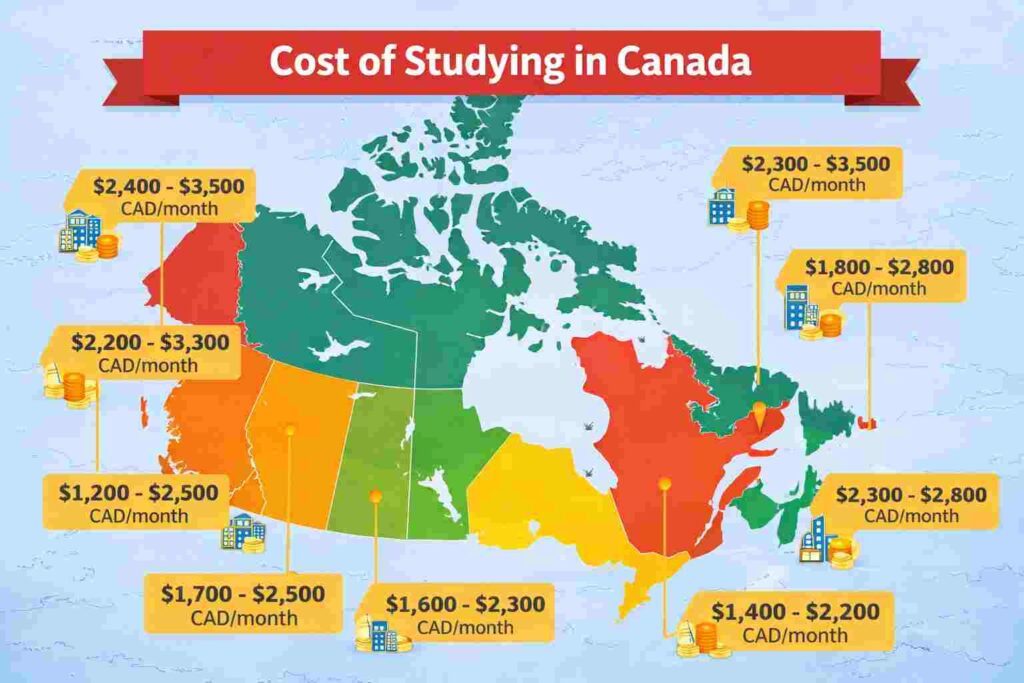
Living expenses depend heavily on the city.
| Expense Category | Cost (CAD/month) |
|---|---|
| Accommodation | 500 – 1,500 |
| Food | 250 – 600 |
| Transportation | 80 – 150 |
| Utilities | 100 – 200 |
| Internet | 50 – 100 |
| Miscellaneous | 150 – 300 |
That works out to roughly $1,200–$2,500 CAD a month, or $14,400–$30,000 CAD a year, depending on lifestyle and location.
Accommodation Costs
| Type | Cost (CAD/month) | Description |
|---|---|---|
| On-campus residence | 600 – 1,200 | Convenient but limited availability |
| Shared apartment | 400 – 900 | Generally the most affordable option |
| Private apartment | 1,000 – 2,000 | More expensive, but fully independent |
| Homestay | 700 – 1,200 | Usually includes meals |
Shared apartments with roommates tend to offer the best value for budget-conscious students.
Study Permit (Visa) Costs
| Item | Cost (CAD) |
|---|---|
| Study permit application | 150 |
| Biometrics | 85 |
| Medical exam | 100 – 300 |
| Police clearance | Varies |
Total visa costs typically run between $300 and $600 CAD, on top of the study permit itself.
Proof of Funds Requirement
To study in Canada, you have to demonstrate real financial capacity. As of September 1, 2025, IRCC requires a single applicant outside Quebec to show CAD $22,895 for one year of living expenses, on top of your first year’s tuition. That figure adjusts annually every September, tied to Statistics Canada’s Low-Income Cut-Off, so confirm the current number directly on canada.ca before you finalize your budget. Between tuition and the living-expense threshold, most students need to show a total somewhere north of $35,000 CAD, and this is mandatory for visa approval.
Our full guide to proof of funds requirements covers how to document this properly.
Health Insurance
International students need health coverage, and requirements vary by province.
| Province | Cost (CAD/year) |
|---|---|
| Ontario | 600 – 900 |
| British Columbia | 900 – 1,200 |
| Alberta | Often free or low-cost |
Additional Costs
| Expense | Estimated Cost (CAD) |
|---|---|
| Flight ticket | 800 – 1,500 |
| Books and supplies | 500 – 1,000 |
| Winter clothing | 200 – 500 |
| Application fees | 50 – 150 per school |
Total Cost of Studying in Canada: Full Estimate
| Category | Cost (CAD/year) |
|---|---|
| Tuition | 15,000 – 40,000 |
| Living expenses | 14,000 – 30,000 |
| Insurance | 600 – 1,200 |
| Miscellaneous | 2,000 – 4,000 |
Altogether, that puts most students somewhere between $30,000 and $70,000 CAD per year, depending on the program and city.
For the full application process alongside this budget, our complete guide to studying in Canada covers the study permit process end to end.
Cheapest Cities to Study in Canada
| City | Average Monthly Cost |
|---|---|
| Winnipeg | Low |
| Regina | Low |
| Saskatoon | Low |
| Halifax | Moderate |
| Quebec City | Affordable |
More expensive cities:
| City | Average Monthly Cost |
|---|---|
| Toronto | Very high |
| Vancouver | Very high |
| Montreal | Moderate |
Some of Canada’s More Affordable Universities
Institutions worth researching if budget is a priority include Memorial University of Newfoundland, the University of Manitoba, the University of Saskatchewan, Brandon University, and Cape Breton University. Tuition at schools like these can run as low as $10,000 CAD/year, though always confirm current fees directly with the institution.
Academic and Language Requirements
Undergraduate applicants generally need a high school certificate (WAEC/NECO or equivalent) and minimum grades that vary by school.
Postgraduate applicants generally need a bachelor’s degree and a minimum GPA, usually somewhere between 2.5 and 3.0 or higher.
For English proficiency, most institutions accept IELTS (the most common), TOEFL, or the Duolingo English Test — typical accepted scores run 6.0–7.5 for IELTS and 80–100 for TOEFL. Higher scores can genuinely improve both your admission and scholarship odds.
Document Checklist
Before you apply, gather your valid international passport, your letter of acceptance from a Canadian institution, your Statement of Purpose (SOP), academic transcripts, proof of funds, passport photographs, a medical examination report, and a police clearance certificate. Arrange everything in a clear, organized format — disorganized files are a common, avoidable source of delay.
Your Statement of Purpose deserves particular attention, since it’s where a lot of otherwise strong applications fall short. It needs to clearly explain why Canada, why this specific course, your career goals, and (where relevant) why you intend to return home. A weak SOP can undermine an application even when every other document is solid.
Ways to Reduce the Cost of Studying in Canada
Apply for scholarships. This is the most effective lever available — government scholarships, university scholarships, and external funding all exist in various forms (fully funded, partial, or entrance scholarships). Apply to multiple schools, submit early, and maintain strong academic scores throughout. Our guide to studying in Canada covers scholarship strategy in more depth.
Work while studying. Most students can work up to 20 hours per week during term time, and full-time during scheduled breaks. At a typical minimum wage of $14–17 CAD/hour, that translates to roughly $800–$1,500 CAD/month in potential earnings.
Choose affordable provinces and cities. Manitoba, Saskatchewan, and Newfoundland generally offer rent and living costs 30–50% lower than major cities.
Consider a college over a university. Colleges often bring lower tuition, more practical programs, and easier admission — a smart entry strategy for budget-conscious students.
Share accommodation. Splitting rent with roommates can cut a $1,200 CAD monthly cost down to $400–$700 CAD.
Cook your own meals. Eating out consistently costs meaningfully more than cooking — a habit that can save around $300 CAD/month.
Buy used books and materials. Second-hand stores and library borrowing can save hundreds of dollars a year.
Use student discounts. Transport, software, and retail discounts all add up over an academic year.
Comparing Canada to Other Study Destinations
| Country | Tuition | Living Cost | Work Opportunity |
|---|---|---|---|
| Canada | Medium | Medium | Excellent |
| UK | High | High | Limited |
| USA | Very high | High | Competitive |
| Germany | Low | Low | Limited English-language programs |
Expert Tips to Save Money
Start financial planning early — don’t wait until admission, begin saving six to twelve months ahead. Avoid expensive cities like Toronto and Vancouver initially, at least until your finances are on solid footing. Combine scholarships with part-time work rather than relying on a single income source. Stick to public transport, since taxis drain a budget quickly. Book flights early and compare prices before committing. And track your monthly spending — rent, food, and transport especially — with an app or a simple spreadsheet.
Common Mistakes Students Make
Underestimating living costs. In practice, living expenses can equal or exceed tuition over the course of a year.
Applying without solid proof of funds. Incomplete or unclear bank statements are a common cause of rejection.
Choosing expensive cities blindly. Always compare cities before you commit to a program.
Ignoring scholarships. Many students skip applying simply because they assume they won’t qualify.
Submitting late applications. This reduces both admission chances and scholarship opportunities.
Depending entirely on part-time work. Always keep a real financial buffer rather than counting on projected earnings.
Skipping a real budget. Without one, overspending happens fast.
Frequently Asked Questions
Can I study in Canada for free? No, but scholarships can meaningfully reduce the total cost.
How much money do I need to move to Canada as a student? Generally at least $35,000–$50,000 CAD when tuition and the current living-expense threshold are combined.
Is Canada cheaper than the UK or USA? Generally yes, and it also offers stronger post-study work options than most alternatives.
Can I work and pay my tuition through that income? Partially, but not fully — you’ll still need real savings behind you.
Which programs tend to be cheapest in Canada? Arts, education, and diploma programs generally sit at the lower end of the cost range.
Conclusion
Studying in Canada is a genuinely valuable investment, but it takes careful financial planning. Most students should expect to spend somewhere between $30,000 and $70,000 CAD per year, all costs included.
With the right strategy — choosing affordable schools and cities, applying for scholarships early, and managing spending deliberately — that cost is very manageable. Canada remains one of the strongest destinations for international students precisely because it combines high-quality education, real work opportunities, and a genuine pathway to permanent residency.
If you’d like help planning your study-in-Canada journey, reach out to us at everymomenttravels@gmail.com.