

































Introduction
Choosing between the UK and Canada is one of the most consequential decisions in planning a global education and career. In 2026, the landscape has shifted meaningfully on both sides — stricter visa caps, revised post-study work rules, and rising living costs all factor in. The “better” choice really depends on your specific goals, whether that’s a fast-tracked master’s degree or a longer-term pathway to permanent residency.
This guide breaks down the real differences to help you decide with a clear head rather than guesswork.
The Core Decision Points
Students weighing the UK against Canada in 2026 are really answering two separate questions: is it better to finish quickly in the UK, or take more time building a life in Canada, and which country actually wants you to stay after you graduate?
The UK offers historical academic prestige and accelerated one-year master’s programs. Canada offers a stronger social safety net and a clearer, points-based pathway to Permanent Residency (PR). This guide breaks down both factors so you can weigh them against your own priorities.
Before choosing, it’s worth understanding the visa process itself in more depth — our step-by-step visa application guide covers the general framework both countries build from.
How to Choose Your Destination, Step by Step
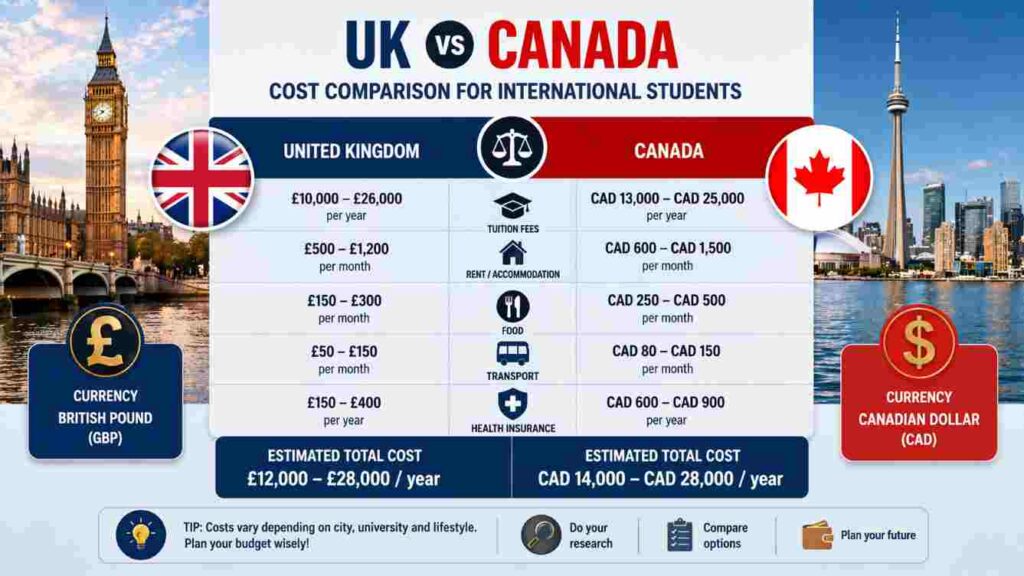
Choosing your destination isn’t just about university ranking — it’s a genuinely strategic decision with several moving parts.
Step 1: Define Your Timeline
The UK route suits you if you want to complete a master’s in 12 months and enter the workforce immediately. The Canada route suits you better if you’d prefer a two-year master’s with more breathing room for internships and part-time work along the way.
Step 2: Calculate Total Investment, Not Just Tuition
Don’t stop at the tuition figure. In the UK, factor in the Immigration Health Surcharge (IHS), which grants access to the NHS. In Canada, factor in the Guaranteed Investment Certificate (GIC) requirement that proves you can cover living costs.
Step 3: Analyze the Job Market
In 2026, the UK job market runs highly competitive for sponsored roles under the Skilled Worker Visa route. Canada’s market, by contrast, leans heavily on regional labor shortages — healthcare, STEM, and skilled trades in particular.
Step 4: Check Immigration Viability
If your end goal is permanent settlement, Canada’s Express Entry and Provincial Nominee Programs (PNP) are generally more accessible than the UK’s path to Indefinite Leave to Remain (ILR), which typically requires five to ten years of continuous residency.
UK Student Visa Checklist
- CAS (Confirmation of Acceptance for Studies): your digital acceptance record, issued by your university.
- Financial proof: you need to show at least £1,334 per month (for up to 9 months) if studying in London, or £1,023 outside London.
- IHS payment: covers access to the NHS during your stay.
- English proficiency: typically IELTS 6.5 or an equivalent score.
- TB test: required for applicants from specific countries.
Canada Study Permit Checklist
- LOA (Letter of Acceptance): from a Designated Learning Institution (DLI).
- PAL (Provincial Attestation Letter): a requirement introduced for most undergraduate students, confirming you fall within your province’s allocated cap.
- GIC (Guaranteed Investment Certificate): proof of at least CAD $22,895 for living expenses (the threshold rose from $20,635 as of September 1, 2025, and adjusts again every September), plus tuition. Our complete guide to studying in Canada covers this requirement in full.
- Statement of Purpose (SOP): a document explaining why you chose Canada and your genuine intent, handled carefully alongside any longer-term settlement goals you might have.
Your choice of housing can meaningfully affect your budget on either side — our complete hotel booking guide is worth a look if you need short-term accommodation while you settle in.
Comparison Table: At a Glance
| Feature | United Kingdom | Canada |
|---|---|---|
| Average tuition (undergraduate) | £15,000 – £35,000 | CAD $25,000 – $45,000 |
| Course duration | 3 years (UG) / 1 year (PG) | 4 years (UG) / 2 years (PG) |
| Post-study work | 2 years (Graduate Route) | Up to 3 years (PGWP) |
| Living costs (yearly) | £12,000 – £16,000 | CAD $21,000 – $25,000 |
| PR pathway | Difficult (5–10 years) | Clearer (Express Entry/CEC) |
| Part-time work | 20 hours/week | 24 hours/week (as of 2026) |
Figures shift with policy updates on both sides — confirm current numbers directly with UKCISA or IRCC before you finalize a budget.
Expert Tips for Success
For the UK: apply early for the Graduate Route if timing matters to your plans — the route’s duration for master’s students has been discussed for possible reduction in future policy cycles, so confirm the current terms before you commit to a start date. It’s also worth noting that in a tighter job market, graduates from research-intensive Russell Group universities often have an edge with top-tier London employers.
For Canada: target in-demand provinces rather than defaulting to Toronto or Vancouver. Saskatchewan, Manitoba, and Atlantic Canada all tend to offer easier PR pathways through regional nominee programs. On the Post-Graduation Work Permit specifically, most programs need to run at least two years to qualify for the full three-year PGWP, though certain master’s programs grant three years regardless of length — confirm your specific program’s eligibility before enrolling.
Common Mistakes to Avoid

Ignoring the “no dependants” rule in the UK. Since 2024, most international students in the UK — aside from those on research-based PhDs — can’t bring family members. Don’t assume a spouse or children can join you without checking this first.
Underestimating the GIC in Canada. The financial requirement has risen substantially in recent years. A meaningful share of rejected applications trace back to students using outdated financial figures — always confirm the current threshold directly with IRCC before you apply.
Applying late for a PAL in Canada. Without a Provincial Attestation Letter, your study permit application gets returned outright. Coordinate with your university’s international office as soon as you receive your offer, not weeks later.
Relying on an AI-generated Statement of Purpose. This is a genuinely high-risk move. Visa officers are trained to look for personal narratives and specific, credible ties to your home country — a generic or obviously templated SOP works against you.
Frequently Asked Questions
Is it cheaper to study in the UK or Canada? Generally, the UK runs cheaper for postgraduate study, since one-year courses save you an entire year of tuition and living costs. For undergraduate study, Canada often offers a better cost-to-value ratio outside major cities.
Can I stay in Canada permanently after studying? Yes. The Canadian Experience Class (CEC) lets you apply for PR after one year of skilled work experience in Canada — one of the more accessible pathways globally.
What is the Graduate Route in the UK? It’s a visa that lets you stay and work, or look for work, in the UK for two years after graduating, with no job offer required to apply.
Did Canada limit the number of international students? Yes — there’s a national cap on study permit applications, meaning most applicants need to secure a Provincial Attestation Letter (PAL) from their chosen province before applying for a study permit.
Conclusion
The UK-versus-Canada decision doesn’t really have a single winner — it has a winner for your specific situation. Choose the UK if you want a prestigious, fast-paced education, access to European markets, and a shorter time away from the workforce. Choose Canada if you’re looking for a longer-term home, a strong social safety net, and a more structured path to permanent residency.
Whichever you choose, preparation is what actually determines the outcome in 2026: confirm your finances against current thresholds, stay aware of visa caps and PAL requirements, and choose a course that genuinely aligns with your chosen country’s labor market. Our guide to choosing the best study abroad program is a useful next step once you’ve picked your direction.