
































The Australian skilled visa process remains one of the most direct routes to permanent residency for people with in-demand qualifications and real work experience. It’s also, in equal measure, one of the more procedurally unforgiving. A single miscalculated points claim, a missed 60-day deadline, or an occupation mismatch can add months or years to your case.
At Every Moment Travels, we walk applicants through exactly this process, and this guide reflects what actually trips people up. It covers the full sequence from first principles: how the system works, each step in order, realistic costs and timeframes, and the mistakes that most commonly derail otherwise strong applications.
How the System Actually Works
Australia doesn’t let you simply “apply” for a skilled visa the way you might apply for a job. Instead, the process runs on a points-tested, invitation-based structure. You lodge an Expression of Interest declaring your points score and occupation — this isn’t a visa application, and it doesn’t guarantee anything on its own. The Department of Home Affairs (for subclass 189) or a state or territory government (for 190 and 491) then reviews EOIs and issues invitations to the highest-ranked or best-matched candidates. Only once invited can you lodge a full visa application.
This two-stage structure exists because skilled migration places are capped each program year, and the government wants to select the strongest-matching candidates rather than process every applicant first-come, first-served.
The Three Main Skilled Visa Subclasses
| Visa | Sponsorship Required | Residency Outcome | Occupation List | Points Bonus |
|---|---|---|---|---|
| 189 — Skilled Independent | None | Permanent, live anywhere | MLTSSL only | None |
| 190 — Skilled Nominated | State/territory nomination | Permanent, live anywhere (with a settlement commitment to the nominating state) | MLTSSL or STSOL | +5 points |
| 491 — Skilled Work Regional (Provisional) | State/territory nomination or eligible family sponsorship | Provisional (5 years); pathway to permanent subclass 191 after 3 years in a regional area | MLTSSL, STSOL, or ROL | +15 points |
There’s no single “best” pathway — the right one depends on your occupation, your points score, and your flexibility about where you’re willing to live. Many applicants who don’t reach a competitive score for 189 find that the nomination bonus available under 190 or 491 is what actually gets them an invitation.
Step-by-Step: The Complete Process
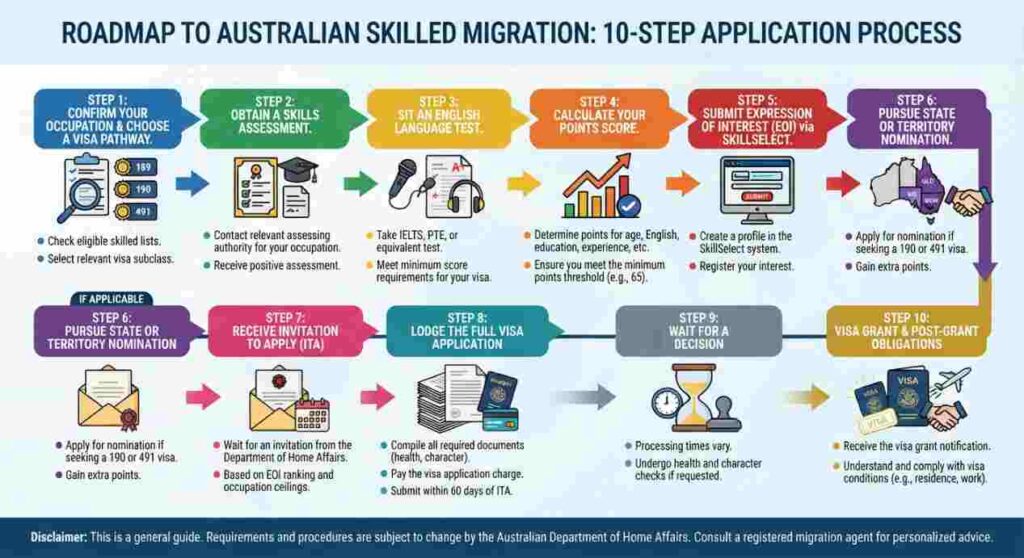
Step 1: Confirm Your Occupation and Choose a Visa Pathway
Every skilled visa ties to a specific occupation and its ANZSCO (Australian and New Zealand Standard Classification of Occupations) code. Your first task is identifying the correct code for your role and checking which list it appears on: MLTSSL (Medium and Long-term Strategic Skills List) — required for subclass 189, also eligible for 190 and 491; STSOL (Short-term Skilled Occupation List) — eligible for 190 and 491, but not 189; and ROL (Regional Occupation List) — eligible for 491 only.
Getting this classification right matters enormously. Choosing an ANZSCO code that only loosely matches your actual duties and experience is one of the most common — and most costly — errors applicants make, since it can undermine both your skills assessment and your points claims for skilled employment.
Step 2: Obtain a Skills Assessment
Before you can lodge an EOI, you generally need a positive skills assessment from the assessing authority relevant to your occupation. Engineers Australia for engineers, ACS for ICT professionals, VETASSESS for a wide range of other occupations, or Trades Recognition Australia (TRA) for trade occupations. The assessing authority reviews your qualifications and employment history against the requirements for your nominated occupation and confirms whether you meet the required skill level.
This step often takes several weeks to a few months, and outcomes vary by authority. Some require detailed employment references addressing specific duties, others rely more heavily on qualification comparability. Start this early, since a negative or partial assessment can force a change of occupation or pathway.
Step 3: Sit an English Language Test
You’ll need to demonstrate English proficiency through an approved test — IELTS, PTE Academic, TOEFL iBT, or an equivalent. Three thresholds generally apply: Competent English (the baseline required for most GSM visas, earning no additional points), Proficient English (a stronger result earning a meaningful points bonus), and Superior English (the highest tier, earning the maximum available English points).
Test results are typically valid for three years from the test date, so timing matters if you’re planning your EOI around a particular result.
Step 4: Calculate Your Points Score
The points test is the core ranking mechanism of the entire system. Points are awarded across several factors, generally including age (the highest band typically covers applicants in their late twenties to early thirties, with points reducing at younger and older brackets, up to a cutoff around age 45), English language ability, skilled employment experience (both overseas and Australian experience count, generally capped at a combined maximum), educational qualifications (usually scored on your highest relevant qualification, not stacked across several), and other factors that may include Australian study, a Professional Year program, credentialed community language skills, regional study, partner skills, and — for 190/491 — the state or territory nomination bonus. For applicants over 45 weighing options beyond the points-tested visas, our complete Australian migration guide covers age-flexible pathways in more depth.
The legislated minimum to lodge an EOI is generally 65 points. In practice, competitive invitation rounds for many popular occupations require considerably higher scores — often well above the minimum for subclass 189 specifically. That’s exactly why the nomination bonuses under 190 and 491 matter so much for applicants whose independent score isn’t yet competitive.
A word of caution worth taking seriously: points calculations are one of the areas where applicants most often overestimate their own score, particularly around skilled employment dates and “closely related” occupation claims. An error here can mean an EOI that looks competitive on paper but never gets invited.
Step 5: Submit Your Expression of Interest via SkillSelect
Once your skills assessment and English results are in hand and you’ve calculated your points, lodge an EOI through the government’s SkillSelect system. You can nominate more than one visa subclass and more than one state in a single EOI, which keeps your options open while you wait.
Your EOI gets ranked against other candidates in the same occupation ceiling. Keep your EOI details accurate and current — most points claimed need to remain valid and correctly reflected at the time you’re invited, not just when you first submit.
Step 6: Pursue State or Territory Nomination, If Applicable
If you’re pursuing subclass 190 or 491, this is where you apply for nomination from a state or territory government. Each jurisdiction runs its own occupation lists, quotas, and criteria — some prioritize applicants already living or working in that state, some require a specific points threshold, and demand for particular occupations shifts from month to month as quotas fill.
Nomination isn’t automatic just because you meet the federal eligibility criteria — the state makes its own selection decision based on its labor market needs, so your strategy needs to account for which jurisdictions currently want your occupation, not just your raw points score.
Step 7: Receive Your Invitation to Apply
Invitations go out in regular rounds. For subclass 189, they go to the highest-ranked EOIs within each occupation’s ceiling. For 190 and 491, the state or territory nomination typically comes with, or immediately precedes, the invitation. Receiving an invitation is a real milestone, but it’s not a visa grant — it opens a defined window in which to lodge your full application.
Step 8: Lodge the Full Visa Application
You generally have 60 days from the date of invitation to lodge a complete application, along with supporting evidence: your confirmed skills assessment and English test results, detailed evidence of skilled employment (contracts, payslips, reference letters, tax records), qualification documents, health examinations through approved panel physicians, police clearance certificates from every country you’ve lived in for 12 months or more (cumulatively) in the past 10 years, and identity and relationship documents for any family members included in the application.
This is where thorough preparation earlier in the process pays off — a well-organized application with consistent, well-evidenced points claims tends to move through processing more smoothly than one where assessors have to chase clarifications.
Step 9: Wait for a Decision
Processing time varies by subclass and case complexity. As a general guide, subclass 189 and 190 applications often take in the order of six to seven months, while 491 timeframes can vary more depending on the nominating state. During this period, the Department may request additional documents or clarification — responding promptly and completely matters, since delays here directly extend your overall processing time.
Step 10: Visa Grant and Post-Grant Obligations
For 189 and 190, the grant confers permanent residency immediately, with the freedom to live and work anywhere in Australia (190 holders generally commit to living in the nominating state for a defined period, typically around two years). For 491, the grant confers a five-year provisional visa. Holders must live, work, and study in a designated regional area during this period, and after meeting the required residence and typically income conditions for three years, can apply separately for the permanent subclass 191 visa — this isn’t automatic and requires its own application.
Realistic Costs
Budgeting accurately matters, since skilled migration costs extend well beyond the headline visa application charge. As a general guide, budget for the Visa Application Charge (VAC). It is currently around AUD $6,135 to $6,140 for the primary applicant on subclass 189/190/491, following the fee increase effective July 1, 2026. Plus skills assessment fees (typically several hundred to over a thousand dollars, varying by assessing authority). Also, English test fees, health examinations, police clearance certificates (cost varies by country), state nomination fees for 190/491 where applicable, and migration agent fees if you engage professional assistance. Confirm the current VAC directly on the Department of Home Affairs fee schedule before budgeting, since these figures adjust periodically.
All told, total costs across the full process commonly range from roughly AUD $8,000 to $15,000 or more per applicant, depending on family composition, occupation, and how many of these steps you manage yourself versus with professional support.
Realistic Timelines
End-to-end, from starting your skills assessment to receiving a visa decision, most applicants should plan for six months to two years. Depending heavily on how quickly your skills assessment finalizes, whether your occupation and points profile attract fast invitation rounds or a longer wait. Additionally, whether you’re pursuing state nomination and how competitive that state’s current quota is, and the completeness and consistency of your lodged application.
Common Mistakes That Delay or Derail Applications

In practice, most avoidable problems fall into a short list: misclassifying the ANZSCO occupation code, leading to an inaccurate skills assessment or a mismatch between claimed employment and the nominated occupation; overestimating skilled employment points by including roles, dates, or hours that don’t meet the “closely related” and minimum-hours tests; letting English test results lapse before lodging the EOI or application; missing the 60-day lodgement window after invitation; incomplete police checks, particularly for applicants who’ve lived in multiple countries; and assuming state nomination is guaranteed once federal eligibility is met, when in reality states apply their own separate, often more selective criteria.
Frequently Asked Questions
Do I need a job offer to apply for a skilled visa? No. Subclass 189 and 190 are points-tested and don’t require a job offer, though one can sometimes support your case indirectly through the nomination process for certain states. If you have a job offer, an employer-sponsored visa is worth comparing as an alternative pathway.
What’s the minimum age to apply? There’s no strict minimum, but applicants generally need to be under 45 at the time of invitation to remain eligible.
Can I apply for more than one visa subclass at once? Yes. A single EOI in SkillSelect can nominate multiple visa subclasses and multiple states — a common strategy for maximizing your options while your points and circumstances are assessed.
What happens if I don’t get invited? Your EOI stays active in SkillSelect for a set period, commonly two years, and gets automatically re-ranked each invitation round. Many applicants use this window to improve their score. This helps them achieve a higher English test result, gaining more skilled employment, or pursuing further qualifications.
Is the 491 visa a “lesser” option than 189 or 190? Not necessarily — it’s structured differently. It carries a regional residence condition and is provisional rather than immediately permanent. But for many applicants whose points aren’t yet competitive for 189, it can be a genuinely faster route into the system, with a clear pathway to permanent residency after three years.
General Information Disclaimer
This article provides general information about the Australian skilled visa process and doesn’t constitute personal migration advice. Visa criteria, occupation lists, points settings, and fees change regularly, and outcomes depend entirely on individual circumstances. No agent can guarantee a visa outcome. Before making any decisions or lodging any application, have your circumstances assessed individually by a currently registered migration agent or immigration lawyer.