
































Introduction
Planning a trip to Europe is exciting. For many travelers, the real challenge starts before the journey even begins: getting a Schengen visa approved. Every year, embassies reject thousands of applications over incomplete documents, weak financial proof, or unclear travel plans. Even genuine travelers sometimes get refused simply because they misjudge what officers look for.
A Schengen visa lets you travel freely across multiple European countries with a single visa. The application process can still feel complicated, especially for first-timers. From choosing the right embassy to preparing financial documents, every step needs care to improve your odds.
Here’s the encouraging part: most refusals are preventable. Understand the requirements, prepare properly, and your approval chances rise significantly. Visa officers mainly want to confirm three things. Do you have a genuine reason to travel? Can you afford the trip? Will you return home afterward?
This guide covers the full application process, the complete document checklist, proven approval strategies, common mistakes, and expert tips from successful applicants. By the end, you’ll know how to submit a Schengen application with a real shot at approval.
Why Many Schengen Applications Get Rejected
Millions of travelers apply for a Schengen visa every year. The process looks straightforward on paper, but embassies reject a large share of applications over missing documents, weak financial proof, unclear purpose, or poor preparation.
For first-time travelers especially, the process can feel confusing and stressful. A rejection doesn’t just delay your trip. It can also complicate future visa applications.
Here’s the core truth: most rejections happen because applicants don’t fully understand how embassies actually evaluate a file. Officials examine your financial stability, your travel purpose, your ties to your home country, your travel history, and the accuracy of your documentation.
The good news stays the same: the right preparation meaningfully raises your approval odds.
Step-by-Step Process to Get Approved
Step 1: Determine the Right Visa Category
Identify your correct visa type before you apply.
| Visa Type | Purpose |
|---|---|
| Tourist Visa | Travel and sightseeing |
| Business Visa | Meetings, conferences |
| Family Visit Visa | Visiting relatives or friends |
| Student Visa | Short study programs |
| Medical Visa | Medical treatment |
Applying under the wrong category is one of the fastest ways to get rejected.
If you’re new to international travel, our complete guide to tourist visas explains the full process, required documents, and approval tips.
Step 2: Choose the Correct Embassy
Apply at the embassy of the country where you’ll spend the most time.
| Travel Plan | Embassy to Apply |
|---|---|
| France 5 days + Italy 2 days | France |
| Spain 3 days + Germany 3 days | First country of entry |
Applying at the wrong embassy can lead to automatic rejection.
Step 3: Book Your Visa Appointment
Most Schengen countries schedule appointments through visa processing centers like VFS Global or TLScontact, or through the embassy’s own portal.
Booking tips:
- Book four to eight weeks before travel.
- Avoid last-minute applications.
- Have every document ready before your appointment.
Step 4: Complete the Application Form
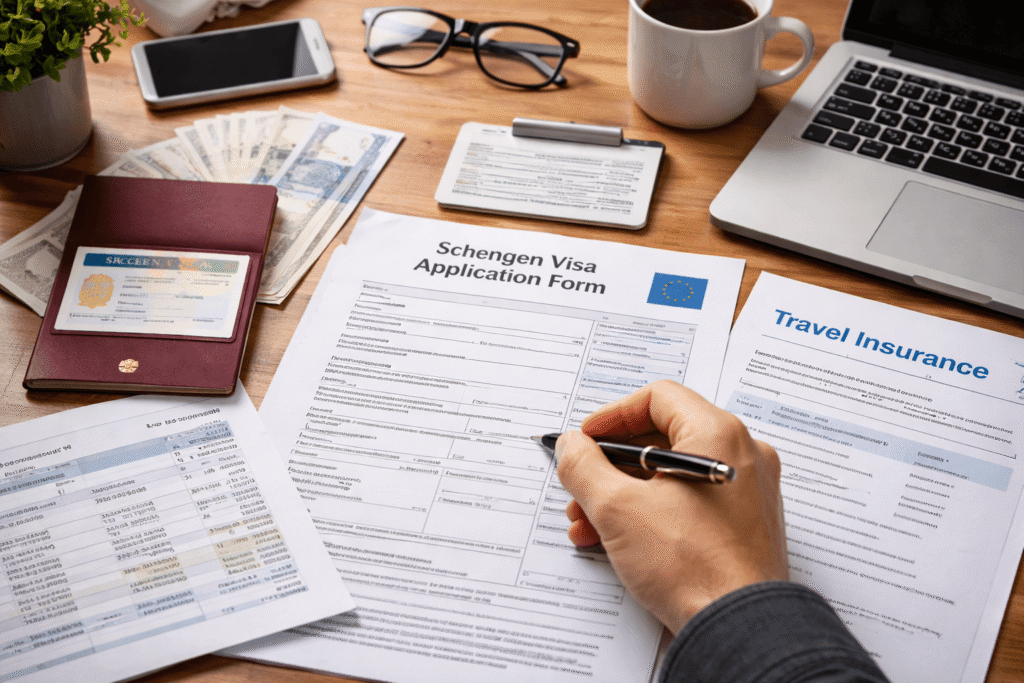
Fill out the form accurately and honestly. It typically requires your personal details, passport information, travel itinerary, accommodation, employment details, and financial support proof. Even small mistakes can raise suspicion.
Step 5: Prepare All Required Documents
Your documentation strength often decides the outcome.
Basic documents:
| Document | Requirement |
|---|---|
| Passport | Valid for at least 3 months after your planned departure from the Schengen Area |
| Visa application form | Completed and signed |
| Passport photographs | Meeting Schengen photo specifications |
| Travel insurance | Minimum €30,000 coverage |
| Flight reservation | Round-trip reservation |
| Hotel reservation | Proof of accommodation |
| Cover letter | Explaining your travel purpose |
Financial documents:
| Document | Purpose |
|---|---|
| Bank statements (6 months) | Proof of funds |
| Salary slips | Employment verification |
| Tax returns | Financial stability |
| Sponsorship letter (if applicable) | Financial support |
Employment documents:
| Applicant Type | Required Documents |
|---|---|
| Employee | Employment letter, leave approval |
| Business owner | Business registration documents |
| Student | School letter |
| Retired | Pension proof |
These documents exist to prove you’ll return home after your trip.
Step 6: Write a Strong Cover Letter
A cover letter should state your travel purpose, your dates, the places you’ll visit, your proof of funds, and your commitment to return home. A clear cover letter helps officers understand your plan quickly.
Step 7: Attend Your Biometrics Appointment
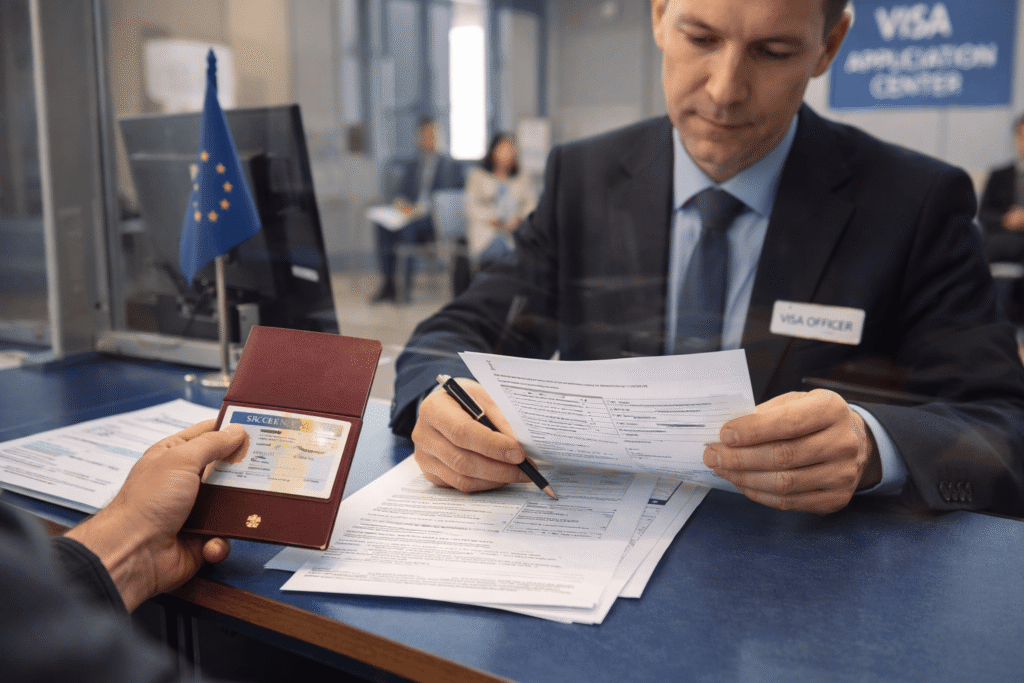
At the visa center, you’ll submit your documents, give fingerprints, take a biometric photo, and pay the visa fee.
| Category | Fee |
|---|---|
| Adults | €80 |
| Children (6–12) | €40 |
| Children under 6 | Free |
Step 8: Track Your Application
Standard processing takes about 15 working days, and up to 30 days during busy seasons. Track your application online through the visa center’s portal.
Complete Requirements Checklist
Confirm every item below before your appointment.
Personal documents: valid passport, passport photos, completed visa form.
Travel documents: flight reservation, hotel booking, travel itinerary.
Financial proof: six months of bank statements, salary slips or other income proof.
Supporting documents: travel insurance, cover letter, employment letter.
Missing even one required document can delay or sink your application.
Strong vs. Weak Applications
| Factor | Strong Application | Weak Application |
|---|---|---|
| Bank balance | Stable financial history | Sudden deposits |
| Travel history | Previous visas | No travel history |
| Documentation | Complete and organized | Missing documents |
| Purpose of travel | Clear itinerary | Vague plans |
| Home ties | Job or business | No employment proof |
Officers look for credibility and consistency above everything else.
Expert Tips to Improve Your Odds
Maintain a healthy bank balance. Most embassies expect roughly €50–€100 per day of stay. Avoid sudden large deposits and avoid showing borrowed money as your own funds.
Provide a clear itinerary. List your cities, attractions, travel dates, and hotel reservations. It shows organized planning.
Embassies require proof of accommodation for every Schengen application — hotel reservations, Airbnb bookings, or a formal host invitation letter all work. Our complete hotel booking guide covers the best platforms and how to avoid common booking mistakes.
Get travel insurance from a reputable provider. Your policy needs at least €30,000 in medical coverage, valid across all Schengen countries, for your entire trip. Our guide to the best travel insurance for Europe walks through exactly what to look for.
Show strong ties to home. An employment contract, business ownership, property documents, or family responsibilities all help convince an officer you’ll return.
Apply early. Submit your application four to eight weeks before travel to avoid unnecessary delays.
Common Mistakes That Cause Rejection
Incomplete documentation. Missing documents weaken your file automatically.
Insufficient financial proof. Embassies reject applications when they doubt you can afford the trip.
Fake hotel or flight bookings. Embassies verify reservations easily, and fake documents can lead to a visa ban.
A vague travel purpose. Unclear plans read as suspicious, not spontaneous.
A weak cover letter. A poorly written letter fails to explain why you’re traveling.
Frequently Asked Questions

How much money should I have in my account? It depends on your trip length, but €50–€100 per day is a commonly recommended guide.
How long does processing take? Typically 15 working days, though busy seasons can stretch it to 30.
Can I reapply after a rejection? Yes, but fix the actual reason for rejection first.
Is travel insurance mandatory? Yes. Every Schengen visa requires coverage of at least €30,000.
Can one visa cover multiple countries? Yes. A Schengen visa lets you travel across all 27 Schengen countries.
Conclusion
Getting a Schengen visa approved feels complicated at first, but the process gets much easier once you understand the requirements. Successful applicants focus on complete documentation, strong financial proof, clear travel plans, honest applications, and solid home ties.
Visa officers are simply trying to confirm one thing: are you a genuine traveler who will respect the visa’s terms? Show financial stability, an organized plan, a valid purpose, and a clear intent to return home, and your approval odds rise significantly.
With careful preparation, your European trip can go from plan to reality. Once your visa is approved, book your flight next — our cheap international flights guide covers how to avoid overpaying for international travel.