
































Finding and booking the right hotel at the right price has become something of an art form. With thousands of platforms all promising “the lowest rates,” travelers often end up overwhelmed by hidden fees, rigid cancellation policies, and photos that don’t quite match reality. Whether you’re planning a honeymoon in Bali or a budget business trip to London, choosing the right booking platform genuinely makes the difference between a smooth trip and a logistical headache.
At Every Moment Travels, this is a question we help clients work through constantly. This guide breaks down the top hotel booking websites for 2026, along with a practical approach for finding the best deal while avoiding the common pitfalls.
Why Booking a Hotel Feels Harder Than Ever
In the early days of online travel, a handful of major players controlled the market. Today, the landscape has fragmented across Online Travel Agencies (OTAs), meta-search engines, and direct-booking rewards programs, and that fragmentation creates real friction for travelers.
The same room can cost $150 on one site and $210 on another, largely due to “member-only” pricing tiers. Many sites hide resort fees or local taxes until the very last checkout screen. And if something goes wrong with your stay, OTAs often point back to the hotel, while the hotel points back to the website — leaving you stuck in the middle.
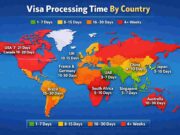
A systematic approach solves most of this. Before you get to hotels, though, make sure your visa is sorted first if you’re traveling internationally — our visa processing time guide covers how long that typically takes by country.
How to Find the Best Hotel Booking Deal, Step by Step
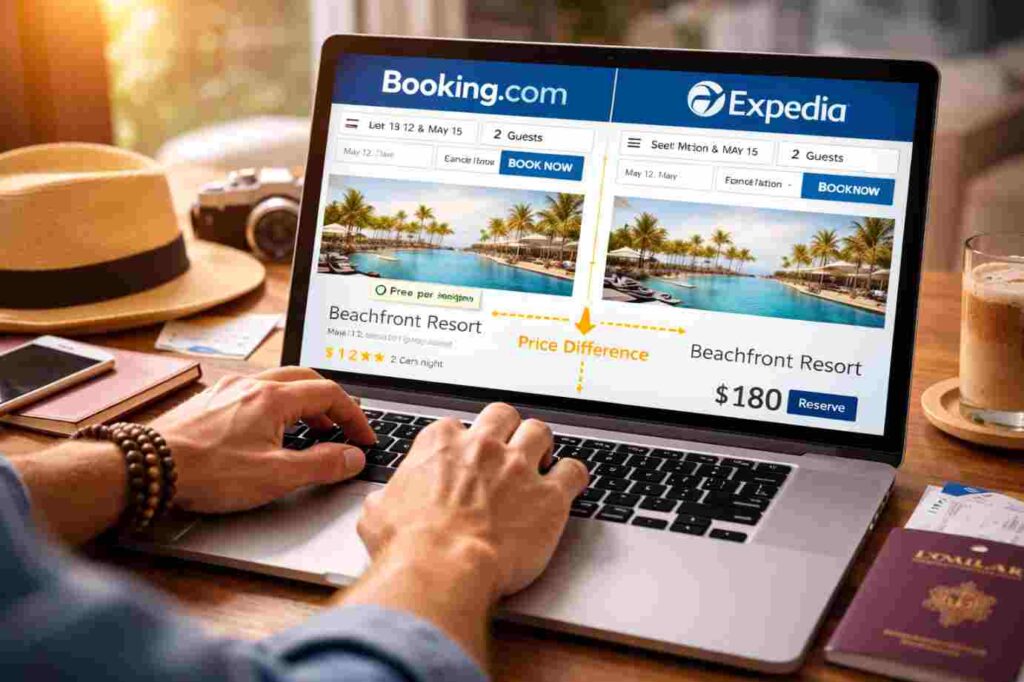
Follow this five-step approach to avoid overpaying.
Step 1: Start With a Meta-Search Engine
Begin with a broad search on a platform like Google Travel or Skyscanner. These sites don’t sell rooms directly — they scan hundreds of other sites, including the hotel’s own website, to show you who currently has the lowest price.
Step 2: Check for Member-Only Rates
Once you’ve narrowed down a few target hotels, log into Booking.com’s Genius program or Expedia’s One Key. Prices often drop 10–20% the moment you’re signed in, purely because you’re logged in rather than browsing as a guest.
Step 3: Verify the Actual Final Price
Click through to the final payment page before you compare anything. Many sites now display a required “total price,” but some still hide taxes until that last step — make sure you’re comparing the full out-of-pocket total, not just the per-night rate.
Step 4: Compare Against Direct Booking
Check the hotel’s own website too. Many major chains — Marriott, Hilton, IHG among them — now offer a best-price guarantee: find a lower price elsewhere, and they’ll often match it and add an extra discount or loyalty points on top.
Step 5: Check Recent Reviews Specifically
A hotel that was excellent in 2024 may have gone through renovation or a change in management since. Filter reviews by “most recent” rather than trusting the overall average, so you’re seeing an accurate picture of the property as it stands today.
Booking Checklist
Before you confirm any booking, check these boxes:
- [ ] Cancellation policy — free cancellation, or non-refundable? Non-refundable rates run cheaper (often around 15%), but carry real risk if your plans change.
- [ ] Payment timeline — pay now, or pay at the property?
- [ ] What’s actually included — does the rate cover breakfast, Wi-Fi, or parking?
- [ ] Real location check — use Google Maps to confirm the actual walking distance to transit or the attractions you care about.
- [ ] Rewards eligibility — are you logged in to actually earn loyalty points on this booking?
Once your hotel is sorted, our guide to finding cheap international flights covers how to lock in an affordable fare to match.
Comparing the Major Hotel Booking Sites
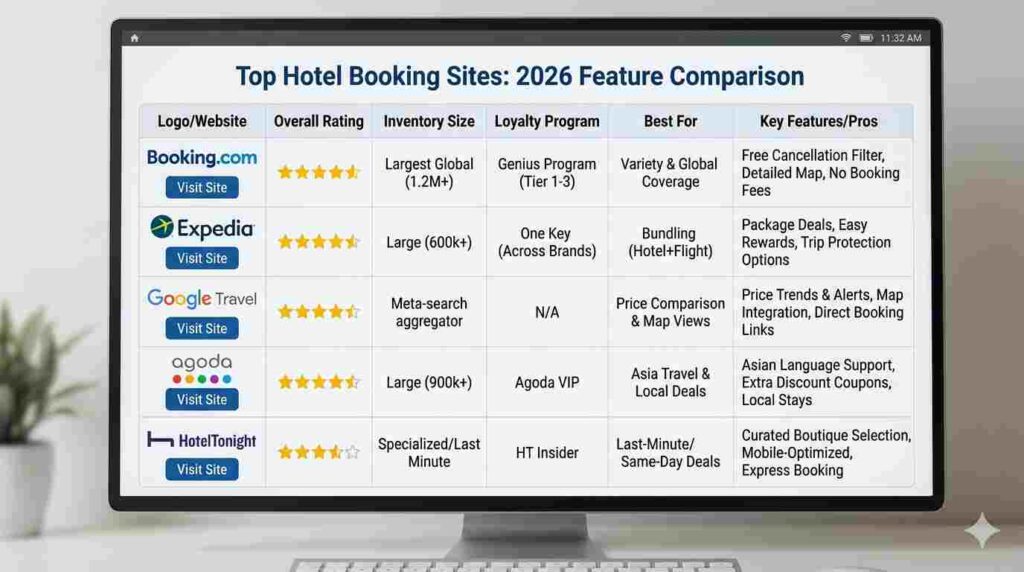
| Website | Best For | Loyalty Program | Key Benefit |
|---|---|---|---|
| Booking.com | Global variety | Genius (Level 1–3) | Largest inventory of apartments and boutique stays |
| Expedia | Bundling | One Key | Real savings booking hotel and flight together |
| Hotels.com | Simplicity | One Key | Easy interface and reliable customer support |
| Agoda | Asia travel | Agoda VIP | Strong rates specifically for Thailand, Japan, and Vietnam |
| Priceline | Last-minute | Priceline VIP | “Pricebreakers” and “Express Deals” for deep discounts |
| Google Travel | Comparison | N/A | Best for seeing every price laid out on one map |
| HotelTonight | Same-day stays | HT Insider | Strong discounts on unsold rooms for tonight specifically |
A Closer Look at the Top Platforms
Booking.com: The Global Leader
Booking.com remains the volume leader — whether you want a luxury hotel in Paris or something more unusual in Mongolia, they likely have it listed. Pricing is generally transparent, the review database runs deep, and the mobile app works well. Their Genius loyalty program is tiered — reach Level 3, and you’ll typically see around 20% off plus free room upgrades at participating properties.
Expedia: Built for Bundling
Expedia sits under the same parent company as Hotels.com and Vrbo. Its One Key rewards program lets you earn OneKeyCash that carries across hotels, flights, and car rentals. If you need a full travel package rather than just a room, Expedia’s bundling tends to beat buying each piece separately.
Google Travel: The Aggregator
Google Travel isn’t trying to sell you the room directly — it’s trying to show you everyone else’s price for it. It pulls data from OTAs and hotel direct-booking sites at once, and tracks price trends, telling you whether the current rate for your dates runs high, typical, or low.
Agoda: Strongest in Asia
Agoda shares an owner with Booking.com but runs its own algorithms and holds deeper relationships with hotel owners across Asia specifically. Watch for “Agoda Special Offers,” which often bundle in free airport transfers or food vouchers.
HotelTonight: For Spontaneous Trips
If you’re comfortable waiting until the day of travel, HotelTonight offers discounted rooms that hotels are actively trying to fill. Its “Daily Drop” feature can knock an extra 10–30% off a specific hotel, though you typically only get about 15 minutes to act on it once it appears.
Wherever you end up staying, it’s worth traveling with real protection in place — our complete travel insurance guide covers what to look for.
Tips Worth Knowing
Clearing cookies can help with stuck sessions. The idea that incognito mode lowers prices is mostly a myth — sites generally don’t raise prices just because you’ve searched twice, they raise them because available rooms are actually dropping. Clearing cookies is still useful for resetting a session that’s genuinely stuck, though.
Calling the hotel directly can work. If you spot a strong price on a third-party site, it’s worth calling the hotel and mentioning it — something like: “I see a rate of $180 listed on Expedia; if I book directly with you, is there any flexibility on that, or a free breakfast you could add?” Hotels often say yes, since it saves them the roughly 15% commission they’d otherwise pay the booking site.
Only go non-refundable when the savings are real. Travel plans shift more easily than they used to — we’d generally only recommend a non-refundable rate when the discount is meaningfully large (25% or more), not just a small saving.
Common Mistakes to Avoid
Ignoring the map. A “cheap” hotel that needs a $50 round-trip taxi to reach the city center isn’t actually cheap once you add that in.
Trusting star ratings blindly. A 4-star hotel in Italy and a 4-star hotel in the US aren’t graded the same way. The user rating (an 8.5/10, for instance) tends to be a more reliable signal than the star count.
Forgetting to log in. Plenty of travelers search as guests and miss out on the member discount that takes seconds to unlock with a quick email sign-up.
Booking on the wrong day. Booking earlier in the week — Tuesday or Wednesday, for instance — tends to yield slightly better rates than searching over the weekend, when demand from other travelers researching their own trips is higher.
Planning your stay properly matters too — our guide to writing a travel itinerary is worth reading alongside this one, especially if you’re also applying for a visa.
Frequently Asked Questions
Is it cheaper to book on an app or a desktop site? Often the app. Several providers, including Booking.com and Trip.com, offer mobile-only pricing that runs lower than the desktop site specifically to encourage app downloads.
Are “mystery deal” bookings worth it? On sites like Priceline or Hotwire, you see the price and star rating but not the hotel name until after you book. These tend to work well for higher-end hotels (4-star and up) in major cities, where most options in a given area are already solid.
Should I pay in my local currency or the hotel’s currency? Choose the hotel’s local currency when given the option. Letting the booking site handle the conversion for you usually adds a 3–5% markup on the exchange rate — a travel credit card with no foreign transaction fees is generally the better route.
Conclusion
The “best” hotel booking website really depends on your priorities. For sheer inventory and ease of use, Booking.com is hard to beat. For pure price comparison, Google Travel is the strongest starting point.
Follow the same basic sequence each time — start with a meta-search, log in for member rates, and verify the true total price before you commit — and you can genuinely save real money on your next trip. The best deal isn’t just the lowest number on the screen; it’s the one that gives you the flexibility and security you actually need for a stress-free stay.