

































Introduction: What Age Actually Means for Australian Migration
One of the most common concerns we hear from clients considering Australia is some version of: “I’m over 40 — is it even worth applying?” It’s an understandable fear. Skilled migration systems in Australia, Canada, and the UK all weight age heavily in their points systems, and a lot of applicants assume that once they pass a certain age, their options disappear entirely.
That’s not quite right, and getting it wrong can mean giving up on a genuinely viable move. Australia’s General Skilled Migration visas (Subclasses 189, 190, and 491) do enforce a strict cutoff — applicants generally need to be under 45 at the time they receive an invitation. But several other major pathways — employer sponsorship, partner visas, parent visas, and specialist talent routes — carry no such restriction. For experienced professionals, tradespeople, healthcare workers, and business owners over 45, these routes are often the more realistic strategy, not a consolation prize.
Australia continues to prioritize skilled migration because it’s facing sustained labor shortages across healthcare, construction, engineering, aged care, IT, agriculture, education, and hospitality. The government has held its permanent migration intake at roughly 185,000 places for the 2025–2026 migration year, with skilled migration remaining the largest category. This guide walks through how the system actually works — including where age matters, where it doesn’t, and how to build the strongest possible application either way.
Why Australia’s Age Rules Exist — and Where They Don’t Apply
Australia’s General Skilled Migration age rule is built on a straightforward economic rationale: younger migrants are expected to contribute more years of tax revenue and workforce participation before retirement. It’s a real policy, and it applies firmly to the points-tested visas.
But it doesn’t reflect the whole picture. Older applicants often bring deep technical expertise, established professional networks, and specialized skills that entry-level workers simply haven’t had time to develop yet — and Australia’s labor shortages, particularly in healthcare, trades, and regional areas, are severe enough that employers are actively looking past the points-test age cutoff through sponsorship routes.
Understanding Australia’s Migration System in 2026
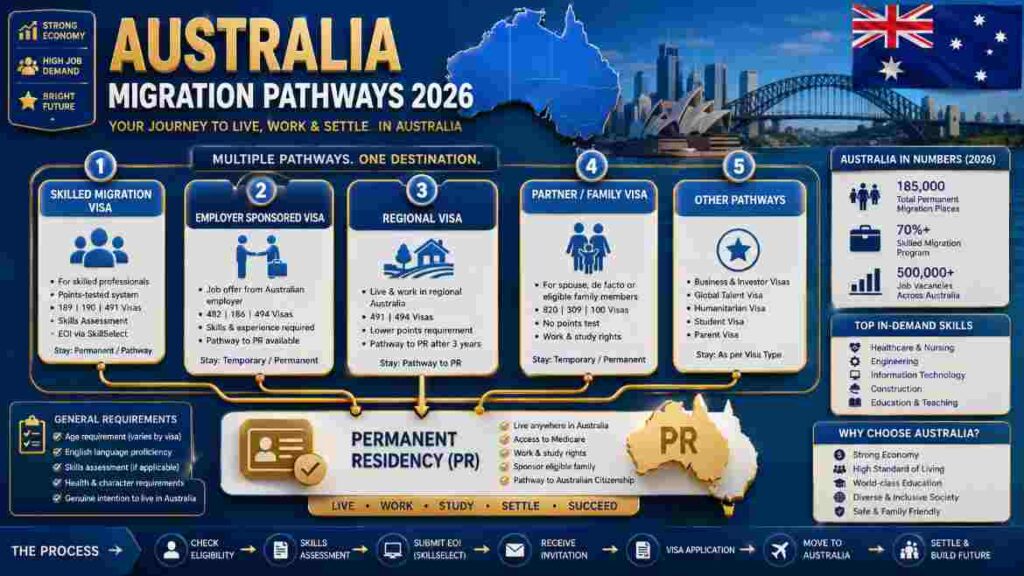
Australia doesn’t run a single immigration pathway — it runs several, each with different age rules and eligibility criteria.
| Visa Pathway | Age Limit | Leads to PR? | Best Suited For |
|---|---|---|---|
| Skilled Independent Visa (189) | Under 45 | Yes | Highly skilled, points-tested applicants |
| Skilled Nominated Visa (190) | Under 45 | Yes | State-sponsored applicants |
| Skilled Work Regional Visa (491) | Under 45 | Pathway to PR | Regional workers |
| Employer Sponsored Visa (482) | No strict limit | Sometimes | Workers with a sponsoring employer |
| Employer Nomination Scheme (186) | Generally under 45, with exemptions | Yes | Experienced workers, high-demand occupations |
| Partner Visa | No age limit | Yes | Spouses/partners of citizens or PR holders |
| Parent Visa | No age limit | Yes | Parents of Australian citizens or PR holders |
| Global Talent Visa | Flexible | Yes | Exceptional achievers in their field |
| Business & Investment Visas | Flexible | Yes | Entrepreneurs and investors |
The Best Pathways for Applicants Over 45
1. Employer Sponsored Visa (Subclass 482)
This is currently one of the strongest routes for applicants past the points-test age cutoff, since it has no strict upper age limit and can lead to permanent residency depending on the stream. Employers are actively sponsoring workers in nursing, aged care, teaching, construction trades (plumbing, electrical work), software engineering, hospitality, and agriculture — sectors facing genuine, sustained shortages.
Basic requirements include a valid job offer, relevant work experience, English proficiency, a skills match for the nominated occupation, and standard health and character checks.
Worth knowing: regional employers often sponsor workers faster than city employers, simply because labor shortages tend to be more severe outside Sydney and Melbourne.
2. Employer Nomination Scheme (Subclass 186)
This can lead directly to permanent residency. While the standard age rule is under 45, exemptions exist for high-income earners, academics, scientists, medical professionals, and workers who’ve been with a sponsoring employer long-term. Successful applicants gain access to Medicare, the ability to sponsor family, and a genuine long-term settlement pathway.
3. Partner Visa
If your spouse or partner is an Australian citizen, permanent resident, or eligible New Zealand citizen, you may qualify regardless of your age. This route comes with no age restriction, full work rights, a pathway to citizenship, and inclusion of family members — making it one of the more straightforward long-term routes for eligible couples.
4. Parent Visa
Parents of Australian citizens or permanent residents may also qualify, with no strict age limit — though processing times, visa costs, and financial sponsorship requirements are all higher for this category than most others.
5. Regional Migration Programs
Australia continues to actively encourage migration into regional areas, which generally means lower competition, a broader range of eligible occupations, faster invitation rounds, and stronger employer sponsorship activity. Northern Territory, South Australia, and regional New South Wales have all seen active regional nomination activity recently — worth checking directly on the relevant state nomination portal, since allocations shift year to year.
Step-by-Step: Applying to Migrate to Australia

Step 1: Check your eligibility profile
Assess your age, occupation, education, English level, work experience, family status, and available funds honestly before choosing a strategy. If you’re over 45, focus your search on employer sponsorship, regional migration, or family pathways rather than the points-tested visas.
Step 2: Confirm your occupation is in demand
Australia updates its skilled occupation lists regularly. Sectors with consistently strong demand include healthcare (nurses, caregivers, doctors), construction (electricians, plumbers), technology (cybersecurity, software development), education (teachers), hospitality (chefs, hotel managers), agriculture, and engineering.
Step 3: Take an approved English test
IELTS, PTE Academic, TOEFL, and Cambridge English are all accepted. Higher scores meaningfully improve your competitiveness, both for points-tested visas and as a general strength signal to sponsoring employers.
Step 4: Complete a skills assessment
Most skilled pathways require formal assessment by an approved authority before you can apply — Engineers Australia for engineers, ANMAC for nurses, ACS for IT professionals, and TRA for trades, among others.
Step 5: Create a SkillSelect profile
Australia’s SkillSelect system lets skilled workers submit an Expression of Interest, including education, work history, English scores, skills assessment results, and partner details where relevant.
Step 6: Pursue state nomination or employer sponsorship
This step matters most if your points score is on the lower end, you’re above the GSM age cutoff, or your occupation is in stronger demand regionally than in major cities.
Step 7: Receive your invitation and apply
Once invited, you’ll need to submit full documentation, complete medical exams, provide police clearance certificates, and pay the relevant visa fees.
Before you relocate, it’s worth understanding what kind of coverage you’ll need during the transition — our guide to travel insurance vs. health insurance breaks down the difference.
Australia’s Points System, Explained
Australia’s General Skilled Migration visas use a points test with a minimum pass mark of 65, though competitive invitation rounds often require scores well above that.
| Factor | Maximum Points |
|---|---|
| Age | 30 |
| English proficiency | 20 |
| Work experience | 20 |
| Education | 20 |
| Partner skills | 10 |
| State nomination | 5–15 |
Age points breakdown
| Age Range | Points |
|---|---|
| 18–24 | 25 |
| 25–32 | 30 |
| 33–39 | 25 |
| 40–44 | 15 |
| 45+ | 0 |
This is exactly why applicants past 45 need to lean on employer sponsorship or family pathways instead — the points test itself simply won’t score them competitively regardless of other qualifications.
Estimated Costs (2026)
| Expense | Estimated Cost (AUD) |
|---|---|
| English test | 300–450 |
| Skills assessment | 300–1,500 |
| Visa application | 1,500–5,000+ |
| Medical examination | 300–600 |
| Police clearance | 50–150 |
| Flight tickets | 800–2,500 |
| Initial settlement funds | 5,000–15,000 |
Choosing Where to Settle
Sydney is strong for finance, technology, and corporate roles, though housing costs are a real challenge. Melbourne stands out for education, healthcare, and the arts. Brisbane tends to suit families looking for a more affordable lifestyle alongside construction-sector demand. Perth is the natural fit for mining, engineering, and trades. Adelaide offers lower living costs and consistently active regional sponsorship activity for skilled migrants.
Australia vs. Canada, at a Glance
| Factor | Australia | Canada |
|---|---|---|
| Skilled migration strength | Strong | Strong |
| Employer sponsorship | Excellent | Moderate |
| Regional opportunities | Very high | High |
| Age flexibility | Better for sponsored visas | Better for younger Express Entry applicants |
| Healthcare | Excellent (Medicare) | Excellent |
If you’re weighing multiple destinations, our guide to post-study work visas is a useful next read for comparing pathways across countries.
Common Mistakes Applicants Make
Waiting too long to apply. Since age directly affects your points-test competitiveness, every year of delay matters more than it might seem.
Ignoring regional Australia. Many applicants focus exclusively on Sydney or Melbourne, missing faster processing, easier sponsorship, and stronger PR pathways available regionally.
Underestimating English test scores. A stronger English result can meaningfully offset a weaker score elsewhere in the points system.
Submitting incomplete or inconsistent documentation. Minor mismatches between your application and your supporting documents are one of the most common causes of delay or rejection.
Working with unregistered agents. Only work with registered migration agents, verified employers, and official government sources — migration scams targeting hopeful applicants are unfortunately common.
Frequently Asked Questions
Can I move to Australia after age 45? Yes. While the points-tested skilled visas (189, 190, 491) enforce a strict cutoff, employer-sponsored, family, and specialist talent pathways remain open regardless of age.
Is Australia removing its age limits? Not as a general policy — there’s no nationwide removal of age restrictions. Some visa categories, however, already provide meaningful flexibility or exemptions.
Which visa is best for applicants over 40? Employer-sponsored visas are generally the strongest option, since they aren’t subject to the same points-test age penalty.
Can I get PR in Australia without a university degree? Yes — skilled trades and demonstrated practical experience can qualify through several pathways, particularly employer sponsorship.
Is Australia more flexible than Canada for older migrants? Generally, yes, on the employer-sponsorship side — Canada’s Express Entry system still weights age fairly heavily, though its category-based draws and Provincial Nominee Programs offer some flexibility of their own.
How much money should I budget to relocate? Most migrants budget somewhere between AUD 10,000–20,000 in settlement funds, depending on family size and destination city.
Recommended Official Resources
Final Thoughts
Age matters in Australia’s migration system, but it isn’t the single deciding factor many applicants assume it to be. The points-tested visas do enforce a hard cutoff at 45 — that’s real, and no amount of strategy changes it. But Australia’s genuine, sustained labor shortages mean employer sponsorship, regional migration, and family pathways remain open and active for experienced professionals well past that age.
The strongest approach is an honest one: know which category you actually qualify for, target occupations in real demand, strengthen your English score and documentation, and apply early rather than waiting for competition to increase further. Australia remains one of the more attractive destinations for skilled migrants — strong salaries, reliable healthcare, and a genuine path to permanent residency — for those who choose the right strategy for their profile.